Showing posts with label Executive Magazine. Show all posts

Saturday, September 7, 2019

Gas sector a catalyst for further cooperation between Lebanon and Egypt - EXECUTIVE MAGAZINE

Nada Boustani, Lebanon's Energy Minister
August 7, 2019
Mona Sukkarieh

The first six months of 2019 saw an unusual series of meetings between Lebanese and Egyptian officials, with energy cooperation at the core of these discussions. If memory serves well, the frequency is unprecedented.

The option of resuming gas imports from Egypt was discussed extensively, especially during the first meetings of 2019. Lebanon previously imported natural gas from Egypt in 2010 via the Arab Gas Pipeline (AGP) to generate electricity. But supplies were interrupted after a few months with various reasons touted (such as Egypt’s inability to pursue exports because production was barely enough to meet local demand, instability in Egypt, and attacks against the pipeline). With the formation of a new government on January 31, Lebanese officials explored the possibility of quickly resuming imports as they scrambled to find solutions to the problems plaguing the electricity sector. The dire state of Lebanon’s power sector and the burden it places on the economy propelled it to the forefront of the government’s reform agenda. Government officials examined the option of importing gas by pipeline from Egypt to generate electricity—in addition to the possibility of buying electricity from Jordan in exchange for water—as among the possible solutions that they thought could be implemented quickly.

Wednesday, February 6, 2019

The Eastern Mediterranean Gas Forum: A Lebanese perspective - MIDDLE EAST STRATEGIC PERSPECTIVES / EXECUTIVE MAGAZINE

February 6, 2019

Energy Ministers from Egypt, Cyprus, Greece, Israel, Italy, Jordan and the Palestinian Authority took an important step in Cairo toward establishing an Eastern Mediterranean Gas Forum (EMGF) on January 14. According to the declaration that followed the meeting, the EMGF will, among other things, assist in the creation of a regional gas market, ensure security of supply and demand, optimize resource development, facilitate the use of existing infrastructure and build new ones if necessary, etc. Intra-regional cooperation in this part of the world was at best marginal before the discovery of major hydrocarbon resources. Since 2009, shared interests and a series of gas discoveries have encouraged dialogue. The EMGF appears to be the first tangible result of these new regional dynamics.

The Forum’s raison d’être is regional energy cooperation. Almost ten years to the day after the announcement of the discovery of Tamar (January 17, 2009) – the first major gas discovery in the Levant Basin – it has become increasingly clear that regional cooperation is needed to make the most out of the region’s resources. The Eastern Mediterranean’s gas potential is promising. But, beside Egypt, the countries in the region have to deal with a number of challenges to exploit their resources. First, these resources are mostly offshore, in deep and ultra-deep waters. When found in commercial quantities, their extraction is expensive. Second, the relevant infrastructure to monetize these resources is quasi-inexistent (outside Egypt).

Wednesday, September 12, 2018

Lebanon’s second licensing round: Lessons learned and the case for stability - MIDDLE EAST STRATEGIC PERSPECTIVES / EXECUTIVE MAGAZINE


September 12, 2018

Preparations for the launching of Lebanon’s second offshore licensing round have begun. The Lebanese Petroleum Administration has published a tentative timeline for the tender, which will be officially launched by the end of 2018. The process, including the pre-qualification phase, will extend over a period of one year.

Tuesday, February 6, 2018

Lebanon’s oil and gas sector: A roadmap for 2018 - MESP / EXECUTIVE MAGAZINE


February 6, 2018 / Lebanon

At the end of January, Lebanon signed its first exploration & production agreements (EPA) with a consortium of companies composed of France’s Total (as operator), Italy’s Eni, and Russia’s Novatek. The consortium had placed two separate bids on October 12, 2017, the only ones received in Lebanon’s first offshore licensing round, for Block 4 and Block 9. With the contracts signed, Lebanon can now look forward to the exploration phase. The consortium has committed to drill two wells in 2019, one in each block. But what can Lebanon expect prior to drilling?

Saturday, May 20, 2017

Troubled waters - EXECUTIVE MAGAZINE

May 15, 2017
Matt Nash

From a technical standpoint, the East Mediterranean is a challenge because the seabed is generally more than one thousand meters below the surface. Ultra-deep water, in industry parlance. From a geopolitical standpoint, the complexity is arguably even greater.

Many problems among a variety of neighbors

Production of East Med gas began in Egypt in the late 1960s. Activity remained localized for over thirty years until discoveries were made off Israel and the Gaza Strip in 1999 and 2000. For political reasons, the relatively small Gaza find remains undeveloped, while exploration continued apace offshore Israel, resulting in discoveries – namely Tamar in 2009 and Leviathan in 2010 (see map below) – that have helped spark intense interest in the so-called Levantine Basin, a subsea structure shared by Lebanon, Israel, the Palestinian Authority, Syria, Cyprus, and Turkey, at least from Turkey’s perspective. In 2012, Cyprus was elated by news of the Aphrodite discovery, but for all the gas Israel and Cyprus have found, not a molecule has yet been exported. In fact, most of the gas (including everything in Tamar, Leviathan and Aphrodite) remains buried for lack of a clear means to move it out of the region, among other reasons.

Wednesday, May 11, 2016

A national oil company for Lebanon? A premature and incomplete debate - MESP / EXECUTIVE MAGAZINE

May 11, 2016

It’s been three years the nascent oil and gas sector in Lebanon was brought to a complete halt. The relative success of the pre-qualification round in 2013 brought the sector to center stage and contributed to the hype surrounding it. But the pre-qualification round was not followed by a tender, which was put on hold for various rational and irrational reasons. No licenses were awarded. No exploration was conducted. Not a single discovery was made.

Yet, the oil and gas debate in the country appears to be oblivious to these realities.

Thursday, April 14, 2016

What lies beneath - EXECUTIVE MAGAZINE

Lebanon must act to keep its seat at the oil and gas table

April 14, 2016 by Roudi Baroudi

Lebanon has missed several opportunities to grow its nascent oil and gas industry at an ideal pace, but now regional developments threaten not just further delays, but also permanent losses unless the country acts to protect its national interests.

The new urgency stems primarily from two principal events. The first was last summer’s discovery of the giant Zohr gas field off Egypt’s northern coast by Italy’s ENI, a find estimated by some to have doubled the North African country’s natural gas reserves overnight. It also significantly increased the likelihood of commercially viable deposits in nearby offshore acreage belonging to Cyprus, Lebanon and Israel. This has sparked renewed interest in this section of the Eastern Mediterranean basin from major international oil companies.

Friday, December 25, 2015

Renewed dynamism | Executive

2016 looks good for the offshore oil and gas sector in the Eastern Mediterranean

by 


After a year riddled with difficult market conditions, dry wells and regulatory hurdles, the offshore oil and gas sector in the Eastern Mediterranean finally has good reasons to look forward to 2016.

In Egypt, the August 2015 discovery of the so-called “supergiant” Zohr offshore natural gas field could not have come at a better time for Egyptian authorities. While the exact size of the field will only be clear after appraisal drilling, Zohr is hoped to bring Egypt some balance between supply and demand, and extricate the country from its energy crisis. That said, and based on what we currently know, more gas is needed to restart exports. All the more reason to ensure a favorable climate for investors, and encourage exploration and production. Although tempting, it would be unwise for Egypt to halt reforms at this stage. Pricing reforms, plans to phase out subsidies and paying down debt owed to international companies (now standing at $3 billion, down from $6.5 billion) have all contributed to restoring confidence in the sector. There is still more to be done, yet policymakers are already backpedalling on earlier promises. On December 14, Prime Minister Sherif Ismail cancelled the previous government’s decision to fully eliminate subsidies within five years; now we are talking about a much less ambitious 30 percent reduction.

Cyprus too received a boost from Zohr after several disappointments in the first half of 2015. France’s Total relinquished its rights to one piece of the country’s offshore acreage (Block 10) in February 2015, one month prior to Italy’s ENI having drilled a second well that failed to find exploitable hydrocarbons. After Zohr, however, Total looks set to extend its soon-to-expire license in Block 11 for another two years. The company, and others, has also recently been inquiring about areas along the Cypriot-Egyptian maritime border. This renewed interest has prompted some to consider the possibility of organizing a new licensing round. The end of 2015 brought more good news for Cyprus: On November 23, the UK’s BG announced it was acquiring a 35 percent stake in Block 12, where Aphrodite is located. This is a major development, which will see the entry of another big player in the Cypriot gas sector (BG is about to complete a merger with Shell). But its main advantage could well be the stake that BG holds in the Idku export facility in Egypt, improving the prospects of sending Aphrodite gas (from Block 12) to Egypt, although some difficulties could persist. A breakthrough in the negotiations between Greek and Turkish Cypriots, resumed in May 2015, could lead to gas cooperation with Turkey and the laying of a pipeline carrying Cypriot (and possibly Israeli) gas to Turkey and European markets, if conditions are right.

In Israel, Prime Minister Benjamin Netanyahu, acting in his capacity as Minister of Economy, approved a gas  framework deal on December 17, after invoking national security. A year earlier, the antitrust commissioner David Gilo had revoked a previous agreement that allowed US based Noble Energy and Israeli company Delek to retain ownership of Israel’s biggest offshore field, Leviathan, in return for giving up two small fields, Tanin and Karish. The decision brought the Israeli gas sector to a halt and both delayed and complicated development of Leviathan, the country’s largest offshore gas field. The gas deal outlined by the government was approved by the Knesset in September, but to bypass the Antitrust Authority, the Minister of Economy – at the time Aryeh Deri – would have had to activate clause 52 by invoking national security. Deri refused. However, he resigned from his post on November 1 and was replaced by Benjamin Netanyahu who proceeded with the gas framework deal soon after. A petition was filed at the High Court of Justice against some of the clauses in the deal, and the Court will examine the case in early 2016. Once the process is complete, it is hoped to bring some stability to the regulatory framework. The authorities are building on that to resume offshore exploration, and are hoping to organize bid rounds in 2016 or 2017.

Also, on December 17, a major breakthrough in the negotiations between Israel and Turkey was announced. A normalization of relations between the two countries would pave the way for gas cooperation. The frequently discussed laying of a gas pipeline between the two, however, will have to go through the Cypriot Exclusive Economic Zone, a considerable obstacle for now, unless progress is indeed made between Greek and Turkish Cypriots.

Meanwhile, the vulnerability of offshore installations is still a matter of concern for Israeli authorities. Israel is reportedly planning to install the Iron Dome missile defense system on navy vessels, a temporary measure until German offshore-patrol vehicles are delivered in 2019.

For its part, Lebanon stands exactly where it was a year ago, with only negligible progress, including data interpretations and reinterpretations. The offshore tender, launched in the absence of basic documents to actually close the bid round, is still on hold. Delays in the sector are largely a part of the overall political deadlock, although a possible breakthrough in electing a new president could have positive ramifications elsewhere, potentially even unlocking the oil and gas file. However, the opportunity cost of procrastination was entirely neglected. International interest, currently at its lowest, would have to be revived. In current market conditions, this is easier said than done.

Finally, while the war is still raging in Syria, post-war reconstruction and opportunities, including in the energy sector, are on everyone’s mind. Identifying offshore prospects is a process that can take place before the arms are silenced. The opportunities, on the other hand, depend on the outcome of the war. In December 2013, Russia’s state-controlled Soyuzneftegaz was awarded an exploration and production license in Syria’s block 2. In September 2015, its chairman Yuri Shafranik decided not to proceed with the project because of the risks involved at this point, and announced that the project would be passed to another Russian energy company. The current Syrian regime would like Russian involvement in offshore Syria, but does not perceive this involvement as exclusive.

All told, 2016 looks like a promising year for offshore oil and gas in the Eastern Mediterranean.

Mona Sukkarieh is the cofounder of Middle East Strategic Perspectives (http://www.mesp.me), a Beirut based political risk consultancy

Wednesday, October 1, 2014

Lebanon’s murky petroleum business | Executive Magazine

Lebanon’s murky petroleum business

How wasta, uneven partnerships and an international web of shell companies characterize the country’s new oil and gas sector

Murky oil business
This Executive investigation into Lebanon’s oil and gas companies is part of a special report on the sector. Read more stories as they’re published here, or pick up October’s issue at newsstands in Lebanon.

“If you want to hurt me, I can hurt you back,” Antoine Dagher tells Executive, laughing as he tries to keep his name out of this article. A former communications manager for Petroleb, one of three Lebanese companies prequalified to bid in the first offshore licensing round, Dagher belatedly clarifies, “I’m not threatening you.” Petroleb still uses Dagher as a consultant, but in early September, so did the Lebanese Petroleum Administration (LPA). Executive had wondered whether or not this was a conflict of interest, which Dagher insisted it was not. 
Apex Gas Limited, is actually registered in Hong Kong, not Beirut, through a process tailored to keep shareholders and directors anonymous
This is only one of the complications encountered in trying to pin down the details about the three ‘Lebanese’ companies — out of a total of 46 — prequalified to participate in Lebanon’s nascent oil and gas sector. A company identified by the LPA as a ‘Lebanese’ prequalifer, Apex Gas Limited, is actually registered in Hong Kong, not Beirut, through a process tailored to keep shareholders and directors anonymous. Taken together, these experiences offer a fresh perspective on the murky nature of the oil and gas industry, and how instead of starting off with a clean slate, it appears Lebanon’s new petroleum sector is already sliding into the shadows.
Experience needed, unless you have a partner
Both Petroleb and Apex have no previous experience in the industry. Only the third prequalified Lebanese business, CC Energy Development (CCED), is an established oil and gas company, having drilled and produced oil onshore in Oman since 2010. But the lack of experience did not stop Petroleb and Apex from making the cut. According to the 2013 decree governing the prequalification process, companies that don’t meet the eligibility requirements — including previous oil or gas production experience — can partner with companies that do meet the requirements to jointly prequalify as one legal entity. This is precisely what both Petroleb and Apex did. Petroleb paired with Bermuda based GeoPark, which is active in South America, and Apex teamed up with the UAE’s Crescent Petroleum, which got into the oil and gas game in the early 1970s. 
Both Apex and Petroleb tell Executive they plan to branch outside of Lebanon, but there is no evidence either has done so yet. Petroleb’s Chief Executive Officer Salah Khayat tells Executive, “Petroleb is active outside Lebanon and is considering various [exploration and production] assets, while building its technical team.” Chief Operations Officer Naji Abi Aad says an announcement of the company’s work outside Lebanon is forthcoming.
Friends in high places
Karim Kobeissi, Petroleb’s lawyer, was an advisor to the Ministry of Energy and Water in 2008 and helped write the 2010 offshore exploration and production law
In addition to serving as Petroleb’s chief executive, Khayat owns 50 percent of the company, which was founded in September 2011, according to papers it filed with Lebanon’s commercial registry. Khayat is the nephew of Tahseen Khayat, owner of Al Jadeed television and founder of the Tahseen Khayat Group, a sprawling conglomerate with businesses in engineering and contracting, publishing, printing, hospitality and leisure, and sales and distribution in both Lebanon and abroad. Omar and Bashar Khayat evenly split the remaining 50 percent of Petroleb’s shares. Karim Kobeissi, the company’s lawyer, was an advisor to the Ministry of Energy and Water in 2008 and helped write the 2010 offshore exploration and production law.
According to the company, its deep connections offer excellent benefits to its bidding partner, GeoPark — an important point given Petroleb’s dearth of experience in oil and gas. COO Abi Aad says, “Everywhere in the world, if you have good connections and a strong position with the main decisionmakers you have [a] good chance, but you have to have the technical requirements. We have very strong connections in the country and good relationships, we know everybody in the country.” He concludes, “You can be sure GeoPark finds us useful.” 
Hong Kong connection
But while Petroleb is up front about its business model, information on Apex is much harder to come by. The company is not registered in Lebanon, nor does it have a website. A booklet produced by the LPA offering information about all  46 prequalified companies is dead silent on Apex, the sole omission.
Apex’s true owners, UniGaz CEO Mahmoud Sidani and Chamber of Commerce, Industry and Agriculture of Beirut and Mount Lebanon Chairman Mohammad Choucair, aren’t on the documents
Apex was registered in Hong Kong in April 2012, company lawyer Tarek Nahas confirms. Nahas says he chose Hong Kong as a place of registration — as opposed to Lebanon — so as to be governed by English law in order “to have a clearer legal framework.” Asked why the company’s papers, which Executive purchased, do not list any Lebanese nationals, Nahas says the company’s true owners, UniGaz CEO Mahmoud Sidani and Chamber of Commerce, Industry and Agriculture of Beirut and Mount Lebanon Chairman Mohammad Choucair, aren’t on the documents. Both Sidani and Choucair confirmed they are partners in Apex, but only Sidani would grant a more in depth interview.
Apex is benefiting from a Hong Kong secrecy provision that allows owners to pay yearly fees to have nominal directors and shareholders listed on paper to “keep your true director identity completely confidential,” as a Hong Kong based incorporation services firm puts it. On paper, the director of Apex is Roger Leo A. Carino and the company’s sole shareholder is Abacus (Nominees) Limited. A conversation with Intercorp, another Hong Kong based company registration service provider, reveals that both Carino and Abacus are strawmen in place to keep Sidani and Choucair publicly distanced from the company. Carino is also listed as the director of Apex Oil and Gas Limited, another company registered in London. Reached by phone, Carino says he doesn’t have any paperwork in front of him and is preparing to travel, so he cannot answer Executive’s questions. He did not reply to an email Executive sent seeking clarification. The sole shareholder of Apex in London is Aries Global Investments, registered in Curaçao in the Dutch Caribbean. Nahas says he knows nothing about the Apex in London, despite the exact same names and directors.
Sidani could not explain why Apex chose to pay money to obscure its real owners from public view, referring Executive back to Nahas, who did not respond to a follow up interview request. 
When set up in 2012, Apex was worth a scant HKD 10,000 ($1,290), and nothing more recent has been publicly disclosed 
Unlike Petroleb’s Abi Aad, Sidani did not cite “connections” as the benefit his company brings to its partnership with Crescent Petroleum, but he did get defensive when first asked. “We are investors, and [as] Lebanese investors, it’s our right to put our money in Lebanese gas. [It’s] as simple as that.” Pressed on what Apex brings to the table, Sidani says, “They want us to share the risk, because this is like bingo, you might spend $400 million on four wells and not find any gas. So we are splitting the risk.” It’s unclear, however, just how much risk burden an apparently tiny company — when set up in 2012, it was worth a scant HKD 10,000 ($1,290), and nothing more recent has been publicly disclosed — can shoulder compared to a company like Crescent, which is worth at least $500 million.
But this is just one question in a sea of uncertainty that encompasses both Apex and Petroleb — and raises questions about the transparency of the entire sector. When asked the simplest of questions, to confirm that Apex is registered in Hong Kong, the LPA declined to answer.


Link to source: http://www.executive-magazine.com/business-finance/business/lebanons-murky-petroleum-business

Wednesday, July 30, 2014

The Cyprus solution | Executive Magazine

How European–Mediterranean energy collaboration can solve problems all around

by Roudi Baroudi


Cyprus will shortly be in position to provide clean, safe and reliable supplies that will meet 20 percent of Europe’s gas needs (Credit: "AFP PHOTO / HO / PIO")

More and more people are arriving at the same conclusion: a miracle cure for much of what ails the European Union is close at hand, and Cyprus is easily the best place to dispense it.

Apart from Germany and a few other exceptions, the EU economy is in a historic slump, while its appetite for energy makes it unnervingly dependent on Russia, which supplies a third of Europe’s gas imports, and other suppliers outside its borders — thereby making the union dangerously vulnerable to factors beyond its control. The recent confrontation over Ukraine only underscored the potential precariousness of this arrangement: while Russia is not likely to damage its own interests by turning off the taps that supply its biggest customer, its pipelines cross the borders of multiple countries that might perceive an interest in disrupting the flow.

Luckily, however, all recent exploration work indicates that deposits beneath the Eastern Mediterranean seabed contain sufficient amounts of oil and (especially) natural gas to revitalize Europe’s economy for decades to come.

Cyprus, Israel, Lebanon and Palestine share what has emerged as a collection of world-class formations; Israel is the only country that has already begun to exploit its reserves, but Cyprus should follow in a few short years. Palestine’s potential can’t be unlocked until some kind of deal is reached with Israel, and Lebanon has been delayed by domestic political infighting, but the latter’s reserves now appear to be the most extensive of the four. And in the longer term, new studies show that Greece may be the real kingpin of the Eastern Mediterranean, further enlarging the region’s capacity to fuel a European renaissance with cheap, safe and reliable energy supplies.

It is difficult to overstate the potential of this treasure trove. Going by the latest estimates, Cyprus will shortly be in position to provide clean, safe and reliable supplies that will meet 20 percent of Europe’s gas needs. Throw in Lebanon and Israel, and that figure rises to 30 percent, while Greece could bring it to 40 percent by 2020. By increasing the number of competing producers, development of the Eastern Mediterranean will also lead to lower energy prices, driving growth across the EU.

For the producers, it means a new shared stake in peace and stability, massive revenues to fund socioeconomic development and permanent reductions in poverty and other needs. For the consumers, it means an economic revival on the scale of America’s ‘fracking revolution’ — with far less controversy and environmental risk.

For the EU as a whole, it can mean even more: restoring both the momentum of the European project and public faith therein, and reducing tensions among member states, particularly along the traditional North–South axis, caused by economic hardship. It can also transform Europe’s southeastern flank, turning a source of instability and refugees into one of opportunity and partnership. Nothing would more fully accomplish the goals of the Euro–Mediterranean ideal, as refined over the years at Trieste, Barcelona and other venues.

All recent exploration work indicates that deposits beneath the Eastern Mediterranean seabed contain sufficient amounts of oil and (especially) natural gas to revitalize Europe’s economy for decades to come


Passing the pipe

These and other gains will not be achieved without first surmounting a few obstacles. The primary political hurdles include Israel’s dismal relations with its Arab neighbors, which make direct cooperation virtually impossible for the time being. Meanwhile, the main technical challenges center on getting the gas to thirsty markets on the European mainland, as well as other customers in East Africa and South Asia.

Cyprus can solve all of these problems — and more — by avoiding, simplifying or essentially erasing them. Its diplomatic position already gives it friendly ties with countries on both sides of the Arab–Israeli divide, and its geographical location makes it the only logical place to situate a new regional energy hub. If the necessary investments are forthcoming, that hub will gather the gas produced by all Eastern Mediterranean countries for distribution via pipeline, ideally via Greece’s Ionian Sea. Why the Ionian? Because that’s where Greece’s potential deposits are situated, so running the pipe through there means turn-key access when those reserves are ready to enter the European energy mix.

In the past I’ve referred to this link as the ‘Peace Pipe,’ mainly because it would almost force the Arabs and the Israelis to regard one another as indirect business partners rather than as mortal enemies. From the EU’s perspective, we could also call it the ‘Prosperity Pipe,’ since it would substantially decrease production and other costs, restoring much of Europe’s competitiveness and opening the way for the revival of its economy.

Other potential markets are far removed from pipeline routes, so the hub should also include a liquefied natural gas (LNG) plant, the output of which would be carried by ship to power stations and other customers along the African and Asian littorals, places where energy is badly needed to achieve development goals. Dubbing this the ‘Peace Plant’ sounds about right, but it’s what the facility will achieve, not what anyone will call it, that will be important. Opening access to more customers will further expand the shared stake of Arabs and Israelis, lessening the likelihood of future conflict.

Once again, the placement of these prospective LNG markets docks perfectly with Cyprus’ geographical and diplomatic qualities, further reinforcing its status as the most commercially viable site to serve as host for the region’s emerging energy economy.

But there’s more — much more. As an EU member state, Cyprus is party to its stringent environmental and competition laws, rules by which other current and potential suppliers (notably Russia and even more distant producers in Central Asia) are not bound. This means no more worries about transit rights, after-the-fact price disputes or violations of sulphur standards: gas processed, piped or shipped through the island would be bound to comply with EU standards on these and other issues.

Europe’s choice

Rarely has any undertaking, let alone one with such far-reaching ramifications, been more eminently qualified to receive official EU recognition as a Project of Common Interest, or key energy infrastructure. The EU’s uppermost governing body, the European Commission, is the rightful catalyst to bring all of these considerations together, not only by providing its own funds, but also by recruiting and coordinating other sources of financing, including the World Bank, major international oil companies (IOCs) and other public, private and multilateral actors.

There is reason for optimism. The European Commission of late has demonstrated increasing interest in the potential of the Eastern Mediterranean in general and Cyprus in particular — and greater awareness of the urgency involved. Vice President and Energy Commissioner Günther Oettinger made all the right signals at an energy conference in Malta, and his voice will be heard, not just because he hails from Germany and is therefore seen as representing the ‘North European’ perspective, but also because his personal reputation is for sober analysis rather than over-enthusiastic boosterism.

In fact, Cyprus will almost certainly become some sort of gas hub regardless of European stewardship: Halliburton and Schlumberger, the world’s biggest oil and gas services providers, have already selected the island as their respective regional headquarters, which tells us all we need to know about what industry insiders think.

The difference is that if the private sector takes the lead, the hub will be designed, developed and oriented to serve the interests of the IOCs; benefits will certainly accrue to Cyprus and the rest of the EU, but mostly as side effects. By contrast, if Brussels plays its rightful role, the entire process will be shaped in such a way as to maximize its advantages for EU citizens. More than ever, the choice is clear.

Link to source: http://www.executive-magazine.com/opinion/comment/cyprus-solution

Wednesday, June 11, 2014

Splitting the spoils | Executive Magazine

Lebanon and Cyprus discuss their potentially shared oil and gas reserves
11/6/2014 by

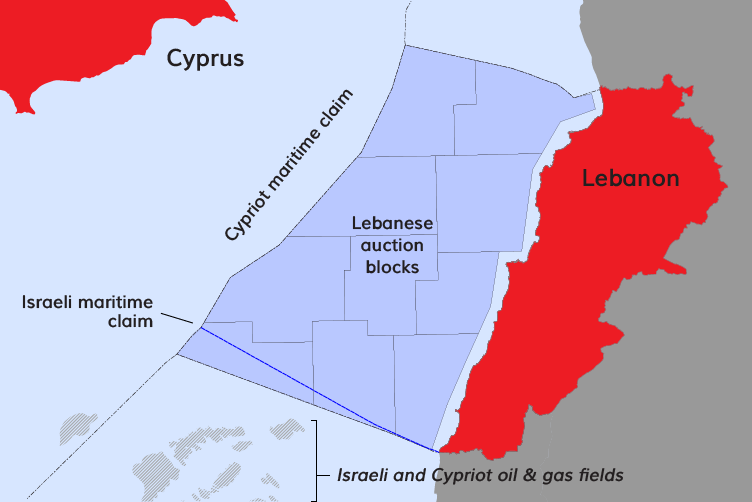
20140611-maritime-border-map

When most people think of oil or gas discoveries, money is the first thing to spring to mind. Industry insiders, however, know that newfound resources often come hand-in-hand with ownership disputes since subsurface deposits predate the lines humankind has drawn above them.

With this in mind, Lebanon and Cyprus are currently in talks aimed at preempting future disagreements over possibly shared underwater hydrocarbon reserves, officials from each country announced in late May.

Neither will know if reserves exist — let alone whether or not said reserves are shared — until drilling begins, but talking now could help boost investor confidence down the road, particularly for Lebanon.

Drilling is still a pipedream in Lebanon as international oil companies cannot bid for rights to explore — and, they hope, produce — until the government approves decrees on block delineation and a model contract. Cyprus, on the other hand, in January signed exploration and production sharing deals with Italy’s ENI and South Korea’s KOGAS that include block 3, which abuts Lebanon’s blocks 1 and 3.


Collective benefit

The early days of the oil and gas industry were governed by what is called the ‘rule of capture’ — meaning whoever captures the resource owns it. The result of this rule was a mad dash by landowners who thought they might have subsurface resources to drill numerous wells in an effort to capture as much as possible.

While sticking multiple straws in a milkshake works well for lovers, drilling multiple holes into a reserve actually decreases the amount of recoverable oil or gas. The more a reserve’s geological seal resembles Swiss cheese, the less will come out of it.


Given the recoverability benefits of poking fewer holes into a reserve — along with lower investment costs — the idea of ‘unitization’ agreements was born.

“[A] unitization agreement,” explains David Ong, a professor of international and environmental law at Britain’s Nottingham Law School, in an email interview, “involves the prior determination of a single operator to develop the overlapping/transborder deposit according to the prior agreed share of the deposit determined by agreement between the licensees/operators/States concerned.” In layman’s terms, once a discovery is made, the parties decide how to divvy up the shared resources before exploiting them — thus maximizing the total amount of recoverable hydrocarbons.

It’s still too early, lawyers specialized in oil and gas legislation tell Executive, for Lebanon and Cyprus to sign a unitization agreement as there are no known reserves to discuss nor a mutually agreed boundary between the two states.

“It will happen between the operators once there is a discovery,” Malek Takieddine, a lawyer specialized in oil and gas, tells Executive.

That said, the two states can hammer out a framework for what a future unitization agreement between companies with rights to drill will look like.

In an email exchange, Ziad Obeid, a lawyer also focused on oil and gas, explains, “there are [two] main levels of agreement for international transboundary unitization: (i) a cross-border agreement/treaty between the relevant states, which regulates or applies unitization of deposits which are in between (straddle) their boundary (which is a sort of ‘framework unitization agreement’), and (ii) a cross-border unitization agreement between the relevant [international oil companies] holding [exploration and production] rights in common petroleum reservoirs, by which the reservoirs are commonly exploited (as a single unit).”

Among the issues the two states will be interested in before discoveries — and money — are made are: whose law applies to offshore installations; which authorities in each country have which powers; what happens if a right holder is qualified to drill in one country but not the other; and, perhaps most importantly, what is the border between them. A unitization framework would ideally cover all of these.

Border complications

Beirut and Nicosia agreed on a maritime boundary back in 2007, but for fear of angering Turkey — which is the sole country that recognizes northern Cyprus as a separate nation — Lebanon’s parliament never ratified the agreement.

In addition to not being ratified, the 2007 agreement identified an end-point for the southern edge of the border but stipulated that point could be moved further south upon later agreement among the three parties concerned — namely Lebanon, Israel and Cyprus. In 2010, Cyprus and Israel signed a boundary deal corresponding to the 2007 agreement’s border at sea that also extends slightly further north on land than Beirut believes it should — a result of Lebanon and Israel not having a demarcated land border; Lebanon sees this as giving around 850 square kilometers of its waters to Tel Aviv.

This, however, does not mean any unitization deal is off the table. Obeid notes that Lebanon’s failure to ratify the agreement with Cyprus “does not necessarily preclude the conclusion of an economic development agreement in which the framework for unitization would be laid out. Of course, such an agreement would need to be without prejudice to Lebanon’s position vis-à-vis its border with Israel.”

Another issue the two states may address is what happens if one country makes a discovery before the other country has awarded rights to the block with a shared reservoir, Obeid says.

Regardless of what they eventually agree, Obeid adds that the fact the two countries are thinking of resolving disputes before they happen “can provide for a better investment climate by adding certainty and reducing investment risks.”
Matt is Executive's Economics & Policy Editor. He has been reporting on Lebanon and regional issues for seven years, particularly specializing in oil and gas, politics and legal matters.


SOURCE