Showing posts with label TR-IL Relations. Show all posts

Sunday, July 26, 2020

Israel is Diving Into the Troubled Eastern Mediterranean - BLOOMBERG

July 26, 2020, 8:00 AM GMT+3
Seth J. Frantzman

The Israeli cabinet last week approved a pipeline deal to move gas offshore via Cyprus to Greece and Europe. The 1,900-kilometer (1,181 miles) link will connect gas fields in the Eastern Mediterranean basin to European markets. The $6 billion project, many years in the discussion, was boosted in January by an agreement signed in Athens between Israeli Prime Minister Benjamin Netanyahu and his Greek and Cypriot counterparts.

The EastMed project puts Israel on a collision course with Turkey. Ankara has laid claim, reinforced with a maritime deal with Libya, to large parts of the Eastern Mediterranean, where it is exploring for gas—and conducting naval exercises. These moves are exacerbating tensions with Greece.

Saturday, January 12, 2019

New pipeline will weaken Turkish-Israeli relationship - ASIA TIMES

JANUARY 12, 2019 12:35 AM (UTC+8)
Joseph Dana


The relationship between Turkey and Israel has never been an easy one to understand. Since formal relations crystalized in 1949, with Turkey becoming one of the first Muslim-majority countries to recognize Israel, both countries have found themselves at arm’s length with the rest of the Middle East.

By the time Israel sent medics to assist victims of Turkey’s tragic earthquake in 1999, the two countries were sharing military technology and bilateral trade was booming. The relationship then took a sour turn, at least rhetorically. A war of words between Turkish President Recep Tayyip Erdogan and Israeli Prime Minister Benjamin Netanyahu reached a fever pitch over the last decade and seemingly threatened the foundations of this unique partnership.

Many observers, however, believed the alliance was never really at risk, due to the sheer amount of trade that moves between the two countries.

But now, all that has changed. The discovery of massive natural gas fields off Israel’s northern coast more than a decade ago and subsequent attempts to export this gas to Europe have highlighted the true fault lines in the Turkish-Israeli alliance. Recent events reveal that a fundamental shift in the alliance is undeniably underway.

Saturday, December 1, 2018

East Mediterranean partnership signals an energy revolution - JERUSALEM POST

Tsipras (L), Netanyahu (R)
DECEMBER 1, 2018 22:24
EMMANUEL NAVON 

Natural gas has turned Greece from a rival to an ally just as relations between Israel and Turkey started deteriorating.

The announcement in November that Israel, Cyprus, Greece and Italy have agreed to build a natural gas pipeline (the longest in the world) from Israel’s offshore gas fields to Europe, clearly indicates that Israel has chosen the Greek option over the Turkish one. In the past, Israel had considered a pipeline to Europe via Turkey, but the idea was dropped in favor of the Greek option. Building a natural gas pipeline via Turkey would have been cheaper and more viable economically, but it became politically unfeasible due to Turkey’s hostile policy toward Israel, Cyprus and Greece.

Natural gas has turned Greece from a rival to an ally just as relations between Israel and Turkey started deteriorating. Israel discovered the huge Leviathan gas field in 2009, shortly before the 2010 MV Marmara incident, which contributed to the rift between Israel and Turkey. In 2010, Benjamin Netanyahu became the first sitting Israeli prime minister to visit Greece, and the Israeli and Greek air forces started their first joint military exercises. In September 2011, Israel and Greece signed a security cooperation agreement. Israel now uses Greek airspace for training purposes.

Friday, July 13, 2018

Elections in Turkey and Gas Discoveries in Egypt Bode Ill for Israel’s Natural-Gas Industry - MOSAIC


JULY 13 2018

While the dictates of economics, geography, and technology suggest that Turkey would be the best possible market for the natural gas beneath Israel’s coastal waters, politics dictate otherwise. Recep Tayyip Erdogan, recently reelected to the Turkish presidency, has been hostile to the Jewish state since first coming to power, and is unlikely to be eager to set up a gas pipeline between the two countries. But, write Oded Eran and Elai Rettig, further gas extraction is only worthwhile if the gas can be exported, and it is now unclear whether Egypt, the only viable alternative to Turkey, will be any more receptive:

Tuesday, February 6, 2018

Delek Shares Tumble on Report That Israel-Turkey Gas-export Deal Is in Jeopardy - HAARETZ

TheMarker Feb 06, 2018 1:10 AM
Eran Azran

Shares of Yitzhak Tshuva’s Delek Group tumbled Monday after Bloomberg News reported that plans to develop an undersea pipeline to deliver Israeli natural gas to Turkey looked increasingly troubled amid fraying bilateral relations. 
Israel has shifted its priorities to exporting to Egypt and Europe, markets with their own political problems or high costs, Bloomberg said, citing two unnamed sources. Turkish pipeline company Botas canceled a December visit to Israel, Bloomberg said. None of the companies involved would comment. 

In another setback for Delek, Moody’s lowered the outlook for the B3-rated debt held by Ithaca, Delek’s wholly owned North Sea energy company, to Negative. Moody’s said it was concerned about the low output rate at Ithaca’s Stella field, the cash flow from which is supposed to help repay the company’s $750 million in debt and reduce its leveraging. Shares of Delek, which owns 45.3% of Israel’s giant Leviathan gas field, finished down 7.45% at 542 shekels ($156.97).

Monday, February 5, 2018

Fraying Israel-Turkey Ties Threaten Planned Gas Venture - BLOOMBERG


February 5, 2018, 5:49 PM GMT+2Yaacov Benmeleh and David Wainer

  • Israeli companies said to shift deal focus to Egypt, Europe
  • Erdogan’s public condemnations have angered Israeli officials
A U.S.-backed initiative to build an undersea natural gas pipeline between Israel and Turkey looks increasingly troubled as Turkish President Recep Tayyip Erdogan escalates his public denunciations of the Jewish state.

Israel has shifted its priorities to exporting to Egypt and other markets because of the growing discord with Turkey, according to two people familiar with the matter, who spoke on condition of anonymity because the issue is sensitive. Efforts to reach governmental understandings with Turkey continue but the pace of talks has fallen off sharply, one of them said.

Thursday, July 20, 2017

Turkey Lobbying Israel to Push Cyprus on Approving Gas Pipeline - BLOOMBERG

July 20, 2017, 3:25 PM GMT+3
Selcan Hacaoglu
  • Officials of both nations discussed gas cooperation last week
  • Negotiations over creating a new federal Cyprus have collapsed
Turkey wants Israel to use its clout to push Cyprus into allowing a pipeline to pass through its waters so the region’s natural gas can be exported to Europe.

“Israel, as a dominant force in the region, could push Cyprus to agree to a compromise deal on the drilling of gas and construction of an export gas pipeline via Turkey” to the benefit of all sides, said Reha Denemec, an adviser to Turkish President Recep Tayyip Erdogan. Officials from both countries discussed possible cooperation on gas during a conference last week in Istanbul, he said. Israel’s Energy Ministry had no immediate comment.

Israel and Turkey patched up ties recently after years of diplomatic estrangement and are eager to advance an energy deal that would help transform Israel into a gas exporter and bolster Turkey as a key gas portal for European states. One key obstacle has been Turkey’s conflict with Cyprus, which has been divided since 1974, with northern Cyprus controlled by a self-declared state supported by Turkey. The latest round of United Nations-sponsored reunification talks faltered earlier this month.

Saturday, June 10, 2017

Israeli commandos head to Cyprus for largest land-based drill - JERUSALEM POST

JUNE 10, 2017 11:57
Anna Ahronheim

Israel and Cyprus have participated in several military drills over the past few months.


Israel has sent a large number of commandos to Cyprus for the largest land-based joint drill ever to take place between the two countries.

According to Cypriot media, the weeklong exercise will take place in the areas of the Troodos Mountains and focus on scenarios for occupying and liberating villages, as well as survival strategies A reported 400 Israeli commandos, as well as attack helicopters and fighter jets, will take part in the drill, in what is believed to be the first time such a large number of Israeli commandos will take part in a military exercise in Cyprus.

The planned drill is said to have unnerved Cyprus’s adversary, Turkey, which used to participate in annual joint navy and air force drills with Israel. After ties between Ankara and Jerusalem were downgraded following the Mavi Marmara incident in 2010, Israel turned to Greece and the Greek Cypriots for military exercises of air, sea, and ground forces.

Saturday, April 29, 2017

Turkish-Israeli pipeline deal on the way? - HURRIYET DAILY NEWS

April/29/2017

“We could have Israeli gas in Turkey in the next three to four years,” said Shaul Meridor, the Israeli Energy Ministry’s director general, at the eighth annual Atlantic Council Istanbul Summit.

The delegations have been engaged in very constructive talks in the last couple of months, Meridor says, noting that a deal between the two governments could occur soon, once the technical and commercial aspects of the pipeline project to transport Israeli gas to Europe via Turkey are agreed upon.

When the energy ministers of both countries met on the sidelines of the World Energy Congress in October 2016 – which also marked the first ministerial-level visit since a reconciliation deal following the Mavi Marmara incident of 2010 – they agreed to establish working dialogue to explore the possibilities of carrying Israeli gas from the Leviathan gas field to Turkey via an undersea pipeline. This proposed pipeline would then be connected to the Trans Anatolian Pipeline (TANAP) and thus reach European markets.

Tuesday, March 7, 2017

US-Israel-Greece poised for annual maritime drill in Eastern Mediterranean - DEFENSE NEWS

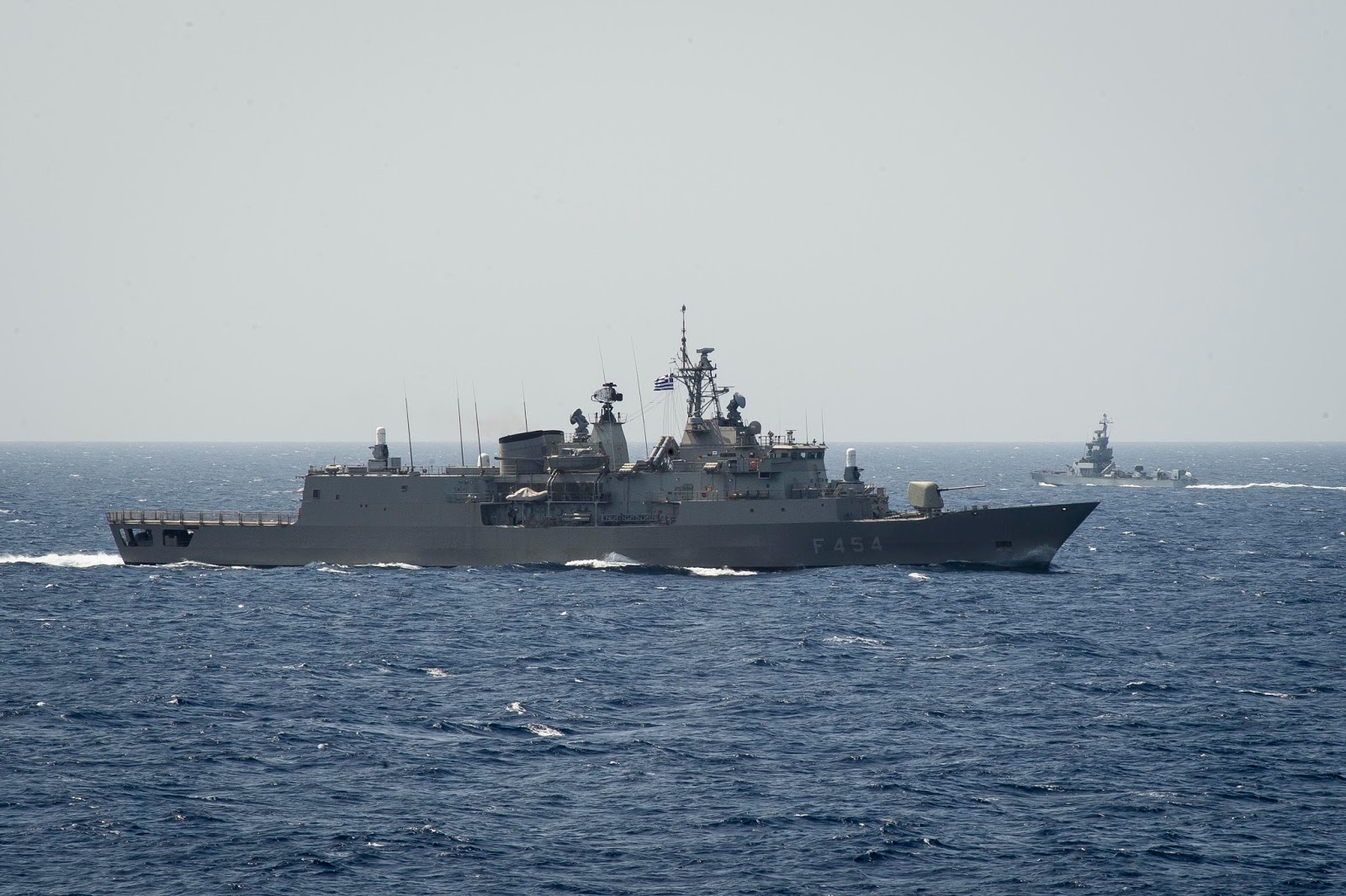
The Hellenic Navy Psara, F-454, front, sails past the Israeli Navy
Keshet, Saar 4.5, while transiting the Mediterranean Sea as seen from
the bridge wing of the U.S. destroyer Porter during Exercise Noble
Dina on April 4, 2016. Photo Credit, MC3 Robert S. Price/US Navy
March 7, 2017
Barbara Opall-Rome

ISRAELI NAVY HEADQUARTERS, Haifa – The trilateral Noble Dina exercise between the American, Israeli and Hellenic navies will begin later this month, with nearly a dozen surface ships, submarines and related air assets scheduled to engage in joint reconnaissance, counterterror and antisubmarine warfare training.

Cyprus will participate as an observer in the annual three-way drill, which begins in Greece and will conclude in mid-April here at the Israeli Navy headquarters in Haifa, said Commander Assaf Boneh, the head of international cooperation for the Israeli sea service.

“It’s one of our most important exercises that allows us to hone our proficiencies in very complex scenarios,” Boneh told Defense News. “We’ll be training in a vast area from Greece to Israel, and this gives us a lot of room to practice multiple scenarios that require jointness.”

Sunday, March 5, 2017

'Cyprus deal could speed up Turkey energy project' - ARUTZ SHEVA 7 / ISRAEL NATIONAL NEWS


AFP, 05/03/17 12:10
A Cyprus peace deal would speed up Israel's project to provide gas to Turkey, the new Israeli ambassador to Ankara said Wednesday.

Eitan Naeh became Israel's first ambassador in Turkey in December when relations resumed in the summer after a six-year diplomatic rift.


"We think that the solution to the Cyprus problem can speed up the energy project," Naeh said, adding it was a "win-win" for everyone.

"A Cyprus solution will make life easier for all," he told reporters during a briefing in Ankara.

Naeh was referring to exporting gas from the Leviathan field off its coast, discovered in 2010 and set to begin production in 2019.

The best way for gas to be exported between Turkey and Israel would be a pipeline via the territorial waters of Cyprus.

Wednesday, March 1, 2017

Cyprus deal would boost Israel’s gas plans, ambassador says - CYPRUS MAIL

March 1, 2017
Elias Hazou

A peace deal on Cyprus would speed up Israel’s plans to export its gas to Turkey, the Israeli envoy to Ankara said on Wednesday. 


“We think that the solution to the Cyprus problem can speed up the energy project,” ambassador Eitan Naeh was quoted as saying, adding it was a “win-win” for all concerned.


TEKMOR Note: A Cyprus settlement is not possible on the current negotiation basis. EU-member Cyprus will carry on with its energy plans whereas the Turkish Cypriot minority, concentrated in the formerly majority Christian, now illegally occupied-colonised north, will become even more dependant on Turkey.

Monday, February 20, 2017

Security of Leviathan Gas field on NATO’s southern flank: an issue in Middle Eastern geopolitics - FOREIGN POLICY NEWS

February 20, 2017
Mehmet Bildik

NATO has been an institution that has expanded its sphere of influence exclusively toward east which NATO’s southern flank poses a complex threat that requires multi-dimensional strategies for territorial defense, cooperative security and crisis management. For the last 25 years of NATO’s history, the Alliance has constantly committed itself to provide security for Middle East and Mediterranean Energy fields.

Regarding counter terrorism and stabilization in the energy fields, the Warsaw Summit of 2016 has underlined importance of the Middle East. To this end, NATO’s Incirlik Airbase is crucial point for Middle East energy security and providing military and strategic capability for Turkey , United States and NATO’s Mediterranean partner Israel.

Saturday, January 14, 2017

Israel eyes energy source to mend regional relations - SANTA FE NEW MEXICAN / THE NEW YORK TIMES

Saturday, January 14, 2017 10:00 pmPeter Barker

ABOARD THE ATWOOD ADVANTAGE — In the ship’s control room, facing four video screens, a driller from Mississippi in dark shades and a black baseball cap with a skull on it held what could be the future of Israel in his hands.

The massive drill he controlled extended down 11,345 feet, more than 2 miles below the surface of a calm Mediterranean Sea, as it plunged deeper and deeper into one of the biggest natural gas fields discovered in the world in recent years.

Once a barren energy island in a part of the planet otherwise awash in resources, Israel is, after years of delay, finally pushing ahead with an ambitious strategy to tap offshore reserves that could transform its economy and, it hopes, its place in a historically hostile region.

If all goes according to plan, Israel will not only become largely energy-independent, it will also supply neighbors that will have new reason to be friends.

Saturday, January 7, 2017

Amid crisis, Greece gains a critical ally: Israel - JERUSALEM POST

Israeli PM Netanyahu (R), Greek PM Tsipras (L) and Cyprus President
Anastasiades in a trilateral summit. (photo: KOBY GIDEON/GPO)
01/07/2017 20:42
George N. Tzogopoulos

Important as it is, energy does not alone constitute the only field of joint interest. What matters perhaps more is the strategic nature of collaboration between Greece, Israel and also Cyprus.

In difficult economic times Greece is endeavoring to shape its foreign policy with relatively low budgets.

Although cuts in the defense sector have a negative impact, a careful and smart strategy in parallel with some favorable circumstances can counterbalance losses and possibly yield more positive results. It is here where the Greek-Israeli partnership deserves particular attention.

Monday, December 12, 2016

Israel and Turkey Seek to Shield Natural Gas Ties From Politics - BLOOMBERG

December 12, 2016 — 3:05 AM EST
Yaacov Benmeleh and David Wainer
  • Governments working on deal that would provide such insurance
  • Israel could pump gas to Turkey in 3 years: energy ministry
Israel and Turkey are working to eliminate a major obstacle to natural gas deals: their own fractious history.

The two governments are working on a framework for the export of Israeli natural gas to Turkey that would protect contracts between companies if diplomatic ties break down, Israeli Energy Ministry Director-General Shaul Meridor said in an interview in Jerusalem. With such a shield in place, gas could begin flowing from Israeli waters to Turkey as soon as 2019, he said.

“For banks to eventually finance such a project they will have to know that no matter what happens between the countries politically, the business side will be protected,” he said.

Saturday, December 3, 2016

Israel, Greece, Cyprus to hold second trilateral summit - JERUSALEM POST

12/03/2016 21:20
HERB KEINON

Meeting in Jerusalem comes less than a year after ‘strategic alliance’ announced in Nicosia.


Energy issues and emergency rescue cooperation will top the agenda when leaders of Israel, Greece and Cyprus meet this week in Jerusalem for their second trilateral summit in less than a year.

Prime Minister Benjamin Netanyahu, Greek Prime Minister Alexis Tsipras and Cypriot President Nicos Anastasiades will hold a one-day summit on Thursday. The three first met together in January in Nicosia in what was hailed as the formation of a new “strategic alliance” in the eastern Mediterranean.

Tsipras and Anastasiades will be accompanied by a number of their senior ministers. The three leaders are expected to issue a joint declaration after their meeting.

Wednesday, November 30, 2016

Minimum 3 years needed to bring Mediterranean gas to global markets - DAILY SABAH / ANADOLU AGENCY

30.11.2016, ANKARA

NOTE: Turkish state propaganda terminology against EU's Republic of Cyprus removed.

A minimum of three years is needed to be able to ship gas firstly to Turkey and further to the world market from the Aphrodite gas field in Cyprus and the Leviathan field in Israel, general manager of Turkish Zorlu Energy Natural Gas Group said Wednesday.

Zorlu Energy General Manager Fuat Celepci told Anadolu Agency that the private sector in Turkey expects progress in Mediterranean gas following the normalization process between Turkey and Israel in the region, but taking into account that Mediterranean gas also constitutes gas from the Aphrodite field in Cyprus.

"The expected steps were taken between Turkey and Israel in the context of normalization, but Mediterranean gas is not just Israeli gas. We need to take concrete steps and present it to world energy markets," Celepci said.

He explained that the route to be used for the transfer of Israeli gas would pass through the exclusive economic area of Cyprus.


Monday, November 21, 2016

Cyprus gas via Turkey the most viable option, experts say - CYPRUS MAIL

November 21, 2016
Elias Hazou

Transporting natural gas to Turkey from Israel and Cyprus seems to be under current market conditions the most viable option, but not without geopolitical risks, experts said on Monday at a conference titled ‘The Future of Eastern Mediterranean Gas’.

The conference, the fourth in a series on energy in the eastern Mediterranean, was organised by the Prio Cyprus Centre, in collaboration with the Atlantic Council, the Friedrich-Ebert-Stiftung in Cyprus and Istituto Affari Internazionali and Strata Insight.

Charles Ellinas, non-resident senior fellow with the Atlantic Council, said that in the long term the transport of natural gas through a floating LNG (FLNG) plant is a serious option, since options such as exporting gas to Europe through Egypt, through the mooted East Med pipeline or through Turkey, seem not to be viable because of low prices internationally.

Sunday, November 20, 2016

Can the American-Israeli Alliance Go to Sea? - FAMILY SECURITY MATTERS

November 20, 2016
ANDREW E. HARROD

"In a world of important and rapidly transforming regions, none is more strategically significant and wildly volatile than the Eastern Mediterranean."

During a recent Hudson Institute panel, former Undersecretary of Defense Douglas Feith echoed a report that has been co-written by the Hudson Institute and the University of Haifa and which calls for the United States and Israel to collaborate in a mutually beneficial Mediterranean naval buildup amidst increasing global naval threats.

According to Hudson Institute naval expert Seth Cropsey, the United States Navy's Sixth Fleet in the Mediterranean once had two aircraft carriers and a large contingent of marines permanently assigned to it. This is in dramatic contrast to the report references, which pointed out that following post-Cold War cuts, the "Sixth Fleet's permanent naval presence is now a single command ship in Italy and four Aegis destroyers equipped for ballistic missile defense, all based in Rota, Spain, just outside the Mediterranean." Retired United States Navy Admiral Gary Roughead said that Americans "have essentially ceded the Eastern Mediterranean, at least from a maritime perspective."