Showing posts with label Israeli Navy. Show all posts

Tuesday, February 19, 2019

Israel's Leviathan Energy Prize: Where Will The Gas Go? - FORBES

Feb 19, 2019, 07:35am
Ariel Cohen

Israel is finally emerging as a natural gas player in the Mediterranean. In the last week of January, the Israeli Navy conducted a complex drill simulating attacks on the country’s offshore oil and gas infrastructure. The exercise included coordinated operations between dozens of naval vessels and aircraft, and even incorporated a live-fire missile test against an abandoned cargo vessel (imitating an enemy transport filled with Hamas or Hezbollah militants). Israel’s week-long “Raging Sea” operation comes on the heels of two joint military drills with Cypriot forces held in November and December – presumably to protect the region’s newest and most valuable energy asset – the Leviathan offshore gas field.

The Leviathan falls almost exclusively in Israeli territorial waters, but neighboring states have demonstrated a mutual interest in seeing the reservoir and surrounding plays developed. Indeed, the vast economic potential of Eastern Mediterranean hydrocarbons has galvanized diplomatic and economic ties between Israel, Cyprus, and Greece. In December, the three nations held a trilateral summit in Beersheba, Israel, where they agreed to launch the EastMed pipeline project, a $7 billion endeavor that would see Israeli gas pumped to Greece via Cyprus and Crete at a rate of 10 billion cubic meters (bcm) per annum. Once in Greece, the gas would then connect to the 20 bcm per annum Poseidon pipeline in Italy, and then onward to the rest of Europe.

Thursday, August 2, 2018

Why Is Israel Spending $500m to Protect Gas Facilities Close to Home? - HAARETZ

Aug 02, 2018 6:04 AM
Hagai Amit
The navy is ordering ships designed to protect drilling platforms far from the coast, even though they will be just 10 kilometers from the shore

The debate under way over how far offshore the natural gas production platforms should be located raises another question about why Israel’s navy is spending 430 million euros ($502 million) to buy four corvettes from Germany.

If plans to locate the facility 10 kilometers from Israel’s coast go ahead as planned, despite protests of residents near Dor Beach concerned about the environmental impact, the Israel Navy will be equipped with a fleet of expensive firepower completely disproportionate to the threats it will face.

The platform, which is being built in Texas and is due to arrive in about six months, will service the giant Leviathan field when it goes into production.

Wednesday, June 6, 2018

Israel navy drills attack on offshore gas rigs - THE TIMES OF ISRAEL

6 June 2018, 1:34 pm

The Israeli Navy successfully completed a complex exercise last week led by its missile boats flotilla, the military announced Wednesday.

The drill included two major attack and defense scenarios at sea.

In the first scenario, an aircraft simulated a missile threat against an Israeli gas rig. The threat was detected on board a Sa’ar 4.5 missile boat, and was shot down by an interceptor missile launched from the ship.

The navy noted that the ship was recently fitted with state-of-the art detection and observation systems, including the new Fire Sickle radar system which officials said significantly improves vessels’ tracking capabilities.

Last week’s drill was the first live test of the ship in its new configuration.

In the second scenario, a seaborne target simulating an enemy ship was struck by two cruise missiles launched by the ships INS Lahav and INS Kidon. The target was successfully hit and destroyed.

Sunday, April 22, 2018

IDF reveals names of four new gas field-defending Sa’ar 6 warships - THE TIMES OF ISRAEL

Sa'ar Class 5 Corvette
22 April 2018, 7:45 pm
JUDAH ARI GROSS

The Israeli Navy on Sunday announced the names of its four new Sa’ar 6-class corvettes, the first of which is due to be delivered by the end of 2019.

The ships will be named “Magen,” meaning shield; “Oz,” meaning valor; “Atzmaut,” meaning independence; and “Nitzahon,” meaning victory.

The first corvette is scheduled to arrive in late 2019. The other three will be delivered by the beginning of 2021.

The ships are far larger and more powerful than the Sa’ar 5-class warships — currently Israel’s biggest — and are specifically meant to protect the country’s gas field and shipping lanes.

“The arrival of the ships will significantly change the face of the Navy,” said the head of the Israeli Navy Maj. Gen. Eli Sharvit.

“The navy will operate vessels with new capabilities that we do not currently possess,” he said.

Thursday, August 17, 2017

The changing face of the Israel Navy - JERUSALEM POST

An Israeli warship arrives at an Israeli navy base in the Red Sea resort city of Eilat July 15, 2009. (REUTERS)

August 17, 2017 03:43 Anna Ahronheim

Expansion of an exclusive economic zone presents challenge to the small Israeli naval fleet.

Some 30 meters underground in the Kirya military headquarters in Tel Aviv sits the Navy War Room, whence senior officers can see every wave crashing on the nation’s shores and every ship and plane in or over its territorial waters.

The Israel Navy is small compared to other IDF corps, and it has a large territory to protect since the expansion of the country’s Mediterranean exclusive economic zone (EEZ) from 40 miles to 150 miles four years ago, a senior naval officer said on Tuesday.

Tuesday, May 16, 2017

IAI completes installation of advanced Alpha Radar on Sa'ar-4.5 missile ship - JERUSALEM POST

ALPHA RADAR is seen on an Israel Navy Sa’ar-4.5 missile ship
(photo credit: IAI)
MAY 16, 2017 06:31 
Anna Ahronheim

Navy to receive total of 11 systems as part of ongoing upgrades to fleet.

The Israel Navy is a step closer to upgrading its entire combat surface fleet, as Israel Aerospace Industries announced that it has completed the installation of the advanced ALPHA radar system on the Sa’ar-4.5 missile ship and is proceeding to operational sea trials.

The Navy is expected to receive two more ALPHA (Advanced Lightweight Phased Array) ELM-2258 radar systems by the end of the year, for a total of 11 systems installed on the missile ships.

Tuesday, March 7, 2017

US-Israel-Greece poised for annual maritime drill in Eastern Mediterranean - DEFENSE NEWS

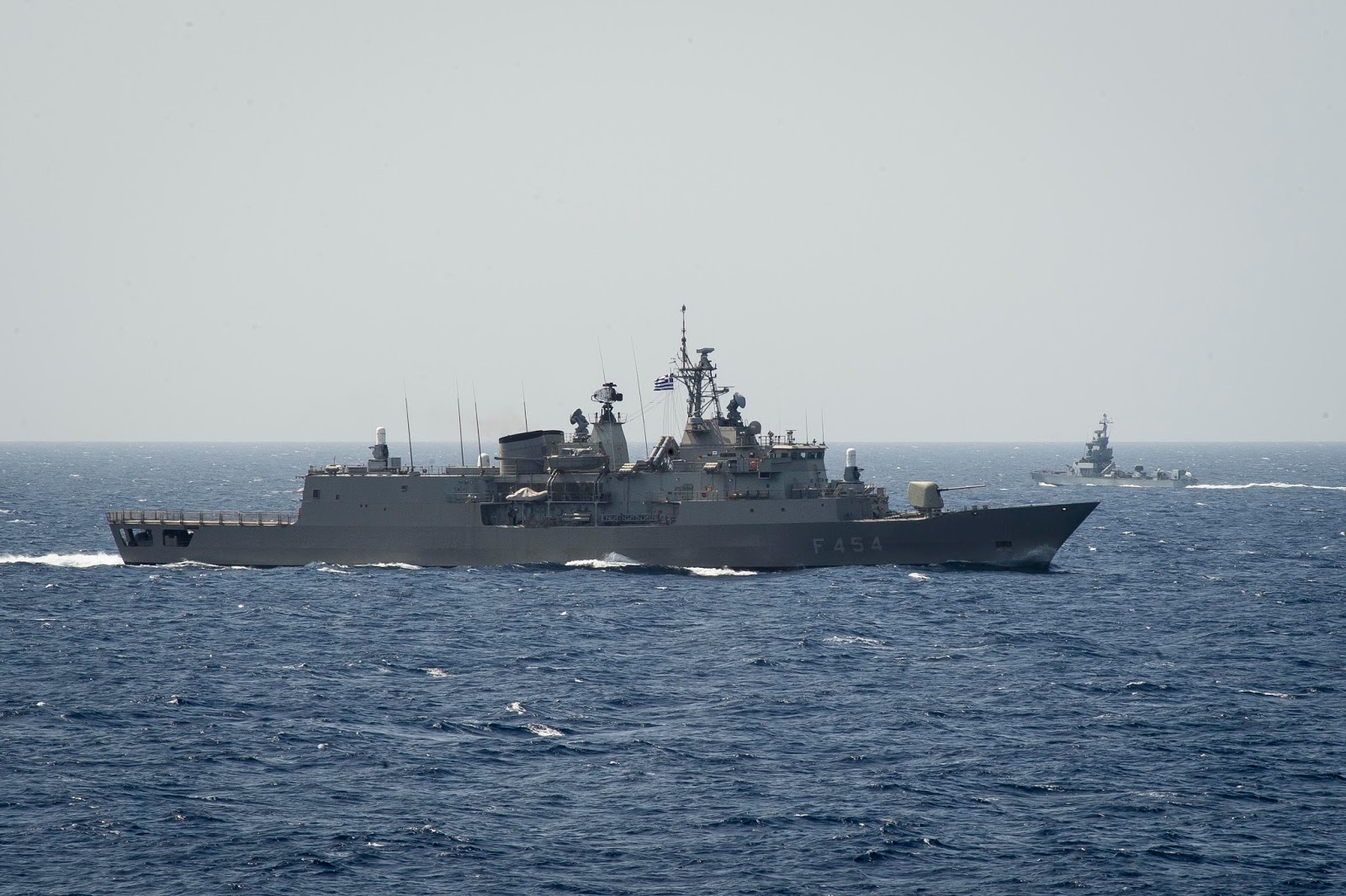
The Hellenic Navy Psara, F-454, front, sails past the Israeli Navy
Keshet, Saar 4.5, while transiting the Mediterranean Sea as seen from
the bridge wing of the U.S. destroyer Porter during Exercise Noble
Dina on April 4, 2016. Photo Credit, MC3 Robert S. Price/US Navy
March 7, 2017
Barbara Opall-Rome

ISRAELI NAVY HEADQUARTERS, Haifa – The trilateral Noble Dina exercise between the American, Israeli and Hellenic navies will begin later this month, with nearly a dozen surface ships, submarines and related air assets scheduled to engage in joint reconnaissance, counterterror and antisubmarine warfare training.

Cyprus will participate as an observer in the annual three-way drill, which begins in Greece and will conclude in mid-April here at the Israeli Navy headquarters in Haifa, said Commander Assaf Boneh, the head of international cooperation for the Israeli sea service.

“It’s one of our most important exercises that allows us to hone our proficiencies in very complex scenarios,” Boneh told Defense News. “We’ll be training in a vast area from Greece to Israel, and this gives us a lot of room to practice multiple scenarios that require jointness.”

Thursday, January 19, 2017

Israel bolsters maritime defense in offshore oil and gas zone - RUSSIA TODAY

19 Jan, 2017 13:36

Photo: Israeli navy patrol vessels take part in a drill simulating the targeting of an infiltrated enemy vessel and the evacuation of a patrol boat, in the Mediterranean Sea off the coast of Ashdod, southern Israel November 8, 2016. © Amir Cohen / Reuters

Tel Aviv is increasing spending on the Navy to protect its offshore oil and gas deposits better and secure a large maritime area neighboring Lebanon, Reuters reports.

The agency says the Israeli defense ministry is not disclosing the information about the new financing, but in 2013 the Navy asked for a $700 million budget increase and an additional $100 million every year to maintain a larger force.

Wednesday, January 4, 2017

Israel The Maritime Power: A Noble Vision, But Is It Feasible? – Analysis - EURASIA REVIEW

JANUARY 4, 2017

Traditionally, Israel has relied primarily on its ground and air forces to meet national security needs. Now it must also bolster its naval forces — this is what ten prominent US and Israeli experts argue in a joint University of Haifa and Hudson Institute report released earlier this year.

The US Navy — the guarantor of free trade — has significantly shrunk its permanent presence in the Mediterranean since the end of the Cold War. As the report notes, “[t]he Sixth Fleet’s permanent naval presence is now a single command ship in Italy and four Aegis destroyers equipped for ballistic missile defense, all based in Rota, Spain, just outside the Mediterranean.”

According to the report, Israel must therefore strive to take on the regional naval policing job and seek even greater cooperation with the US Navy. In other words it must play the role of deputy sheriff in a similar manner to the United Kingdom and Australia.

Sunday, November 20, 2016

Can the American-Israeli Alliance Go to Sea? - FAMILY SECURITY MATTERS

November 20, 2016
ANDREW E. HARROD

"In a world of important and rapidly transforming regions, none is more strategically significant and wildly volatile than the Eastern Mediterranean."

During a recent Hudson Institute panel, former Undersecretary of Defense Douglas Feith echoed a report that has been co-written by the Hudson Institute and the University of Haifa and which calls for the United States and Israel to collaborate in a mutually beneficial Mediterranean naval buildup amidst increasing global naval threats.

According to Hudson Institute naval expert Seth Cropsey, the United States Navy's Sixth Fleet in the Mediterranean once had two aircraft carriers and a large contingent of marines permanently assigned to it. This is in dramatic contrast to the report references, which pointed out that following post-Cold War cuts, the "Sixth Fleet's permanent naval presence is now a single command ship in Italy and four Aegis destroyers equipped for ballistic missile defense, all based in Rota, Spain, just outside the Mediterranean." Retired United States Navy Admiral Gary Roughead said that Americans "have essentially ceded the Eastern Mediterranean, at least from a maritime perspective."

Thursday, December 31, 2015

Israel's Gas Field to receive Iron Dome protection in 'Barak 8' | Arutz Sheva 7 - Israel National News

Following series of successful tests, Israeli offshore gas interests to receive advanced missile defense system to protect for all threats

By Raphael Poch, 12/31/2015


Test of Barak 8 Missile systemPhto Credit: IDF Spokesperson's Unit
Head of the Israel Aerospace Industries (IAI) told Israeli press Wednesday that the newly developed ‘Barak 8’ system which will be installed on Israeli naval ships will be able to protect Israel’s offshore gas assets.

Following the successful tests of the new system in India, Yossi Weiss, CEO of the IAI, said that part of the mission of the project is to protect the Israeli offshore gas assets.

“Technology is giving us the answer to the unfolding developments and threats of our enemies,” he said in an interview with Walla! News.

Weiss added that the system will also be used for “other naval assets." Weiss said the system is capable of providing an answer for a wide range of naval threats, including ‘sea-to-sea’ missiles and torpedoes, air to sea missiles, and land to sea missiles. The system itself uses advanced radar technology which is far superior to previous systems.

The system also has a land based derivative which has been sold to the Indian Air Force. According to current plans between the two nations, that system will soon undergo testing as well.

Vice President for Missiles, Systems and Space Group of the IAI, Boaz Levy, also spoke about the missile tests yesterday and said that “both an Israeli as well as an Indian ship have the systems currently installed.”

While the decision remains with the IDF as to when and how to install further systems, Levy added that the system could be fully operational on Israeli Naval ships in a matter of months.

According to IAI standards, three successful tests are needed to certify a new program. The two trials which occurred in India in the past week, have completed the trial run phase for the ‘Barak 8’ system, and have classified it as ready for deployment.  

SOURCE

Sunday, December 20, 2015

Israeli Navy to Install Anti-Rocket Missiles on Patrol Boats to Defend Gas Rigs | Natural Gas Europe

December 20th, 2015 - The Israeli navy will install missiles on its patrol boats, in order to protect off shore natural gas infrastructure, reported Ha'aretz daily, a reliable Israeli daily.

Although the report hasn’t divulged on the missiles' operating system, the missiles themselves will be taken from the Iron Dome system, a mobile system capable of intercepting short aerial objects, including short range rockets. The missiles will be installed on Saar 5, an Israeli patrol boat.

The Iron Dome system was designed to intercept short range rockets such as those used by Hamas, the Palestinian group that controls Gaza Strip. Last week the chief of Israel's National Security Council, revealed that Hamas attempted to shoot at Israel's natural gas infrastructure, during operation Protective Edge, in the summer of 2014, but missed because the weapons were not sophisticated enough. However, he added that now Hamas is in possession of more sophisticated weapons.

The Iron Dome system was developed in the last few years by Israeli companies and its interception ability was proven during the 2014 Protective Edge operation, in which it is assumed that about 90% of all launches were successful, i.e. destroyed the rockets that were targeted at civilians and other targets.

The Iron Dome is a mobile short range anti rocket system and became operational in 2011. By late October 2014, the system had intercepted 1,200 rockets. However so far the Iron Dome was operated only from land and operating it from sea will set new challenges to its developers. Iron Dome installation on the patrol boats is a filling the gap step until the arrival of new battle ships, Saar 6 model, that are expected to enter service in the Israeli navy around 2019. Those boats will be equipped with Barak 8 system, an anti-missile system.

According to the report, the Israeli navy also plans to increase intelligence gathering in areas around the rigs and also to buy satellite hours from private satellite operators in order to enhance its intelligence gathering capabilities.

"We must ensure that the gas will continue to flow. There is no other option because there is no redundancy and there are no other energy reserves," a navy officer was quoted by Ha'aretz. The officer also supported the approval of the natural gas regulatory framework and said that the delay in its implementation already enabled the IDF to improve its preparations.

Ya'acov Zalel

Source

Tuesday, December 1, 2015

Interview with Formr Israeli Navy Chief: Marine Infrastructure Security Not Just Israel's Problem


December 01st, 2015

INTERVIEW WITH FORMER ISRAELI NAVY CHIEF: MARINE INFRASTRUCTURE SECURITY NOT JUST ISRAEL'S PROBLEM

Eastern Mediterranean security matters came up during the UOG 2015 conference held last week in Tel Aviv, Israel.
One of the speakers at the event was Vice Admiral (Ret.), David Ben-Bashat, formerly the Israeli navy commander in chief, a position he held from 2004 to 2008. Following his presentation to the conference, Natural Gas Europe conducted an interview with Mr. Ben-Bashat.
NGE: How difficult is it to attack and harm Israeli natural gas infrastructure at sea?
Ben Bashsat: Generally it depends on a few elements, among them the platform's distance from the shore, who the guy is [who wants to cause harm], what kind of terrorist activity, and the operational capability.
If you ask specifically for this region, then we know that there are intentions from the Gaza Strip, where Hamas, a terrorist group, is in control, and from Lebanon where Hezbollah, also a terrorist group, has military means. They have even declared that they can do it. We know of a few attempts [to strike at Israeli marine natural gas assets] by Hamas [from Gaza] that fortunately were unsuccessful. Currently the Hezbollah [because of an involvement in Syria] is not involved in such activities, though the organisation still declares [those intentions]. We, as Israel, are defending ourselves and I believe that we have the right tools to defend ourselves.
NGE: Are the natural gas platforms immune from terrorist attacks?
Ben Bashsat: We are dealing here with terrorist organizations, not a normal country with a government. Such organisations don’t always behave responsibly. Hezbollah has already shot some merchant ships in the region. Therefore if they decide to do something, they don’t care if their actions might harm innocent civilians. And therefore we need to take into consideration that they will not always behave logically. When you are talking about a platform that is in a fixed
Vice Admiral (Ret.), David Ben-Bashat, formerly the
Israeli navy commander in chief
position, then it is not a big deal for them to find exactly where the platform is located. Therefore, they can make all the preparations and they can get Iranian support or some other organizations' support. We need to take it as a serious threat and that is what Israel does. We take it seriously. And we are organizing ourselves for that.
NGE: What kind of threats is the infrastructure exposed to?
Ben Bashat: We need to consider threats on the water, underwater, from the air and from the shore. We are preparing the answers and this is a combination between [private] forces on the platforms, which are trained, taught and guided by us [the Israeli military], and the envelope around the area that is controlled and patrolled by military forces like the Israeli navy. It is not always an easy task to accomplish, but we do it. Thanks to good intelligence we have good replies to all threats and scenarios.
NGE: What are the possible aerial threats?
Ben Bashsat: Syria and Hezbollah possess missiles that can hit marine objects. There is also a possibility of operating a UAV [Unmanned Aerial Vehicle] which can carry explosives. However, the Israeli Navy is well equipped and has an answer to any scenario.
NGE: How important are the four battle ships that the Israeli navy has ordered from Germany in order to defend the country's offshore resources?
Ben Bashsat: Very important. We started it a long time ago. The navy started the push to get [the battle ships]. But Israel has limited resources. However, the government became aware of the need to protect our energy resources and those are far away from the Israeli shore. Our enemies might have the capability to hit them, and therefore, it is very important to upgrade the fleet with ships that can stay at sea [for a long period] and to be around. You need to be there. There is no vacuum [on the sea]. You need to have the picture and to be able to respond quickly at the moment of need.
NGE: How do you see the Russian involvement in the region?
Ben Bashsat: As it was published, the involvement of Russia in Syria is coordinated with Israel. There were meetings between senior officers from both sides. But we still have to watch, though at least there is a coordination. I remember from the Soviet times that the Russians were there without any coordination with us.
NGE: Is Russia's presence in the Middle East posing a threat to Israeli gas interests, like possible natural gas deals with Turkey?
Ben Bashsat: Right now we are not dealing with Turkey [a potential customer for Israeli gas]. Maybe when we make gas deals with Turkey and when contracts are signed, we'll have to find a way to talk to the Russians. Right now it is far away [in the future].
However if Turkey improves relationships with us it will be a big benefit for Israel. They need it so why not do it? Right now I don’t see Erdogan rushing to improve the relationship with Israel. But I also hear rumours that something might happen [between Israel and Turkey]. Maybe the gas will be a leverage for rapprochement between the two countries. For us it is very important. That was the way it was before Erdogan came to power. And it is important for us to cooperate one day with Turkey.
****
Since the interview was conducted before the incident in which Turkey shot down a Russian fighter jet, I returned to Mr. Ben Bashat and asked him to adapt his answers to the new situation.
"This incident would not lead to war," he said, referring to the incident. "However it is raising the tension between the two countries. So now they have to be very careful in what they do. I see it as a message from Turkey to Russia. So far there are no implications on the Mediterranean and it is more an affair between Russia and Turkey. If the confrontation is not exaggerated by one of the sides, a routine will be resumed.
NGE: Is the security situation of other countries in the region different from Israel's?
Ben Bashsat: I believe that Egypt and Cyprus share the same security challenges as Israel. Therefore, I see room for cooperation between the countries. We can share the [military] picture, the capability, the concept, the intelligence, because this Jihadist international terrorism is aimed at anybody: Americans, Europeans, Middle East countries, Saudi Arabia. Everybody has to be aware of the dangers. [In that respect] Israel is not unique any more."
NGE: So what should be done?
Ben Bahsat: In this region we need to work together--public forces with private. You need to involve other countries in the region. We need to build a security platform among Israel, Cyprus and Greece and invite other countries like Jordan and Egypt to join. In that case, it is win-win-win situation. It concerns not only gas; it is a very strong leverage for other issues.
Ya'acov Zalel


 Natural Gas Europe welcomes all viewpoints. Should you wish to provide an alternative perspective on the above article, please contact editor@minoils.com  
Kindly note that we only lightly edit content for grammar and do not edit externally contributed content.

Sunday, November 29, 2015

Israel Tested Successfully A Missile Designed To Protect Offshore Natural Gas Platforms


November 29th, 2015

ISRAEL TESTED SUCCESSFULLY A MISSILE DESIGNED TO PROTECT OFFSHORE NATURAL GAS PLATFORMS

The Israeli Navy has completed successfully a test of a new missile, Barak 8, a surface to air missile designed to protect against various types of airborne threats including anti-ship missiles and UAVs (unmanned aerial vehicle). The missile was launched from aboard a battle ship and hit a small UAV in what a navy officer described as small and difficult target to hit, according to Ha'aretz daily.
Barak 8 is planned to be mounted on the four battle ships Israel has ordered from Germany this year, in a $500 million deal, a third of it is paid for by the German tax payer. The missile will be able to hit targets that are moving in supersonic speed.
In future tests the ability of the missile will be tested against land-sea missiles like the Russian supersonic Yakhont anti-ship cruise missile. The Yakhont can be launched from land and with 600 km range poses a risk to Israeli natural gas infrastructure in the east Mediterranean if it is launched either from Syrian shores or from Lebanese shores. According to the naval officer, who briefed reporters, the missile's development phase will be ended in one to two years' time following "the elimination of a few risks [in the development phase]".
Barak8 is developed in cooperation with India.