By HEDY COHEN/GLOBES, 03/11/2016
Israel Natural Gas Lines CEO Samuel Tordjman says pipeline in Dead Sea area will be operational next year.
The first natural gas pipeline to Jordan is scheduled to begin operating in 2017, Israel Natural Gas Lines CEO Samuel Tordjman announced Thursday. The pipeline, currently being constructed in the Sdom area by the Dead Sea, will supply gas from the Tamar reservoir to private customers in Jordan. A second pipeline to be built in the Beit Shean area is due to supply gas from the Leviathan reservoir to the Jordanian National Electric Power Company (NEPCO).
In February, the Tamar partners signed a letter of intent with private customers in Jordan to supply 1.8 BCM over 10 years. In September 2014, the Leviathan partners also signed a letter of intent to supply 45 BCM of gas to NEPCO over 15 years; the value of the contract is estimated at over $15 billion. The discussions of the gas plan in Israel, however, which have been taking place for a year, have stalled the negotiations between the two countries.
Showing posts with label German Marshall Fund (GMF). Show all posts
Friday, March 11, 2016
Thursday, January 14, 2016
Israeli Gas: Too Soon to Declare Victory | German Marshall Fund
Israeli gas might not be developed for years to come without at least partial resolution of a number of challenges, including uncertainty about export markets and high risks for potential buyers.
To facilitate the development of Israeli gas, the government should promote an honest and open national public conversation about gas and should replace problem making with problem solving.
A robust national public conversation will help manage expectations about future benefits of the development of Israeli gas and deepen the foundations for project development.
To enable the development of Israeli gas, the Israeli government should work to address risks that worry investors, attract new commercial partners and consider public investment.
The only obstacle to Israel’s capitalizing on its gas bonanza is government interference, according to the dominant narrative in the country; if only the authorities approve a new framework for the gas sector, an economic and geopolitical windfall will follow.[1] This narrative has some truth to it. Hitherto the government has done more to hamper development than to enable it. But the assumption that billions of dollars of investment will follow once the Israeli government gives the green light, and the inevitable appeals have been exhausted, is wishful thinking. The resolution of the antitrust stand-off will heal a self-inflicted wound but will do little to address the other challenges holding back Israeli gas. Only when these are addressed can Israel begin to sell its surplus gas in foreign markets and, even then, the benefits will be fewer than advertised. Israel needs a reality check on what it will take for its gas to reach export markets and what to expect when, and if, it does.
Gas Development Takes Time
Developing major gas projects is a very demanding and lengthy process. In Qatar, it took 25 years after the discovery of the North field for the first liquefied natural gas (LNG) to be exported (from 1971 to 1996). The Gorgon field in Australia, which will soon come online, was discovered in 1981. The fields supplying the Sakhalin-2 LNG project in Russia were discovered in the mid-1980s, and the first LNG was exported from there in 2009. It took a similar length of time for the Snøhvit field in Norway to be developed (discovered in 1984, first LNG produced in 2007). Gas flowed within seven years of discovery at Pluto LNG in Australia, one of the fastest such projects to be developed. A typical best-case scenario is a decade from discovery to exports. Some world-class discoveries such as the Natuna D field in Indonesia (discovered in 1968), the Prudhoe Bay field in Alaska (1968), or the Shtokman field in Russia (1988) have still not found a path to market. Some may never be developed at all.
The reason for these delays is that gas development is capital intensive and has a long payback period for their investors. As such, project sponsors work diligently to map and address every possible risk. During this process, the development concept might change as proposed pipelines turn into LNG facilities or vice versa; new partners come in and old partners leave; governments change the rules to give the project a boost or to improve their own take; and markets and costs change, prompting project sponsors to revise their plans repeatedly.
This long development cycle is frustrating. Project sponsors want to recoup their original investments; host governments want to deliver the benefits that they have promised to their voters, who, in turn, are eager to see these materialize; and possible buyers, financiers, builders, and service providers all await their share of the promised gains. Meanwhile, there is a chorus claiming that gas must be developed as soon as possible, before a “window of opportunity” closes. After some time, fatigue creeps in as the participants lose faith in the process and the public turns cynical.
Projects succeed when they have capable and committed partners, who engage stakeholders at the local, national, and international level, and who take advantage of a favorable political, commercial, and financial environment to move ahead. Often this process takes years and even decades to complete. Slow progress can be particularly frustrating for Israel given its experience with Mari B and Tamar, which were developed relatively quickly. These fields were geared to supplying the local market and so did not face many of the risks that come with export projects.
Challenges in Developing Israeli Gas
Gas in Israel has its share of advantages and disadvantages. Leviathan and Tamar are large fields, bringing economies of scale. The gas is dry and of high quality, so processing is relatively inexpensive. As the gas is fairly close to national and regional markets, infrastructure costs associated with development should not be prohibitive.
But, for the moment, there is no obvious outlet for all this gas. There are several options but no clear winner. A pipeline to Turkey would tie the gas into a single market where there is considerable competition and that could be affected by changing political relations between Israel, Cyprus, and Turkey. A pipeline to Southeast Europe would be very costly and face competition from the Caspian region and other sources. Any pipeline geared to currently expected production levels would not offer economies of scale if there were additional discoveries; a whole new pipeline would then be required. A liquefaction facility onshore Israel would face obstacles in securing construction permits and would be a major terrorist target. A liquefaction facility onshore Cyprus could be a solution, but this would be the first time in the world when gas produced in one country would be exported as LNG from another. A floating LNG facility at either Tamar or Leviathan would probably be too small for the gas available and vulnerable to attack. In any event, floating LNG is a breakthrough technology without any functioning projects as yet. The market in Egypt for imported gas is limited, while gas for re-export needs a change in commercial structure to be viable and is exposed to changes in the political relationship between the two countries. Finally, exports to Jordan, if they materialize, would be insufficient to absorb Israel’s available gas,
In short, project sponsors are constantly weighing several development paths, trying to find a balance between risk and reward with which they are comfortable. In doing so, they face two additional challenges. First, any option must be durable, which means it needs to survive the changes in politics, economics, and markets that are likely to occur over the next 15 to 20 years. Shocks can come from many sources: Israeli politics could lead to changes in taxation or the amount of gas that is permitted to be exported, despite assurances of regulatory “stability.” Changes in regional politics could threaten the sustainability of exports, as they did with Egyptian exports to Israel. Non-state actors may threaten or attack gas infrastructure, raising the risk premium and thus the cost of development. All these risks need to be managed at a time of lower oil and gas prices worldwide.
The second challenge is specific to Tamar and Leviathan. The project sponsors are upstream companies that focus on exploration and production rather than the mid and downstream aspects of the gas business. In practice, this means that they prefer others to shoulder the risks of building infrastructure and marketing gas while they themselves sell gas at or near the wellhead for a predictable price. This structure, however, shifts many of the risks from the producer to the buyer, who, by guaranteeing a price, bears a disproportionate risk relative to the reward.
Given these challenges, what can stakeholders do to facilitate the development of Israeli gas? First, the public conversation in Israel about gas needs to be upgraded, and secondly, problem-solving should replace problem-making. Only when challenges are acknowledged and addressed head-on can available Israeli gas find its way to new markets.
Upgrade the Conversation
In Israel, the antitrust issue has been handled with little informed public debate and scant attention to institutions and processes.[2] From an investor’s perspective, an apparent resolution through the use of political force is no resolution at all, because of its precariousness. The Knesset may change the law in the future despite the Israeli government’s commitment to “stabilization.” Indeed, any “stability” commitment contradicts the principle of parliamentary sovereignty. Stability comes from engagement with stakeholders and from public understanding and support, which can only emerge from a frank and open national conversation about natural gas.
This public conversation should consist of four elements. First, the authorities should reset the tone on antitrust issues and more candidly explain to the population the challenges of creating competitive conditions in a small national market. Ensuring competition in a market with limited buyers and/or sellers is difficult, as is balancing domestic needs with exports.[3] The investment climate is at least as important as the ownership of resources, the main focus of the anti-trust narrative until now. The country should seek to attract investors rather than dissuading them by restricting the amount of gas that can be exported. New investment could itself create more competition in the small Israeli market. Multiplying supply sources will not in itself create more effective competition when there is one big buyer — Israel Electric Corporation (IEC). Markets can only develop through multiple buyers and sellers.
There are many tools to address antitrust concerns. The state can investigate accusations of market abuse and impose remedies. It can oblige companies to compete against each other by marketing gas individually rather than jointly.[4] In short, there is a sensible middle way to create competition in this nascent market without claiming that there is a major antitrust threat or invoking “national security” to override legitimate concerns about how the gas market functions.
Secondly, it would be better for Israeli leaders to talk about the country’s improved energy security rather than dwell on the notion of insecurity. The improvement in Israel’s security of supply in just a few years has been remarkable. When Egyptian gas was cut off, IEC had to turn to oil to make up most of the difference, leading to a doubling of fuel costs within two years and an 11 percent increase in CO2 emissions.[5] Now, as domestically produced gas has entered the system, the economic and environmental benefits are clear. Greater use of natural gas in sectors such as transport and agriculture could deliver additional benefits. The system is still too reliant on a single gas field, Tamar, but that dependence will diminish when Leviathan and smaller fields come online. It is important to explain the benefits that have accrued so far in order to win public understanding and support for the difficult task of managing the sector fairly and efficiently.
Thirdly, the official narrative should move away from the supposed “window of opportunity” for developing Israeli gas before competing suppliers such as Iran, for example, reach the market. A sense of urgency can be useful in streamlining decisions, but experience shows that there is no such window in practice. Opportunities come and go; some options are more attractive than others at different times. Sometimes it pays to move quickly, and at other times it is best to wait. Many companies rushed to develop LNG facilities for imports into the United States because of an impending gas shortage, just a few years before shale gas took off. Gas is a long-term business and there is no single window of opportunity that should obsess the Israeli public.
Fourthly, the public conversation should stop advertising the “geopolitical benefits” that Israel is supposed to reap by developing its gas. Close energy relations rarely translate into closer political relations, as Israel’s own experience with Egypt shows. As with Egypt, energy relations follow political relations: they can reinforce ties when relations are cordial and get in the way when relations deteriorate. Energy provides less political leverage than is often claimed. If energy dependence led to political dependence, Russia would have far fewer problems in Ukraine.[6] If the Israeli public is sold a set of presumed geopolitical benefits, disappointment and recriminations are likely to follow.
Solving Problems
A robust public conversation should help manage expectations and deepen the foundations for project development. But there are three more areas that require attention.
First, new commercial partners may be needed to enable gas development to move forward. The entry of BG Group into Block 12 in Cyprus, for example, may help to resolve the risk-reward conundrum that has held back potential exports from Cyprus to Egypt.[7] To encourage new partners to invest in discovered fields, the sovereign’s main role is to provide an attractive investment environment. Noble Energy cited the changes in taxing gas exports proposed in March 2014 as having “a detrimental effect on [its] ability to reach commercial terms with Woodside,”[8] which was negotiating its entry into the Leviathan field at the time.
Israel faces one additional hurdle: companies might hesitate to invest for fear of damaging their relations with other Middle Eastern producers. The Israeli government could reduce this risk by inviting and encouraging Egyptian firms to buy Israeli gas and even participating directly in its development as co-investors. Such a prospect would provide political cover and might convince other companies to look at investing in Israel differently.
Secondly, the Israeli government should address certain risks that worry investors. Force majeure is a major concern. Israel has a compensation mechanism for critical infrastructure in case of damages caused by acts of war and terror, but the amount of financial recovery through the fund is not guaranteed.[9] Such uncertainty raises risks and costs. Export sustainability is another risk. Companies seek assurances that Israel will not go back on its commitment to export gas if circumstances change, for example if the regime changes in a destination market or if there are outbreaks of violence there. When the United States faced a similar concern from investors about LNG exports, the Department of Energy issued clarifications to reassure investors that it would not regulate exports in a way that affected prices.[10] For its part, Israel could provide assurances about its commitment to maintain exports under most foreseeable circumstances and about the implications of any future suspension of exports.
The Israeli authorities might even consider an extension of its compensation mechanism to cover, in part, some of the lost revenue arising from specific events such as regime change in destination markets or war. Such moves would reassure investors who are considering investment in Israel’s gas industry.
Thirdly, public finance will probably be needed to develop the gas sector fully.[11] State support has proved essential to reassure investors in projects that are far less risky than Israeli gas. The Israeli authorities could explore additional options, including investment guarantees and direct investment in the gas fields or the enabling infrastructure. Properly formulated, such initiatives could align the interests of the sovereign with those of project sponsors and communicate the state’s support for the development of the gas sector.
Unexploited Israeli gas might stay in the ground for years to come without at least partial resolution of this rather long list of challenges. The authorities should make it a priority to create a propitious climate for the development of the country’s gas resources. Large-scale projects only succeed if the major stakeholders work tirelessly to resolve issues holding back development. An honest public dialogue that is reasoned rather than hyperbolic would do much to improve the climate. All parties need to address the tangible issues that delay development and aim for solutions that promote the interests of both the state and private parties. It is only when such changes take place that Israel can hope to realize the true potential of its newfound wealth.
Secondly, the Israeli government should address certain risks that worry investors. Force majeure is a major concern. Israel has a compensation mechanism for critical infrastructure in case of damages caused by acts of war and terror, but the amount of financial recovery through the fund is not guaranteed.[9] Such uncertainty raises risks and costs. Export sustainability is another risk. Companies seek assurances that Israel will not go back on its commitment to export gas if circumstances change, for example if the regime changes in a destination market or if there are outbreaks of violence there. When the United States faced a similar concern from investors about LNG exports, the Department of Energy issued clarifications to reassure investors that it would not regulate exports in a way that affected prices.[10] For its part, Israel could provide assurances about its commitment to maintain exports under most foreseeable circumstances and about the implications of any future suspension of exports.
The Israeli authorities might even consider an extension of its compensation mechanism to cover, in part, some of the lost revenue arising from specific events such as regime change in destination markets or war. Such moves would reassure investors who are considering investment in Israel’s gas industry.
Thirdly, public finance will probably be needed to develop the gas sector fully.[11] State support has proved essential to reassure investors in projects that are far less risky than Israeli gas. The Israeli authorities could explore additional options, including investment guarantees and direct investment in the gas fields or the enabling infrastructure. Properly formulated, such initiatives could align the interests of the sovereign with those of project sponsors and communicate the state’s support for the development of the gas sector.
Unexploited Israeli gas might stay in the ground for years to come without at least partial resolution of this rather long list of challenges. The authorities should make it a priority to create a propitious climate for the development of the country’s gas resources. Large-scale projects only succeed if the major stakeholders work tirelessly to resolve issues holding back development. An honest public dialogue that is reasoned rather than hyperbolic would do much to improve the climate. All parties need to address the tangible issues that delay development and aim for solutions that promote the interests of both the state and private parties. It is only when such changes take place that Israel can hope to realize the true potential of its newfound wealth.
[1] For example, see Steven Scheer, “How Israel turned a gas bonanza into an antitrust headache,” Reuters, October 1, 2015, http://uk.reuters.com/article/2015/10/01/uk-israel-economy-natgas-insigh...
[2] See Michael Leigh, “More straight talk needed on offshore energy,” Times of Israel, July 30, 2015, http://blogs.timesofisrael.com/more-straight-talk-needed-on-offshore-ene...
[3] For example, see enalytica, “How LNG Affects Local Markets? Lessons for Alaska from Western Australia,” January 2015, http://enalytica.com/#/research/2015-01-exports-vs-domestic
[4] Nikos Tsafos, “A simpler way to market competition,” The Jerusalem Post, January 19, 2015, http://www.jpost.com/Opinion/A-simpler-way-to-market-competition-388269
[5] Israel Electric Corporation, “Investor Presentation as of June 30, 2015 – North America Investor Meetings,” https://www.iec.co.il/en/ir/pages/investorpre.aspx; International Energy Agency, CO2 Emissions From Fuel Combustion Highlights 2015, http://www.iea.org/publications/freepublications/publication/co2-emissio...
[6] Nikos Tsafos, “Ukraine and the Limits of Gas Diplomacy,” National Interest, March 7, 2013, http://nationalinterest.org/commentary/ukraine-the-limits-gas-diplomacy-...
[7] Nikos Tsafos, “Cypriot Gas After BG’s Entry,” LinkedIn Pulse, November 23, 2015, https://www.linkedin.com/pulse/cypriot-gas-after-bgs-entry-nikos-tsafos
[8] Noble Energy, 10K 2014, p. 6
[9] Noble Energy notes that “In Israel … we insure against acts of war and terrorism in addition to providing insurance coverage for normal operating hazards facing our business. Additionally, as being part of critical national infrastructure, the Israel offshore and onshore assets are included in a special property coverage afforded under the Israeli government’s Property Tax and Compensation Fund Law; however, the amount of financial recovery through the fund is not guaranteed.” Noble Energy, 10K 2014, p. 78
[10] King & Spalding Client Note, “U.S. Department of Energy (DOE) Clarifies its Position on Modification or Revocation of DOE Liquefied Natural Gas Export Authorizations,” November 4, 2013, http://www.kslaw.com/imageserver/kspublic/library/publication/ca110413.pdf
[11] See Anastasios Giamouridis and Nikos Tsafos, “Financing Gas Projects in the Eastern Mediterranean,” The German Marshall Fund of the United States, July 2015, http://www.gmfus.org/publications/financing-gas-projects-eastern-mediter...- See more at: http://www.gmfus.org/publications/israeli-gas-too-soon-declare-victory#sthash.EEZrwpKD.dpuf
Download the PDF here
SOURCE
Friday, December 11, 2015
Greece, Cyprus, Egypt to speed up talks over sea boundaries | Reuters
Fri Dec 11, 2015
ATHENS | BY ANGELIKI KOUTANTOU AND RENEE MALTEZOU | REUTERS/ALKIS KONSTANTINIDIS
Egyptian President Abdel Fattah al-Sisi, Greek Prime Minister Alexis Tsipras and Cypriot President Nikos Anastasiades met in Athens to discuss how they could take advantage of gas reserves especially after Egypt this year discovered the biggest offshore gas field in the Mediterranean.
"The discovery of significant hydrocarbon reserves in the east Mediterranean and at Zohr, can and must be a catalyst for wider regional cooperation," Anastasiades said after the third such summit since November 2014.
The leaders set up a joint committee to work on tourism, investment and energy projects. They will explore the potential for new pipelines in the region depending on the level of gas reserves found in the eastern Mediterranean, Tsipras said.
However, independent experts say most of the gas found off Cyprus, Israel and Egypt will go for domestic consumption and question whether there is sufficient to make a pipeline to Europe viable.
"A gas pipeline (or electric cable) from the Eastern Med to Greece, via Crete, and on to the Balkans and Eastern Europe is a non-starter on the basis of the quantities so far discovered," said Michael Leigh, head of the Eastern Mediterranean Energy Project at the German Marshall Fund think-tank.
The next summit will take place in Cairo next year.
"We aim to have visible and tangible results through the joint projects," Sisi said.
Maritime zones claimed by countries for commercial research, known as economic exploitation zones, are governed by the U.N. law of the sea or bilateral accords between neighboring states which normally settle on an equidistant boundary.
Cyprus, which is ethnically split between its Greek and Turkish Cypriot populations after a Turkish invasion in 1974, defined its economic zone in 2004 and since then its maritime boundaries with Egypt and Israel. It found gas offshore in 2011, in a move which has been challenged by Ankara.
Tsipras said defining sea borders was not aimed at excluding third countries - a veiled reference to Turkey, with which all three have prickly relations.
Anastasiades, who is trying to negotiate Cyprus settlement, said natural resources "should be a chance for cooperation and not confrontation" in the region.
"Our aim is not to exclude anyone," he said. "Our cooperation is not against anyone. Our energy sources can suffice for the needs of many Europeans and other neighbors."
Turkey and Greece, an EU member, have been at loggerheads for decades over land, air, sea and sea-floor borders in parts of the Aegean Sea. Egypt has been at odds with Turkey since Sisi led a military coup that ousted an elected Muslim Brotherhood president backed by Ankara in 2013.
(Additional reporting by Lefteris Karagiannopoulos; Editing by Paul Taylor and David Evans)
Monday, July 13, 2015
Financing Gas Projects in the Eastern Mediterranean | GMF
POLICY PAPER
Financing Gas Projects in the Eastern Mediterranean
July 13, 2015
In this paper, the authors provide a detailed assessment of the factors that influence investment in gas and related infrastructure projects worldwide with a focus on the Eastern Mediterranean. They examine the relative merits of project finance and corporate finance for the development of offshore gas resources and for bringing the gas to market. In this analysis, they draw lessons from experience around the world and from the track record of the companies involved in exploration and production in the Eastern Mediterranean.
The authors explain the respective roles of the public and private sectors in financing gas projects and look at company strategies to make use of both sources of finance. They provide a detailed analysis of EU and other public financial instruments that can be mobilized for offshore gas projects in the Eastern Mediterranean.
Their paper concludes with a number of recommendations to governments and economic operators on the principles that should govern their financing strategies in the Eastern Mediterranean. The paper clarifies the complex issues involved in decisions concerning the financing of offshore gas projects and will be of value to those in the industry, financial institutions, government, and the wider policy community.
Download PDF here: http://www.gmfus.org/file/6324/download
Source: http://www.gmfus.org/publications/financing-gas-projects-eastern-mediterranean
Monday, March 9, 2015
LEBANON: THE NEXT EASTERN MEDITERRANEAN GAS PRODUCER? | Natural Gas Europe
LEBANON: THE NEXT EASTERN MEDITERRANEAN GAS PRODUCER?
A policy brief entitled Lebanon: The Next Eastern Mediterranean Gas Producer?, published by the German Marshall Fund and authored by Bassam Fattouh, director of the Oxford Institute for Energy Studies and professor at the School of Oriental and African Studies, and Laura El-Katiri, research fellow at the Oxford Institute for Energy Studies addresses Lebanon’s challenges in its path towards natural gas production, discusses the benefits that gas production could bring Lebanon and assesses various export scenarios. The report issues recommendations for Lebanon to achieve a sound management of future gas revenues and maximize the economic benefits of its hydrocarbon wealth.
The report highlights the fact that although no exploratory drilling has been conducted yet, the wide range of estimates (varying between 25 to 95.5 Tcf of gas), is indicative of the considerable uncertainty surrounding the subject. The government is keen to diversify Lebanon’s energy mix away from oil to strengthen its security of supply and to reduce air pollution, but gas production is not likely to begin before the mid- 2020s, adds the report. Currently, the share of natural gas in the fuel mix of the power sector has fallen to zero. We will summarize below the main findings of the report.
1.Domestic hurdles
The major challenge for Lebanon is the domestic political climate that has led to repeated delays in the launching of the country’s first licensing round. According to the report, Lebanon’s hydrocarbon sector and its institutional and regulatory framework are still in their infancy. The report identified the country’s weak administration, its widespread corruption, and its poor business climate as the most challenging hurdles to overcome.
2.Partial regulatory progress
The report listed the regulatory progress achieved so far and highlighted the pending legislations to be issued for Lebanon to move forward: Lebanon adopted the Offshore Petroleum Resources Law in August 2010 (Law 132), which provides the legal and institutional framework for the exploration and exploitation of offshore oil and gas resources in Lebanon. This was followed in April 2012 by Decree 7968/2012, establishing the Lebanese Petroleum Administration (LPA) as the body responsible for the management, monitoring, and supervision of petroleum activities, including the issuing of licenses and the implementation of agreements. The LPA, however, is not an autonomous body and falls under the tutelage of the Ministry of Energy and Water Resources and, indirectly, is reliant on the Council of Ministers for key decisions regarding the hydrocarbon sector. In February 2013, the government issued Decree 10289/2013, setting out the Petroleum Activities Regulations for Lebanon, which provide the basic guidelines for Lebanon’s hydrocarbon sector. The decree stipulates requirements for license applications and the scope of agreements with energy companies. The appointment of the members of the LPA and the passing of these decrees paved the way for the launch of a prequalification round at the beginning of 2013. The response to the government’s call for expressions of interest demonstrates the commercial attractiveness of Lebanon’s potential offshore energy resources for international investors. Some 50 international companies registered interest, which is high, especially when compared to earlier bidding rounds in Israel and Cyprus, which faced political constraint. Two decrees are yet to be issued for the country to open its licensing round. The failure to pass these two decrees illustrates Lebanon’s complex domestic political landscape and the difficulty of delimiting Lebanon’s EEZ, in light of the dispute with Israel, which could escalate if either country decided to award blocks in the disputed area, says the report.
3.Domestic political rivalries
Lebanon’s domestic rivalries were identified by the report as the main reason for the delays in the energy sector. Exaggerated expectations created by politicians were also criticized for their detrimental effect on future decisions.
4.A pending maritime border dispute with Israel
Lebanon and Israel have overlapping claims over some 854 square kilometers. The authors of the report warn on the possibility of escalation of the conflict if licenses for exploration were awarded in the disputed area.
5.Potential benefits from the exploitation of offshore riches
The initial policy priority for Lebanon, when revenues from energy production begin to flow, will be to reduce the state’s debt estimated at 146 percent of GDP in 2014. The report warns however that using resource revenues to reduce public debt may not be possible as expectations have been raised of the availability of future financial resources for public expenditure. There is also a risk that lower interest rates, resulting from reduced debt levels, would provide an incentive for borrowing, producing a credit bubble, adds the report as they benefit richer households and encourage wasteful consumption that could negatively impact the environment.
6.Preliminary work for the sound management of gas revenues
The report suggests that a balanced strategy to manage future gas revenues must be put in place. A sovereign wealth fund will ensure those revenues are saved for future generations while the remaining funds should be allocated to reduce public debt, directed to public investments and transfer payments. The report stresses on the importance of managing public expectations to relieve pressure from decision-making and ensure sound and realistic decisions are taken.
7.On the export quota
The report highlights the importance of meeting domestic demand first before allocating a portion of the gas discovered to export markets. Natural gas independence will ensure a saving of up to $1.9 billion on the annual energy bill (as estimated by the Ministry of Energy) and significant environmental benefits, adds the report.
8.Interim solutions to meet domestic demand
The disruption in the flow of Egyptian gas to Lebanon led to the signing of a deal between Lebanon and Syria in 2003 to import Syrian gas at a level of around 1.5 bcm of natural gas per year, according the report. Insufficient gas production and civil unrest have prevented Syria from meeting its domestic demand and its export obligations. The report highlights that importing gas from Israel would make commercial sense for Lebanon but because of the state of war between the two countries, it is not a feasible option. Lebanon could import gas in the form of LNG but would have to incur the high costs attached to the construction of an onshore regasification terminal due to the complex geopolitical landscape that make the pipeline option complex.
9. Lebanon’s export options
The report highlights Lebanon’s strategic positioning, ‘with good coastal and land access’, which gives it a natural advantage for export. Many factors will contribute in deciding Lebanon’s export strategy, including as stated in the report: the size of its reserves, domestic and foreign demand, export targets, the cost of Lebanese gas production, price, and competition, as well as the availability of finance for pipelines or LNG facilities to bring the gas to market. The timing of Lebanon’s entry into the export market will also largely determine its export markets. Regional markets (Jordan and Egypt) may slip away to the benefit of Israel should Lebanon delay its entry further, warns the report. Exporting gas via LNG would offer the flexibility in the choice of the export market but largely depends on the size of the discoveries. Only substantial amounts of recoverable gas would justify a 2-train facility, explains the report. By the time Lebanon is ready to exports, new players may block Lebanon’s entry. Energy partnerships with Egypt and Cyprus could be attractive to Lebanon. Exporting gas via pipeline to regional customers (including Egypt, Turkey, Syria, Iraq and Jordan) could be an option if the size of the discoveries does not permit an LNG investment. However, Israel is currently in talks to export some of its gas to Egypt and Jordan. In the event Israel overcomes its regulatory hurdles (including a dispute with the Antitrust Authority), and those deals come to fruition, Lebanon may not be able to acquire those countries as customers.
10.The benefits of the successful development of Lebanon’s gas resources
According to the report, the successful development of Lebanon’s gas resources could ensure energy security and lift the economy. The shift from heavy fuels to gas will also have environmental benefits, adds the report.
11. Challenges ahead
Establishing a sound regulatory framework and ensuring the efficient and transparent management of future gas revenues are major challenges, highlights the report. The report adds that political climate may cause further delays in exploration and production and it is questionable whether full transparency in the process can be achieved. A plan to manage future gas revenues needs to be put in place such as setting up a sovereign wealth fund. Drawing on the experience of existing energy producers (such as the US and Norway) comes highly recommended in the report. The EU is supportive of regional cooperation and can assist Lebanon in managing offshore incidents and maximizing the benefits of its hydrocarbon wealth.
You can access the report here: file:///home/chronos/u-e951b91f2f5868becda1d08e9ad67e37d6ad26bd/Downloads/Fattouh_El-Katiri_Lebanon_Feb15_web.pdf
Source: http://www.naturalgaseurope.com/lebanon-the-next-eastern-mediterranean-gas-producer-22534
Friday, October 10, 2014
Why Is Turkey Increasing Tensions in the Eastern Mediterranean? | GMF
Why Is Turkey Increasing Tensions in the Eastern Mediterranean?
10 October 2014
WASHINGTON—On September 23, the drill ship SAIPEM 10000 — built in South Korea at the cost of $250 million and flying the flag of the Bahamas — arrived in the Exclusive Economic Zone (EEZ) of Cyprus to begin exploring for gas under a license awarded to an Italian-South Korean consortium, ENI-KOGAS. The Cyprus government hopes that additional discoveries over the next 18 months in its EEZ will be sufficient to make its plans to build a liquefied natural gas (LNG) plant on the island, to condition gas for export, commercially viable.
The Turkish authorities declared that the drill ship violated Turkey’s area of maritime jurisdiction and sent the Corvette Bafra to monitor operations. Another Turkish warship, the Gelibolu, engaged in planned maneuvers south of Cyprus ostensibly to ensure maritime safety in the eastern Mediterranean. The Cyprus foreign minister, Ioannis Kasoulides, said that exploration would continue despite Turkey’s “potential harassment.”
On October 3, a Turkish NAVTEX (navigational warning) notified mariners that Turkey would conduct its own seismic surveys starting on October 20 in sea areas that encroach on Cyprus’s EEZ. The Cyprus president, Nicos Anastasiades, asked UN Secretary-General Ban Ki-Moon to persuade Turkey not to violate Cyprus’s EEZ. Anastasiades also announced that he would not participate in further talks with the Turkish Cypriot leader Derviş Eroğlu, aimed at ending the division of the island, as long as Turkish activities, which he deemed unlawful and threatening, continued offshore.
Why has Turkey escalated tensions at this moment, when the two Cypriot leaders have begun renewed, albeit wearisome, efforts to find a solution to the division of the island? The simplest explanation, offered by observers close to the Turkish foreign ministry, is that Turkey is following its consistent policy of opposing explorations offshore pending such a solution. Others suggest that Turkey is seeking to move the offshore energy issue into the settlement talks, a step opposed by the Greek Cypriot side. Eroğlu may also wish to look tough in the run-up to the April 2015 leadership election in the northern part of the island.
But the broader geopolitical context may also be relevant. Turkish President Recep Tayyip Erdoğan may be signaling that Turkey remains a power to be reckoned with at a time when he is facing a number of serious setbacks. On Tuesday, a curfew was declared in six Turkish provinces following demonstrations against the government for inaction over the advance by fighters from the Islamic State (ISIS) on Kobane, just over the border in Syria. Twenty-three people are reported to have been killed during these demonstrations. There has been a further outpouring of refugees into Turkey as a result of fighting over Kobane. Erdoğan claimed that “ISIS and the PKK (The Kurdistan Workers’ Party) are the same for Turkey,” implying that Turkey would lose from the struggle along its border, whatever its outcome. His position on Turkish involvement in the Iraq-Syria conflict remains ambiguous despite a pledge from the new NATO Secretary-General Jens Stoltenberg that the alliance would protect Turkey from any spillover of the conflict with fighters from the Islamic State.
Other developments this week may also have irked Ankara. The outgoing European Commission has justissued its annual report on Turkey’s progress toward fulfilling the conditions for eventual EU membership. While constructive in tone and recognized by the Turkish EU minister as objective, the report expresses serious concerns about attempts to ban social media in Turkey, limitations on press freedom, inadequate guarantees of minority rights, and the lack of independence of the judiciary, especially in its handling of allegations of corruption. As in the past, the Commission pointedly “urged Turkey to avoid any kind of threat or action directed against a member state, or source of friction or actions, which could damage good neighborly relations and the peaceful settlement of disputes.”
Ankara has chosen not to heed this advice and has ramped up its rhetoric, denouncing the Greek Cypriot side for suspending its participation in Cyprus settlement talks. Turkey also holds Cyprus responsible for blocking progress in several chapters of its EU membership talks. Greek Cypriot leaders have confirmed that offshore energy resources will benefit all Cypriots, but Turkey distrusts this commitment given the present stalemate in the settlement talks. The conservative European Peoples Party in the European Parliament and the U.S. Department of State have taken Turkey to task for escalating tensions. Although Cyprus may seem like a sideshow compared with the challenges in Iraq, Syria, and Ukraine, the EU, the United States, and the UN should use their influence to prevent an escalation of this longstanding offshore dispute. Their goal should be to ensure that the offshore energy resources in the Eastern Mediterranean benefit all the countries in the region, including Turkey, and that they do not become an additional source of conflict.
Sir Michael Leigh leads GMF’s project on energy in the Eastern Mediterranean.
Link to source: http://blog.gmfus.org/2014/10/10/why-is-turkey-increasing-tensions-in-the-eastern-mediterranean/
Labels:
Eastern Mediterranean,
Erdogan,
EU,
German Marshall Fund (GMF),
ISIS,
Navtex,
Turkey,
Turkish Threats,
UN,
USA
Monday, June 9, 2014
U.S. Interests in the Eastern Mediterranean—a New Persian Gulf? | German Marshall Fund
U.S. Interests in the Eastern Mediterranean—a New Persian Gulf?
Posted on 06 June 2014. Tags: Anti-communism, Asia, Eastern Mediterranean Resources AE - Greece, German Marshall Fund, International relations, Member states of the United Nations, NATO, Politics, Syria, Western Asia
For more than two decades, the United States has taken Eastern Mediterranean maritime security for granted. But the discovery of energy sources is changing the regional security landscape, eliciting maritime competition over exclusive economic zones (EEZs) among Israel, Lebanon, Cyprus, Turkey, similar to maritime competition over energy sources in the East and South China Sea. Regional actors such as Israel and Turkey are also building up their naval capabilities, with Turkey recently changing the naval balance via plans for a new aircraft carrier.
The United States has three main concerns in the Eastern Mediterranean: conflict between Israel and its neighbors; the division of Cyprus; and European energy security. However, creeping maritime militarization of the region is putting U.S. interests at risk, and the U.S. Sixth Fleet based at Naples could well be drawn into any attempt to defuse a crisis at sea. Moreover, China has also entered the Mediterranean security scene and become more assertive in this region post-Arab Spring.
China’s new proactive behavior is driven by the need to secure energy sources in the Middle East and North Africa and determination to prevent another “Libya case” of Western intervention for regime change, wherein Beijing suffered huge investment losses and had to evacuate their citizens. It is also fearful about increasing Chinese Uyghur separatist ties with Syrian jihadists that threaten to attack and destabilize Xinjiang, as well as the potential threat of jihadists accessing Xinjiang-based nuclear warheads.
As such, China has embarked on a new proactive diplomacy, with three UN Security Council vetoes on Syria and dispatching its warships to the coast of Syria to conduct naval war games with Russia. This makes Syria a ground zero of great power rivalry with China, Russia, and Iran on one side and the United States, Saudi Arabia, the Gulf States, and much of NATO on the other. Indeed, Chinese scholars call Syria the new “Afghanistan” as an international hotbed of jihadi fighters exporting extremism abroad as well as a battleground for proxy wars between great powers. In light of this heightened tension, former NATO SACEUR Admiral James G. Stavridis in a 2013 Foreign Policy op-ed called for the United States to adopt an Eastern Mediterranean strategy.
Some scholars have likened Eastern Mediterranean to a new Persian Gulf — meaning the United States has similar interests in safeguarding U.S. allies and protecting freedom of navigation — and argued for a new U.S. force posture in the Eastern Mediterranean by establishing new cooperative security sites and regional defense partnership. In this regard, China can play a constructive role as an extra-regional partner for joint stabilization of the Mediterranean.
With forecasts that China will be a top LNG importer by 2020, and with its growing interests in Eastern Mediterranean gas, Beijing has a stake in regional maritime security. It also shares convergent interests with regional actors in counter-terrorism against al Qaeda-affiliated groups. In instances like Syria where China and the U.S./NATO share divergent interests, cooperative security engagement with China would contribute to a confidence-building template for crisis management to prevent miscalculation and escalation, and help stabilization of the Mediterranean.
Christina Lin is a fellow at the Transatlantic Academy, an initiative of the German Marshall Fund of the United States in Washington, DC, and a fellow at the Center for Transatlantic Relations at the Paul H. Nitze School of Advanced International Studies (SAIS), Johns Hopkins University.
Link to source: http://blog.gmfus.org/2014/06/06/u-s-interests-in-the-eastern-mediterranean-a-new-persian-gulf/
Tuesday, February 11, 2014
The Geopolitics of Energy in the Eastern Mediterranean February 11, 2014 / Washington, D.C. | German Marshall Fund of the US
The Geopolitics of Energy in the Eastern Mediterranean
February 11, 2014 / Washington, D.C.

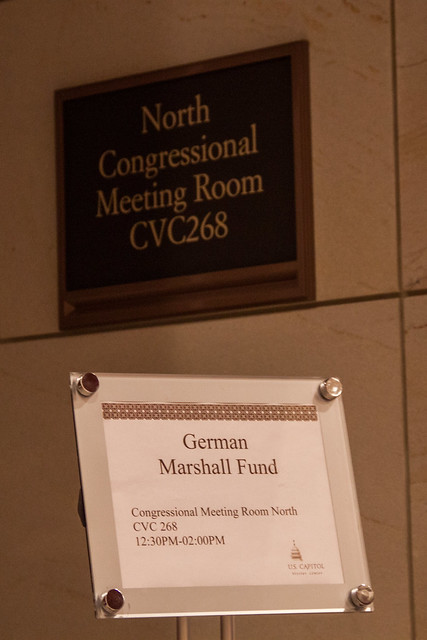
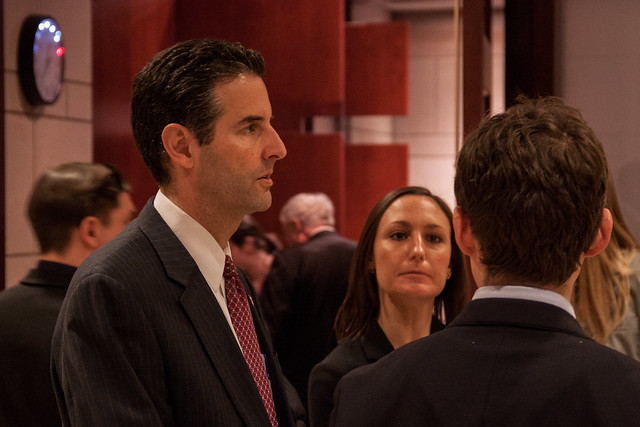
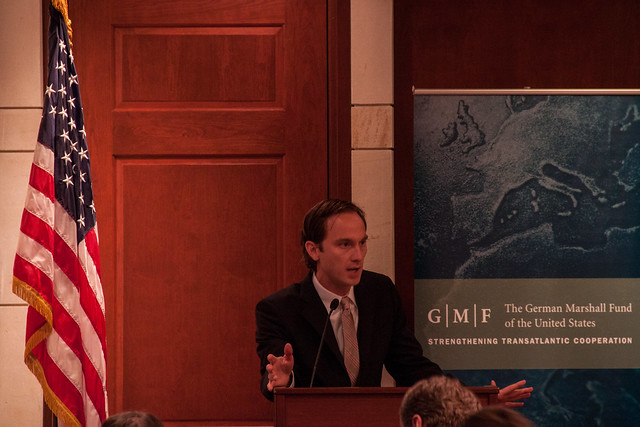
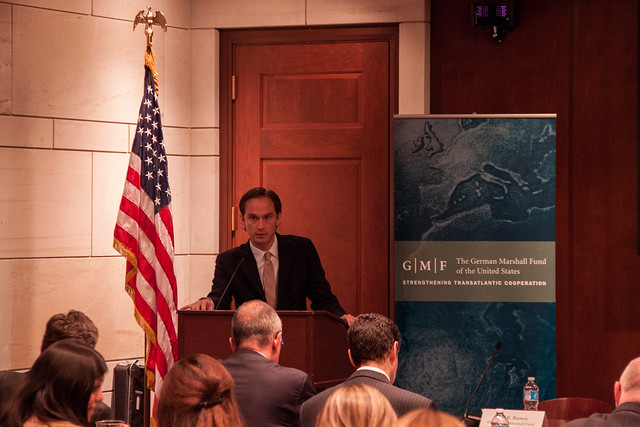
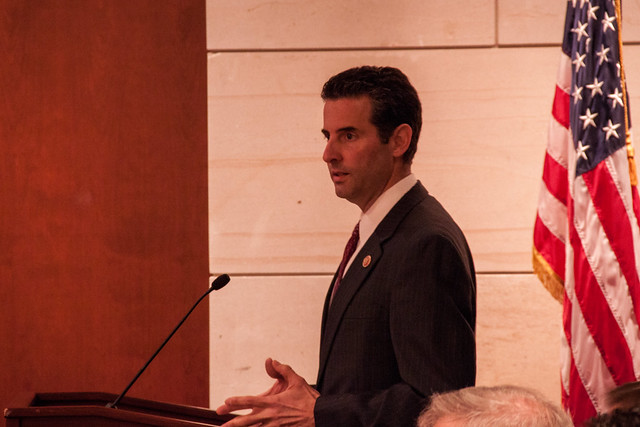
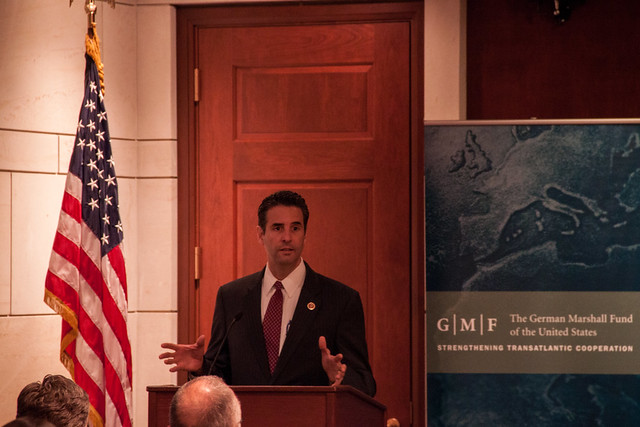
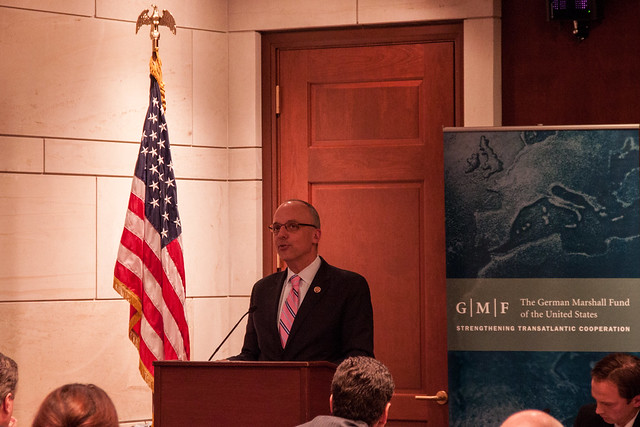
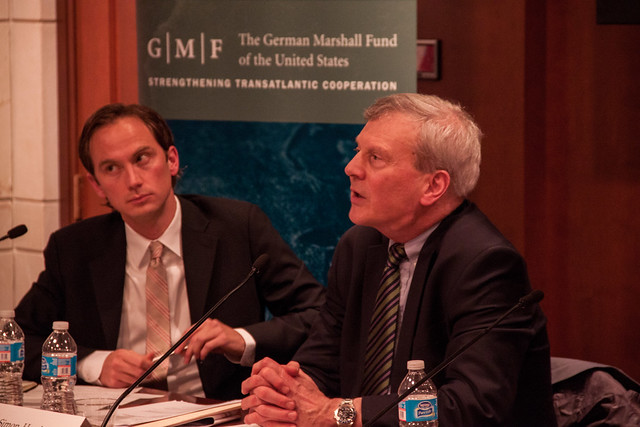
On Tuesday, February 11th, GMF convened a public event in the United States Capitol complex to examine the geopolitics of energy in the Eastern Mediterranean under the auspices of its Eastern Mediterranean Energy Project. The event brought together an audience of fifty senior representatives and leading issue experts from a host of Washington Embassies, think tanks, and the U.S. Congress.
Four members of the U.S. House of Representatives attended and delivered remarks: Congressman John Sarbanes (D-Maryland), Congressman Gus Bilirakis (R-Florida), Congressman Ted Deutch (D-Florida), and Congressman Michael Turner (R-Ohio). Their speeches echoed common sentiment across political party lines that developing natural resources in a thoughtful and multilateral way can support stability in tense neighborhoods, such as the Eastern Mediterranean. All four members expressed their support for continued engagement by leaders in the U.S. and in countries in the region.
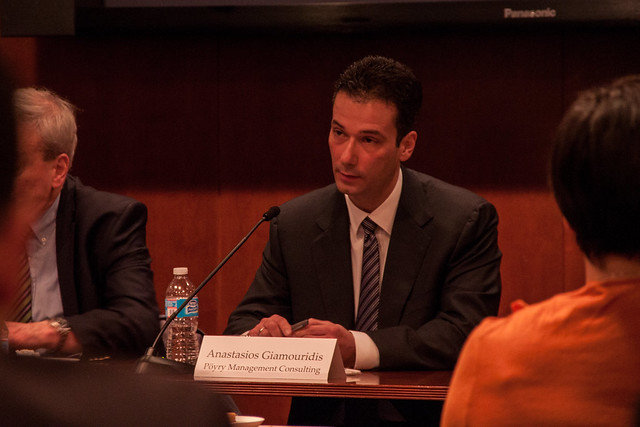
Following the remarks by the members of Congress, nonresident fellow Neil Brown opened the panel discussion, which featured experts Anastasios Giamouridis, senior consultant at Pöyry Management Consulting; Simon Henderson, director of the Gulf and Energy Program at the Washington Institute for Near East Policy; and Eric V. Thompson, vice president and director of CNA Strategic Studies. The subsequent conversation bore out many of the practical and political difficulties and opportunities presented by recent finds of natural gas in the Eastern Mediterranean.
Henderson made the point that although the discovered gas reserves are believed to be large enough to cover the domestic consumption of both Israel and Cyprus, further exploration is hampered by the small scale of the finds in absolute terms. He also pointed out that Turkey would be the most logical market for Israeli gas, should the resource develop, however Israel would likely remain a small player in the Turkish gas market, competing with the likes of Gazprom and others.
Giamouridis emphasised that the exploration of energy resources in the Eastern Mediterranean is still in an early phase, particularly in Cyprus. It is unclear exactly how much natural gas may be available in commercial terms, given the deep water nature of the resource and dry gas properties. He also highlighted that discussions of a pipeline to Turkey as the most logical export option for East Med gas fail to understand commercial complexities and risk factors and that the Turkish market may in fact not offer the best economic returns for East Med gas sellers in the long term. Finally, according to Giamouridis, linking the exploration and extraction of Eastern Mediterranean natural gas to the peace process would be a “recipe for disaster” that would make potential investors very nervous about financing costly extraction projects.
Thompson discussed the potential economic benefits of developing natural gas reserves by Cyprus and Israel, which could promote economic and political stability within each country. However, new infrastructure, such as offshore drilling rigs and pipelines, present new targets for groups such as Hezbollah. This could create a more complicated maritime security environment which could make it more difficult for the U.S. to operate there. Thompson also argued that the manner of development of potential gas reserves by Cyprus could orient that country more towards EU or Russia.
Link to source: http://www.gmfus.org/archives/the-geopolitics-of-energy-in-the-eastern-mediterranean/
Labels:
Cyprus,
Geopolitics,
German Marshall Fund (GMF),
Israel
Subscribe to:
Posts (Atom)