Tuesday, June 25, 2013

Total signs outline deal on Cyprus LNG facility: sources | Reuters

Total signs outline deal on Cyprus LNG facility: sources

The logo of French oil company Total is pictured during the company's 2012 annual result presentation in Paris February 13, 2013. REUTERS/Philippe Wojazer
NICOSIA | Tue Jun 25, 2013 1:07pm EDT
(Reuters) - France's Total (TOTF.PA) has signed an outline deal to invest in facilities to export gas from Cyprus, which wants to exploit its reserves rapidly to help it emerge from financial crisis, government sources said.
Total, Italy's Eni (ENI.MI), South Korea's Kogas (036460.KS) and Noble Energy (NBL.N) are among the energy firms that have signed deals to explore Cyprus's new-found gas potential.
Government officials in Cyprus said on Tuesday that Total had signed a memorandum of understanding on a second liquefied natural gas (LNG) production line, known as a train in the industry.
The estimated cost would be $3 billion, they said, which would be in addition to the estimated $6 billion cost of the first LNG train.
Further details on the terminal and the first train are likely to come out on Wednesday, when Cyprus is expected to sign a memorandum of understanding with Noble, Delek Drilling (DEDRp.TA) and Avner Oil Exploration (AVNRp.TA) to develop it.
Shipment of Cypriot gas by pipeline eventually could be possible, but in the shorter term Cyprus aims to start building an LNG terminal by early 2016 and start LNG exports from 2019.
Total officials could not immediately be reached for comment.

(Reporting by Francesco Guarascio, Michele Kambas in Nicosia, Michel Rose in Paris; writing by Barbara Lewis; editing by Jane Baird)


Link to article: http://www.reuters.com/article/2013/06/25/us-cyprus-lng-idUSBRE95O0QY20130625

Sunday, June 23, 2013

Israeli government approves 40 pct limit on natural gas exports | Reuters

Israeli government approves 40 pct limit on natural gas exports

JERUSALEM, June 23 Sun Jun 23, 2013 9:04am EDT
(Reuters) - Israel's government on Sunday approved limitingnatural gas exports to about 40 percent of the country's newly-discovered offshore reserves.
Prime Minister Benjamin Netanyahu ended months of uncertainty on Wednesday when he said that Israel would keep 60 percent of the gas, or roughly 540 billion cubic metres, for domestic use and allow the rest to be sold abroad.
Netanyahu disappointed environmental groups and opposition lawmakers who have called for even stricter limitations, saying his government had found the right balance that ensures Israel's energy security for a few decades while still satisfying exploration companies seeking access to the global market.
"We did the right thing for Israel. Without gas exports, there will not be gas for the domestic market," Netanyahu said in broadcasted remarks at the start of a weekly cabinet meeting.
"This mistake, this surrender to populism - 'let's save the gas for ourselves'. A number of countries did this, and they saved the gas for themselves. It's still buried, under the ground and water, beneath layers of populism and bureaucracy," he said.
Exploration companies had lobbied strongly for a large export quota, saying the Israeli market alone was too small to warrant further investment in developing the fields.

Two of the world's largest offshore fields found in the past decade lie in Israeli waters. Tamar, with an estimated 280 bcm, was discovered in 2009, and a year later Leviathan, was found with an estimated 530 bcm. (Reporting by Ari Rabinovitch; Editing by Greg Mahlich)

Link to article: http://www.reuters.com/article/2013/06/23/israel-natgas-idUSL5N0EZ0BQ20130623

Wednesday, May 8, 2013

President of Cyprus in Israel: New partnership, old conflicts | +972 Magazine


May 8, 2013
Dahlia Scheindlin

Cyprus and Israel have grown closer in recent months over the massive natural gas discovery that transcends their respective maritime exclusive economic zones. But when it comes to the military occupations in which the two countries have long been embroiled, political friendship has its limits.

Recently-elected president of the Republic of Cyprus (RoC) Nicos Anastasiades, elected in January 2013, spoke at Tel Aviv University’s Faculty of Law Tuesday evening following an official visit that included meetings with both Prime Minister Benjamin Netanyahu and President Shimon Peres. His talk was a full-throated call to nurture the budding friendship it has sparked with Israel despite the recent thaw in Israel’s relationship with RoC’s long-standing nemesis, Turkey.

With Israel and Turkey hopefully on the road to repairing relations, there are sure to be ramifications for international cooperation on the enormous cache of hydrocarbons discovered over the last few years beneath the seas of Cyprus and Israel. Cyprus might be edgy about where Israel’s loyalties lie. Perhaps this is part of the timing of the visit.

Wednesday, April 17, 2013

Σφαλιάρα Σ.Λαβρόφ στον Α.Νταβούτογλου | DEFENCE NET


17/04/13 - 19:04

"ΝΑ ΣΕΒΑΣΤΕΙΤΕ ΤΟ ΔΙΚΑΙΟ ΤΗΣ ΘΑΛΑΣΣΑΣ ΤΟΥ 1982"

"'Εκοψε τον αέρα" του Α.Νταβούτογλου στο θέμα των κυπριακών υδρογονανθράκων, αλλά και σε ότι αφορά την ελληνική ΑΟΖ, ο Ρώσος υπουργός Εξωτερικών Σε.Λεβρόφ, ξεκαθαρίζοντας δημοσίως στις δηλώσεις του μετά την συνάντηση με τον Τούρκο ΥΠΕΞ στην Κωνσταντινούπολη ότι "Για τους υδρογονάνθρακες όχι μονο στην ανατολική Μεσόγειο και σε όλο τον κόσμο θα πρέπει να τηρηθούν οι διεθνείς κανόνες και οι αρχές του δικαίου της Θάλασσας του 1982"Δηλαδή τάχθηκε υπερ της εφαρμογής της συνθήκης του Modego Bay, μια συνθήκη που δεν αναγνωρίζουν μόνο η Τουρκία και οι ΗΠΑ.

Ουσιαστικά ξεκαθάρισε ότι απορρίπτονται οι τουρκικές, έτσι ή αλλιώς, πρωτάκουστες και πειρατικές θέσεις για την ΑΟΖ Ελλάδας και Κύπρου.

Επίσης δήλωσε ότι "Η Ρωσία θα στηρίξει όλες τις έρευνες για τον φυσικό πλούτο για το συμφέρον όλων των Κυπρίων".

Thursday, April 4, 2013

The Geopolitics of Israel’s Offshore Gas Reserves | Jerusalem Center for Public Affairs

April 4, 2013
David Wurmser


The flow of natural gas from Israel’s Tamar reservoir in the Mediterranean to the Ashdod reception facility was inaugurated on March 30, 2013, ushering in a new era in Israel’s energy sector. Israel will not only become independent in being able to supply its own energy needs, but it is likely to become an energy exporter as its maritime gas fields are further developed.
On January 17, 2009, Israel’s economy and even its strategic stature changed when a team led by the Texan firm Noble Energy discovered gas in the Tamar field in the eastern Mediterranean, which is estimated to contain 9.7 trillion cubic feet (TCF) of natural gas. The Tamar well-heads which contain methane gas are rated at a high level of purity, with an energy value of production per well-head over four-fold higher than Saudi oil well-heads. Two years later, the same team drilling a few dozen kilometers further west discovered a monstrous gas field, appropriately called Leviathan, which is now estimated to contain 18 TCF and could begin supplying gas in 2016.

Sunday, May 13, 2012

Cyprus says response to second licensing round 'beyond expectations' | Cyprus Mail

13 May 2012

Commerce Minister Neoclis Sylikiotis on Friday hailed the 15 bids submitted by 29 companies from around the world in Cyprus’ second licencing round for offshore hydrocarbon reserves, saying the result 'surpassed our expectation'.
Flanked by the ministers of finance and agriculture, former commerce minister Antonis Paschalides, top advisers and senior officials, Sylikiotis announced the results of the licensing round for the remaining 12 offshore blocks in Cyprus’ Exclusive Economic Zone (EEZ), half an hour after it closed. The small -for the occasion- conference room was packed to the brim with journalists, photographers, cameramen, and representatives of the bidding companies, including a large number of Europeans and Koreans sitting at the back and straining to hear the names of their competitors listed by the minister.
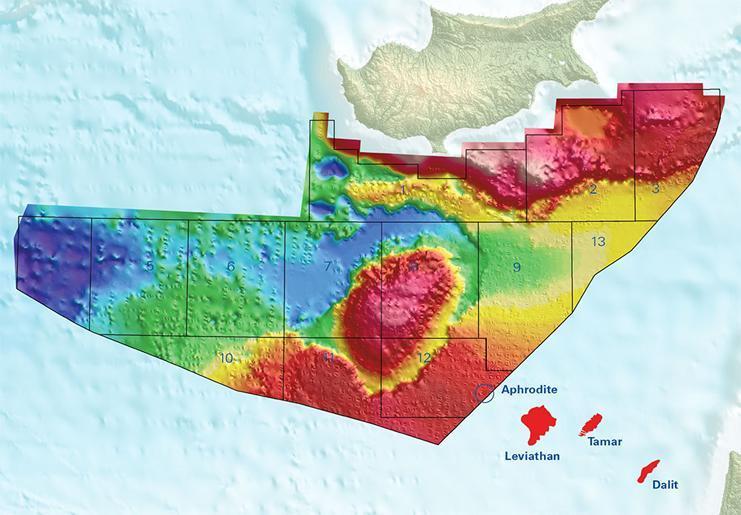
Photo - see caption
Blocks on offer in second licensing round - except Block 12, which is licensed to Noble Energy (Source: PGS)

According to Sylikiotis, 15 bids from five companies and ten consortia were submitted fornine of the 12 remaining blocks, the most popular being Blocks 9 and 2. Each bid was not restricted to one block, with 33 applications for licences made in total.

Block 9 neighbours the sizeable gas find in Block 12, US-based Noble Energy’s offshore concession. Noble announced last December that it had discovered an estimated 5-8 trillion cubic feet (tcf). The Cyprus Mail learnt that the only blocks not bid for were Blocks 1 (off the island’s southern coast), 4 (on the western fringes of Cyprus’ EEZ) and the smallest Block 13.
The companies involved hail from 15 countries: Canada, US, Israel, France, Russia, UK, Malaysia, Italy, Australia, Korea, Norway, Netherlands, Lebanon, Cyprus and Indonesia, with Israeli companies leading the pack in terms of the number involved. Sylikiotis noted that the results of the bidding process 'have surpassed our expectations', adding that the second bidding round was a very important moment, as it created prospects for prosperity, progress and peace for Cyprus and neighbouring countries.
He thanked all companies that expressed an interest, signifying the trust and respect they had for the Cyprus Republic and the fair procedures in place. He assured all present that the licensing process will be completed 'in full transparency' and in strict adherence to existing legislation and EU provisions. Sylikiotis highlighted that the present stage in Cyprus’ offshore hydrocarbon exploration activities was the result of the work of three consecutive governments, under presidents Glafcos Clerides, the late Tassos Papadopoulos, and incumbent Demetris Christofias. In the last decade, Cyprus has signed EEZ agreements with Egypt, Israel and Lebanon though the latter has yet to ratify it.
The second licensing round was launched last November and published in the EU Official Journal on February 11, 2012. It expired after a three-month bidding period. The bids will be evaluated by an advisory committee made up of permanent secretaries of the ministries of commerce, finance, foreign affairs and agriculture, along with the attorney-general, energy service director and geological survey department head. They will submit their recommendations to the minister who will take them to cabinet for a final decision within six months, after which negotiations with the preferred bidders will start. Licences are expected to be awarded some time in 2013, said Sylikiotis.
The list of companies and consortia involved reveals some 'big' names in the energy world, including Malaysian national company Petronas, Russian Gasprombank, French giant Total, Korean public company KOGAS, (one of the largest liquefied natural gas import companies in the world), Australian company Woodside Energy Holdings, ENI (Italy’s largest industrial company) and the US Marathon Oil.
From morning until the round’s closing time at 2pm, boxes and boxes of applications in different shapes and sizes were brought in trucks and buses hired by representatives of the 15 bidders. The boxes were stored in a 'strong room' at the ministry, kitted with an alarm system, cameras, and will remain under permanent police guard 24-hours a day for the next six months.
The significant interest shown in the second round is a far cry from that registered in the first in 2007 when only Noble was awarded a licence. There was some concern that Turkey’s sabre-rattling in the lead up to the end of the second round might put bidders off, but the results reveal that bids have been made for nearly all the blocks contested by Turkey.
With the Mediterranean basin estimated to hold trillions of cubic feet of gas, the prospect of tapping into those deposits could lead to unprecedented regional cooperation or more turbulence over maritime border disputes, particularly between Cyprus, Turkey, Greece, Lebanon and Israel. Just last month, Ankara gave the go-ahead to its state run oil firm TPAOto conduct offshore exploration in waters to the north, west and east of the island, and launched an on-shore drill in occupied Famagusta.
Turkish daily Sabah yesterday reported that Turkey’s National Security Council has decided to develop and modernise its naval bases in the Mediterranean. The paper reports that the numbers of frigates on duty in the Mediterranean will be increased from two to four, torpedo boats from three to five and coastguard ships from one to three.
Cypriots and Cypriot-based companies are involved in a number of bids submitted. Dimosthenis Mavrelis, a partner in the Chrysi Demetriadi law firm participating in bid no.9 with Israeli and Norwegian companies, hailed yesterday as a 'historic day' which will lead to economic growth and a 'new era' in Cyprus-Israel relations. 'We have worked very hard with our partners in Israel and Norway who are here and have confidence in the Cyprus Republic and its future,' he said.
Petrolina’s Dinos Lefkaritis said his company made an 'excellent choice' in choosing to collaborate with the American/Israeli joint venture Oak Delta to bid on one of the 12 blocks available.'Our partners are strong companies and we believe we’ve made a good enough bid which will at least make us contenders,' he said, noting that the newly formed companySigma was also part of the bid.
Cypriot-based companies are involved in bids from Winevia Holdings and RX-DRILL ENERGY CYPRUS, as well as the consortium PT Energi Mega Persada Tdk &Frastico Holdings Ltd. The latter bid is a concerted effort between companies from Cyprus, Indonesia and Canada. According to reports the Canadian interest in the consortium is represented by mammoth conglomerate Triple Five, which recently registered an interest in investing in ailing national airline Cyprus Airways.
THE FIVE COMPANIES AND TEN CONSORTIA BIDDING:
1. Petra Petroleum Inc (Canada)
2. Consortium: ATP East Med Number 2 BV (US), Naphtha Israel Petroleum Corp Ltd (Israel), DOR Chemicals Ltd (Israel) and Modi’in Energy Limited Partnership (Israel)
3. Total E&P Activities Petrolieres (France)
4. Consortium: Total E&P Activities Petrolieres [operator] (France) , NOVATEC Overseas Exploration & Production GMbH (Russia) and GPB Global Resources BV (Russia)
5. Consortium: Premier Oil [Operator] (UK) and VITOL (UK)
6. Consortium: Premier Oil [Operator] (UK), VITOL (UK) and Petronas (Malaysia)
7. Consortium: Edison International SpA [operator] (Italy), Delek Drilling Ltd Partnership (Israel) and Avner Oil Exploration Ltd Partnership (Israel), Enel Trade SpA (Italy) and Woodside Energy Holdings PTY Ltd (Australia)
8. Consortium: ENI (Italy) and KOGAS (Korea)
9. Consortium: CO Cyprus Opportunity Energy Public Company Ltd (Norway) and AGR Energy AS [Operator] (Israel)
10. Consortium: Oak Delta NG Exploration Joint Venture (US/Israel)
11. Consortium: Capricorn Oil (UK), Marathon Oil (US), Orange NASSAU Energie (Netherlands) and CC Energie SAL (Lebanon)
12. Winevia Holdings Ltd (Cyprus)
13. RX-DRILL ENERGY CYPRUS LTD (Cyprus)
14. Consortium: PT Energi Mega Persada Tdk & Frastico Holdings Ltd (Canada/Indonesia/Cyprus)
15. Emannuelle Geoglobal Rosario (Israel)

Thursday, April 19, 2012

Israel-Cyprus Deal on Gas as Lebanon Won’t Negotiate | Bloomberg

Israel-Cyprus Deal on Gas as Lebanon Won’t Negotiate

Israel’s biggest gas discovery, potentially turning the fuel importer into an exporter, is prompting a race by nations from Lebanon to Turkey to tap similar deposits in disputed waters of the East Mediterranean.
Noble Energy Inc. (NBL) is developing the Leviathan and Tamar fields off Israel that hold about 30 trillion cubic feet of gas, more than triple the U.K.’s remaining reserves and worth about $670 billion at today’s prices. The Houston-based company also is behind the Aphrodite discovery off Cyprus.
With the U.S. estimating the region holds about 122 trillion cubic feet of gas, enough to supply the world for one year, Lebanon and Turkey stepped up prospecting. Territorial disputes will have to be resolved first or the potential will remain untapped.
“All sides are looking at the eastern Mediterranean in a new light, but at the same time border disputes remain very important,” said Charles Gurdon, managing director of London- based risk assessor Menas Associates. “In the end, most of these cases will have to go to international arbitration.”
Countries in the region will have to temper disputes over maritime borders and sovereignty before companies such as BP Plc (BP/), Total SA (FP) and Royal Dutch Shell Plc (RDSA) can realize its potential as an export hub, according to the Observatoire Mediterraneen de l’Energie, an industry group.
“Joint exploitation of resources may change the whole political situation for the benefit of the region,” said Sohbet Karbuz, an oil and gas director at OME. “Energy can also become an extension of politics by other means.”

‘Implacably Opposed’

Lebanon and Israel have no defined maritime border, while Turkey doesn’t recognize the Greek Cypriot-led government of the Republic of Cyprus and relations with Israel have soured since Turkish activists died on a Gaza-bound flotilla two years ago. Tensions boiled over when Turkey sent an exploration vessel accompanied by warships and jets to stop Cyprus drilling for oil and gas last year.
“The sides are implacably opposed, whether it’s northern and southern Cyprus, whether it’s Turkey and Cyprus, whether it’s Israel and Lebanon,” said Gurdon at Menas, which advisesExxon Mobil Corp., BP and Chevron Corp. (CVX) among others. “In the end, people want to determine where the territory starts and stops.”
Cyprus will award permits covering 12 offshore blocks south of the island in its second licensing round, open for bids until May, according to Solon Kassinis, director of the energy service at the Ministry of Commerce, Industry and Tourism. Turkey also plans to start drilling for oil off northern Cyprus later this month, Energy Minister Taner Yildiz said in Istanbul today.
Egypt is planning to hold a licensing round in the Mediterranean after the Leviathan and Aphrodite discoveries, Gurdon said in a presentation in London today.

‘Second North Sea’

The East Mediterranean could become the “second North Sea” following Cyprus’s first offshore gas discovery last year, Kassinis said.
“The Lebanese have systematically refused to talk to us about border issues, whether territorial or maritime, and have unilaterally submitted their claims to the UN,” said Yigal Palmor, an Israeli Foreign Ministry spokesman. “We therefore have no choice but to submit our own claims to the UN as well, but the preferred solution is obviously direct negotiations.”
The North Sea, where Britain and Norway pump most of the oil and gas, is the world’s sixth-largest supplier of crude. While it still holds more than 26 billion barrels of oil equivalent resources, extraction peaked at the beginning of the last decade, U.K. government data show.

Cyprus-Israel Pipeline

As North Sea production declines, energy producers are looking to other regions, including the Mediterranean, to meet rising gas demand as countries seek alternatives to Russian supplies.
Cyprus is working with Israel, 300 miles (480 kilometers) south across the Mediterranean Sea, on the potential construction of a pipeline to connect their gas fields. The link would allow the countries to meet domestic demand before liquefying the fuel for export, Israeli Prime MinisterBenjamin Netanyahu said Feb. 16.
Israel is examining plans to ship liquefied natural gas, or LNG, as far as Asia after 2018, said Gerry Peereboom, a director at Noble Energy. Israel may also pump gas to Egyptian LNG plants, said Raafat El-Beltagy, deputy chairman of Egyptian Natural Gas Holding Co.

LNG Exports

“Israel is now in the position to decide whether they’ll allow the companies that hold these gas resources for export to the international market,” said Richard Quin, an analyst on the Middle East and North Africa at Wood Mackenzie Consultants Ltd. “The challenges of exporting LNG from Israel are quite substantial. It could easily be a decade for exports actually to happen.”
The Aphrodite field spans waters between Cyprus and Israel. Noble and other international oil companies have stayed away from northern Cypriot waters as tensions with Turkey persist, maintaining divisions that have split the island since Turkey invaded the north in 1974. Turkey has said development projects should await resolution of Cyprus’s political status.
“The issue of Turkey remains absolutely critical, because Turkey doesn’t recognize Cyprus’s rights” to award licenses, Menas’s Gurdon said. “Turkey may adopt gunboat diplomacy and it may be difficult for Cyprus to search for and develop fields which are close to northern Cyprus.”
The European Union, which only recognizes the Republic of Cyprus, has withheld elements of Turkey’s EU membership talks as it calls on the country to acknowledge the island nation and help resolve its ethnic divisions. Turkey has said it’s open to collaboration to exploit the region’s resources and market the fuel abroad.

‘Affordable Gateway’

“Potential cooperation may at last bring peace and stability to the region,” said Ayse Berris Ekinci, acting deputy director for energy at Turkey’s Ministry of Foreign Affairs. “Turkey represents the safest, most feasible and affordable gateway for the eastern Mediterranean natural gas resources to the European markets.”
Turkey’s state oil producer Turkiye Petrolleri AO struck an agreement with Shell in November to explore off the city of Antalya, away from Cypriot waters. Turkey has also received interest from companies including Exxon Mobil, BP, Chevron, Total and ConocoPhillips (COP) to explore in its east Mediterranean waters, according to the Energy Ministry.

EU Presidency

Cyprus is due to take over the EU’s rotating presidency on July 1, potentially boosting its clout in negotiations. The island’s Aphrodite discovery is only 65 kilometers from Israel’s Leviathan field, the world’s biggest offshore gas find of 2010. The Tamar field off Israel, discovered a year earlier, is due to start output next year.
“The latest discoveries will certainly be a source of dialogue between the countries,” said Rob West, a London-based oil analyst at Sanford C. Bernstein & Co. “It’s just not clear whether the dialogue will involve disputes over resource entitlement or rather cooperation.”
Claims over gas fields in the region’s Levant Basin extend to Lebanon, Israel’s northern neighbor and 100 miles across the sea from Cyprus.
Lebanon has said some Israeli fields may stretch into its waters and has asked the United Nations to intervene to prevent a conflict over exploration areas as the country gears up for its first offshore oil and gas bidding round this year. Lebanese militant group Hezbollah, which fought a war with Israel in 2006, has repeatedly pledged to protect the nation’s offshore resources.
To contact the reporter on this story: Eduard Gismatullin in London ategismatullin@bloomberg.net
To contact the editor responsible for this story: Will Kennedy at wkennedy3@bloomberg.net
Link to article: 4/2012 | Israel-Cyprus Deal on Gas as Lebanon Won’t Negotiate | Bloomberg