Friday, November 8, 2013

Cyprus in Plan to Develop a Natural Gas Industry | New York Times

Cyprus in Plan to Develop a Natural Gas Industry

  • FACEBOOK
  • TWITTER
  • GOOGLE+
  • SAVE
  • E-MAIL
  • SHARE
  • PRINT
  • REPRINTS
LONDON — Cyprus, seeking to rebuild its economy after the collapse of its banking industry, will announce on Thursday an agreement with Total, the French oil giant, to develop a plant to liquefy natural gas, the Cypriot energy minister said.
Andreas Manolis/Reuters
The Cyprus energy minister, Yiorgos Lakkotrypis, is a former Microsoft executive.
Many questions remain, including where the gas would come from, given that Cyprus’s own offshore natural gas reserves have yet to be developed — or even fully explored. But the government is intent on liquefying natural gas to turn it into a shippable export product, part of a long-term strategy to pull the economy out of the deep recession that followed its financial crisis this year.
The deal with Total is highly speculative, though. The pact will be nonbinding and will depend on Total’s discovering gas in the offshore areas it is now exploring.
“Total follows with interest and supports the government’s efforts to promote the development of a gas liquefaction project in Cyprus, whose membership in the E.U. is a major asset,” the company said.
Building the facility, which could cost as much as $6 billion, “is not going to solve all the problems,” the energy minister, Yiorgos Lakkotrypis, a former Microsoft executive, said in an interview on Tuesday in London. “But it is going to go a long way for psychological reasons.”
Converting natural gas to liquefied form makes it feasible to export by ship, rather than requiring the construction of new pipelines.
Cyprus is still years away from having a natural gas industry of any sort. But the involvement of Total would give credibility to the effort. “What it potentially brings is an experienced player into the monetization of Cypriot gas,” said Catherine Hunter, an analyst at IHS, a market research firm in London.
Cyprus also probably hopes that Total would confer a kind of European seal of approval to ward off potential opposition from Turkey, which still controls the northern part of the island, a legacy of its 1974 invasion of Cyprus. Turkey objects to the Cypriot government’s awarding exploration tracts to foreign companies on the grounds that any oil and gas wealth should be shared with the island’s Turkish Cypriot residents.
Ms. Hunter said a liquefied natural gas, or L.N.G., plant on Cyprus might be eligible for European Union funds on the grounds that a new source of gas within Europe would contribute to energy security and create competition for dominant suppliers like Gazprom of Russia.
But Turkish hostility is only one of the obstacles to Cyprus’s gas export ambitions. The biggest question mark lies over the availability of the gas itself.
Noble Energy, based in Houston, found a large gas field called Aphrodite in deep water off southern Cyprus in 2011. Originally the amount of gas was estimated at five trillion to eight trillion cubic feet. But after Noble conducted further testing, Mr. Lakkotrypis said, the estimate was lowered to 3.6 trillion to six trillion cubic feet.
Either way, that is a lot of gas. If Cyprus used gas instead of burning fuel oil for most of its needs, about 10 percent of that would be enough to power the country for 20 years, Mr. Lakkotrypis said.
Yet it may not be enough to supply an L.N.G. facility by itself, analysts say. The industry rule of thumb is that a single-unit L.N.G. facility, which chills the gas to a liquid, requires about six trillion cubic feet of gas to make the plant economically viable.
A two-unit plant, which Mr. Lakkotrypis said could cut unit costs 30 percent, would require about 12 trillion cubic feet, far more than Cyprus’s estimated reserves.
It is possible that more gas will be found. Both Total and the Italian energy company Eni are exploring. Cyprus is in an area called the Levantine basin, where exploration began only in the last couple of decades and which the industry thinks contains large amounts of gas.
Cyprus has already identified the site for the L.N.G. plant at Vasilikos, an industrial zone on the south coast of the island, and is beginning the design work. Noble has been helping with that effort, but Mr. Lakkotrypis says that Total would probably be in charge. “Only the likes of Total can be the operator,” he said.
In some respects, building the plant could take on a life of its own. Mr. Lakkotrypis said construction would employ about 4,000 people — enough to make at least a small dent in the 75,000 unemployed. Cyprus, he said, is already on its way to becoming a regional hub for the energy industry.
Noble, which has Israeli partners, has found a very large field called Leviathan in Israeli waters not far from the boundary with Cyprus. J. Keith Elliot, Noble Energy’s head of eastern Mediterranean operations, said in an interview this summer that the company thought there was more to find in its own exploration block and in others. “In our view there is quite a bit of exploration left to do,” he said.
But finding more gas would take time. There have been hopes that Israeli gas from Leviathan might go to a Cypriot plant, if built. But talks on the subject have yet to produce an agreement, and Israel has many options — including building its own L.N.G. facilities and sending gas by pipeline to its neighbors.
There are questions, though, about who would buy the gas. Demand for L.N.G. has been weak in Europe of late and the production of shale gas in the United States could soon lead to American exports. “Global dynamics in the L.N.G. market paint an uncertain picture for future demand,” said Katan Hirachand, managing director for energy project finance at Société Générale in London.


Link to article: http://www.nytimes.com/2013/11/07/business/international/cyprus-in-plan-to-develop-a-natural-gas-industry.html?_r=1&

Greece encouraged by Ionian Sea hydrocarbon survey | UPI

Greece encouraged by Ionian Sea hydrocarbon survey

Nov. 8, 2013 at 12:32 AM   |   0 comments

ATHENS, Greece, Nov. 8 (UPI) -- Greece this week hailed the preliminary results of an oil and gas survey in the Ionian Sea showing similarities to earlier finds in Italian and Albanian waters.Greek Energy Minister Yiannis Maniatis, speaking Wednesday at a petroleum industry conference in Athens, said the first conclusions of a seismic survey carried out in the Ionian and south of Crete by the Norwegian company Petroleum Geo-Services were promising.
Maniatis said the initial findings revealed geological analogies between the underwater area of the North Ionian and Italian and Albanian regions of the sea where oil and natural gas have already been found, the Greek daily To Vima reported.
In the findings, PGS reported "a diversity of geological characteristics of the Greek subsoil and a corresponding number of potential petroleum resources" -- potentially good news for the cash-strapped country, which is seeking to improve its financial situation by ramping up its oil and natural gas production.
Greece says it believes it has at least $600 billion of gas and oil reserves, while the U.S. Geological Society has estimated the Ionian Sea holds 22 billion barrels of oil off western Greece.
The report notes that the 1981 discovery of the Katakolon oilfield in the Ionian is evidence of the presence of a system of hydrocarbons off the western Peloponnese region, while the area south of Crete remains unexplored.
PGS was chosen last year to undertake the seismic surveys after it performed similar work off the coast of Cyprus that led to the tapping of the first hydrocarbon reserves in the island's exclusive economic zone.
A research vessel collected data for three months in an 86-square-mile zone stretching from the northern Ionian Sea to 125 miles south of Crete. Since then, it has been evaluating the data.
The first round of concessions in the area are slated to be tendered in mid-2014, and if there are takers, drilling could start the same year.
Maniatis said the government has already started the process of opening the doors for three plots, while negotiations with short-listed companies are in the final stages. The exploration rights to exploit hydrocarbons there are expected to be ratified in the coming weeks by the Greek Parliament, broadcaster ANT1 reported.
The findings were revealed at the American Association of Petroleum Geologists conference in Athens, which drew a roster of oil majors, including E.ON, Chevron, Eni, Exxon Mobil, Gazprom, OMV, RWE, Shell, Petronas, as well as foreign diplomats.
Maniatis used the occasion to declare Greece had "entered the map of global energy" and to assure the industry players the country is stable and eager to work with them to develop its resources.
He stressed its energy institutional framework is in line with EU regulations and oil industry standards, and asserted Greece's corporate tax "can only be reduced and not increased," To Vima reported.
"Greece is an extremely attractive place to invest in a sustainable and contemporary context and invites companies to invest while respecting the environment," he said.


Read more: http://www.upi.com/Business_News/Energy-Resources/2013/11/08/Greece-encouraged-by-Ionian-Sea-hydrocarbon-survey/UPI-99101383888720/#ixzz2kZaAzdE7


Link to article: http://www.upi.com/Business_News/Energy-Resources/2013/11/08/Greece-encouraged-by-Ionian-Sea-hydrocarbon-survey/UPI-99101383888720/

Thursday, November 7, 2013

Cyprus, French energy company sign memorandum on natural gas plant | Shanghai Daily

Cyprus, French energy company sign memorandum on natural gas plant

NICOSIA, Nov. 7 (Xinhua) -- Cyprus and French giant Total energy company signed a Memorandum of Understanding (MoU) on Thursday to develop a natural gas liquefaction terminal on the south shores of the eastern Mediterranean island.
According to an official announcement, the MoU sets down Total's commitment to give priority consideration to using the plant for liquefaction and export of natural gas to Europe and Asia.
It states that the two sides agreed to cooperate in connection with the future use of the liquefaction plant taking into consideration Total's views on the development of the project.
Total has secured two offshore blocks in the Cyprus marine Exclusive Economic Zone and is expected to start exploratory drilling for both gas and oil next year.
Cyprus has also signed a similar MoU with Texas-based Noble Energy, which has already tapped a gas reserve in a separate block, estimated to contain between 3.5 and 5.5 trillion cubic feet of natural gas.
Cyprus is negotiating with Israel to jointly develop the liquefaction plant which will also serve exports by Israel, which has tapped huge amounts of natural gas in the Levantine basin of the eastern Mediterranean.
Gas reserves in Cyprus' Exclusive Economic Zone are estimated at over 60 trillion cubic feet, but the gas is not expected to reach land before 2020.
Economically depressed Cyprus is pinning its hopes for economic recovery on income from the building of the liquefaction plant, which will provide employment opportunities for thousands of unemployed people and future gas sales.
The project, along with constructing an undersea gas pipe, is estimated at 10 billion euros (13.4 billion U.S. dollars).
The European Commission recently approved three projects of common interest which concern Cyprus, one of them being a feasibility study for a natural gas pipeline from Cyprus to Greece.
Cyprus entered into a 10-billion euro bailout agreement with international lenders earlier this year and its banking system was dealt a near-mortal blow when it was forced to recapitalize by using uninsured depositors' money.
A group of technocrats from the European Commission, the European Central Bank and the International Monetary Fund is set to conclude a second review this year of the Cypriot economy on Thursday, which government sources expect to be successful.
This will entitle Cyprus, which has been shut out of international markets since May 2011, to receive more loan money to finance its government operations.


Link to article: http://www.shanghaidaily.com/article/article_xinhua.aspx?id=178727

Wednesday, November 6, 2013

Ukraine ramps up shale revolution, signs $10bn gas deal with Chevron | Russia Today

Ukraine ramps up shale revolution, signs $10bn gas deal with Chevron

Published time: November 06, 2013 11:20
(L-R sit) Chevron's General Manager for Europe Derek Magness , Ministrer of Ecology and Natural Resources of Ukraine Eduard Stavytsky and Viktor Ponomarenko, Chairman of the National Joint Stock Company "Nadra Of Ukraine" sign documents as (L-stay) Geoffrey Pyatt, US Ambassador to Ukraine, and President of Ukraine Viktor Yanukovych (C) and James Jones (R) Process Control Consultant at Chevron attend during the ceremony in Kiev on November 5, 2013. (AFP Photo)
Kiev and Chevron have agreed to jointly develop Ukraine’s shale gas in a joint venture estimated at $10 billion, another step towards Ukraine's 2020 goal of energy independence.
The government signed a 50-year production-sharing agreement (PSA) with Chevron to extract shale gas in western Ukraine, Energy Minister Eduard Stavytsky said at a press interview in Kiev on Tuesday. 
"This is one more step towards achieving full energy independence for the state. This will bring cheaper gas prices and the sort of just prices which exist (elsewhere) in the world," Stavytsky said after signing the agreement with Chevron chief Derek Magness.
Ukraine’s is close to signing a EU trade association agreement in Vilnius in late November, a move which could trigger a new series of trade and gas wars with Russia, who in October demanded Kiev 'immediately' pay its $882 million gas debt. 
“The cost of gas production will be at least three times lower than what Ukraine is paying for in imports,”Stavytsky told journalists Tuesday.
Chevron will invest $350 million in the first 2 or 3 years to explore shale gas in the Olesska field, which is located across two regions – Lviv, which borders Poland, and Ivano-Frankivsk, which shares a border with Romania to the south.
The 2,000 square mile Olesska oil field is expected to produce 5 billion cubic meters per year, and at full capacity could hit 8-10 billion cubic meters, Stavytsy said.
Together with the Yuzivska shale field located in the eastern Donetsk region, over five years, Ukraine could reap an extra 11 to 16 billion cubic meters of gas, according to government officials. Royal Dutch Shell signed a PSA on January 1 2013 to develop Yuzivska shale reserves.
To compare, Naftogaz, Ukraine’s financially troubled state gas utility in October said 17 billion cubic meters of gas would be ‘enough’ to heat Ukraine through the winter.
European countries hope to match the US shale gas boom, and the energy independence it has brought. However, Europeans have shown much more political dissent towards fracking, and already, Chevron has pulled out of shale exploration deals in Lithuanian and Romania.  
Ukraine sees shale gas as a win-win: they can both cut costs and move away from Russian gas. 

Gas debts

It’s the end of the year again, which means Ukraine, as it appears to do every year, is scrambling to pay its gas bill to Russia. Ukraine has started to pay off its $882 million debt for Russian gas throughout the year, but not very much, Gazprom spokesperson Sergei Kupriyanov told Interfax on Wednesday, who called it just a ‘drop in the ocean’.
“Ukraine has an extensive non-payment credit history for Russian gas, piling and restructuring debt,”Aleksey Grivach, deputy director of Gas Projects at Russia's National Energy Security Fund, told RT.
“However, after signing the 2009 ‘pre-pay’ contact, Naftogaz has become a more disciplined buyer. Since then, there have been a few minor delays, but they have managed to settle on good terms,” Grivach said.
Since the ‘pre-pay’ contract was established, Ukraine has excessively complained of ‘expensive’ gas prices, which average around $400 per thousand cubic meters for Russian gas.
Ukraine currently imports more than half of its gas from Russia. It is speeding up its effort to diversify its supply, and has looked at different exporters, fracking, new offshore projects in the Black Sea, as well as new LNG terminals and pipes to diversify supply. 
“The other alleged Ukrainian projects to diversify supply - an LNG terminal in Odessa, the White Stream pipeline from Azerbaijan, or the new idea of an LNG pipeline in Croatia- none of these are serious,” Grivach said, unconvinced by the feasibility of these plans
At the press conference Stavytsky said his government is discussing other PSAs with Exxon, ENI, and Electricite de France SA, for exploration of the Black Sea shelf.


Link to article: http://rt.com/business/ukraine-chevron-shale-gas-284/

Cyprus Joins the Middle East | Daniel Pipes


N.B.: 
Washington Times title: "Cyprus rides a troubled sea of oil and gas opportunity."


Link to article: http://www.danielpipes.org/13588/cyprus-oil-gas

Tuesday, November 5, 2013

PIPES: Cyprus rides a troubled sea of oil and gas opportunity | Washington Times

By Daniel Pipes, Tuesday, November 5, 2013

The republic of Cyprus has entered into the maelstrom of the world’s most volatile region, thanks to newfound gas and oil reserves, combined with an erratic Turkish foreign policy and a civil war in Syria. Even as leaders of this Mediterranean island show skill dealing with these novel threats and opportunities, they need support from a strong U.S. Navy, something not now available.

Cypriot underwater gas and oil discoveries follow directly on ones found earlier in Israeli seas, located adjacent to them and uncovered by the same American (Noble) and Israeli (Delek, Avner) companies. The current estimate of 5 trillion cubic feet of natural gas, as well as some oil, has a value estimated at $800 billion, a huge sum for a small country whose current gross domestic product is a mere $24 billion.

The great majority of this energy will likely be exported to Turkey or Europe. A pipeline to Turkey would be cheapest and easiest but so long as Turkish troops continue to occupy 36 percent of Cyprus, this will not happen. A recent court decision permitting the Israeli government to decide what quantities of energy to export now offers other possibilities: Cyprus could swap gas with Israel that then goes to Turkey, or the two allies could jointly build a liquefied natural gas terminal in Cyprus.

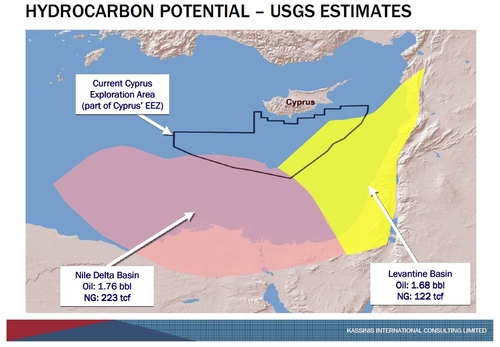
Eventually, should Egypt, Gaza, Lebanon and Syria find gas and join the modern world, they too could take part, turning the area between Egypt and Cyprus into a truly major resource. According to the U.S. Geological Survey, the contiguous Nile Delta and Levantine basins together contain an estimated 345 trillion cubic feet of natural gas and 3.44 billion barrels of oil.

These newfound reserves can help either solve or inflame the Cyprus problem. The Cypriot government wisely delimited its maritime boundaries with Egypt in 2003, Lebanon in 2007 and Israel in 2010. It has contracted new exploration to France’s Total, Italy’s Eni and South Korea’s Kogas. Energy-hungry Turkey looms over this treasure, however. Ankara wants its northern Cyprus puppet-state to receive part of the income from the new reserves, while Turkey’s 1974 invasion of the island raises fears that its erratic and roguish prime minister, Recep Tayyip Erdogan, might invade the republic’s territory.

Mr. Erdogan and Foreign Minister Ahmet Davutoglu have pursued an ambitious foreign policy of “zero problems with neighbors” which, ironically, has led instead to zero friends. Strained relations with Georgia, Armenia, Azerbaijan, Iran, Iraq, Syria, Israel, the Palestinian Authority, Saudi Arabia, Egypt and Serbia raise the prospect of Ankara reverting to an older Turkish pattern of lashing out at Cyprus and Greece. In both cases, for instance, it could encourage disruptive refugee flows.

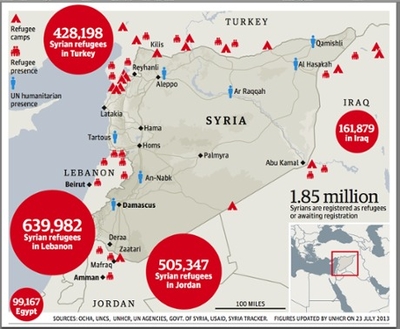
This is where the brutal civil war underway in Syria, just 70 miles away, enters the equation. So far, that conflict has not had a major impact on Cyprus, but the island’s proximity, its minimal defense capabilities, and its membership in the European Union make it exceedingly vulnerable (an illegal immigrant setting foot on Cyprus is close to reaching Germany or France). The 2.2 million refugees from Syria since 2011 have so far bypassed Cyprus in favor of Lebanon, Jordan, Turkey, Egypt and Iraq, in that order. However, this could quickly change if the Alawites living closest to Cyprus take to the sea in sizable numbers, or if Ankara encourages Syrians to emigrate to northern Cyprus and then sneak across the border into the republic.

Unlike nearby Israel, which is also surrounded, Cyprus lacks either a military option or protective fences: The personnel of the Turkish armed forces, about 700,000 strong, approximate the size of the entire population in the republic of Cyprus — about 850,000. Put another way, Turkey’s population outnumbers that of Cyprus by nearly 100 times. Nicosia can, however, create alliances, especially with Israel, to enhance its security. Israel in turn gains by combined gas operations, strategic depth for its air force and a diplomatic friend. As an aide to Cyprus’ President Nicos Anastasiades told me, “We are Israel’s ambassador in the European Union.”

So far, so good. The U.S. Navy, though, has been hollowed out in the Mediterranean Sea to the point that Seth Cropsey, a former Navy official, describes the 6th Fleet as just a command ship in Italy and a few ballistic-missile destroyers in Spain. This force urgently needs to be revitalized to support America’s Levantine allies as tensions further heighten in their immediate region.

Daniel Pipes (DanielPipes.org), president of the Middle East Forum, recently visited Cyprus.

SOURCE

Turkish Companies' Efforts To Import Israeli Natural Gas Face Diplomatic Roadblock | International Business Times

Turkish Companies' Efforts To Import Israeli Natural Gas Face Diplomatic Roadblock

on November 04 2013  

Turkish energy companies are trying to import Israeli natural gas via pipeline, but a diplomatic chill between the two countries has made such deals difficult.

The eastern Mediterranean is experiencing a natural gas boom with recent discoveries in the Levant Basin, a stretch of sea that extends from the coasts of Cyprus, Israel, Lebanon and Syria, which is estimated to contain 122 trillion cubic feet of gas. As a result, Israel is in the midst of a natural gas bonanza and ready to export the commodity to its neighbors.
Turkey relies on such exports and its demand for natural gas is only growing. The country gets natural gas through pipelines that originate in Azerbaijan, and Istanbul is looking to diversify its energy portfolio, unless it involves Israel.
Relations between the two countries have been strained since May 2010, when Israeli navy commandos stormed a ship that was seeking to break an Israeli naval blockade of Hamas-controlled Gaza and killed nine Turkish activists. That strain has affected efforts of Turkish energy companies to diversity Turkey's energy sources.
However, recent comments by leading Turkish officials suggest that Zorlu and Turcas may have problems doing a deal for Israeli natural gas imports.Most recently, Turkey's Zorlu Energy has reportedly been in talks with Israeli firms, Reuters reported Friday. Also, Istanbul-based Turcas Holding last month offered Israel $2.5 billion to construct a 292-mile pipeline to bring natural gas from Israel to Turkey.
“We have issues with Syria, an issue based on a principle,” Ahmet Davutoglu, the Turkish foreign minister, said. “But let me say it clearly: The Turkish government has never cooperated with Israel against any Muslim country, and it never will.”
Davutoglu's comments came in response to a recent Israeli strike on a Syrian missile base. Many in the West and in Israel view the comments as hypocritical as Turkey itself heavily criticizes Syria and calls for military action against the regime. The comments are the latest in a string of antagonistic tirades made by leading Turkish officials. Back in 2011, Recep Tayyip Erdoğan, the Israel-denouncing prime minister of Turkey, warned about Israel’s and Cyprus’ plans to work together in developing the energy resource in the region.
"Israel cannot do whatever it wants in the eastern Mediterranean. They will see what our decisions will be on this subject,” Erdoğan said. “Our navy attack ships can be there at any moment."

SOURCE

Monday, November 4, 2013

Total to get involved in Cypriot LNG terminal | Kathimerini

Total to get involved in Cypriot LNG terminal

Total SA, already a strategic partner of the Cyprus government, has expressed an interest in extending its cooperation with Nicosia to the processing of natural gas, with the Cypriot Cabinet on Wednesday approving a draft memorandum of cooperation with the French energy giant, according to sources cited by Kathimerini in Cyprus.
The MoU concerns Total’s participation in planning and developing a liquefied natural gas (LNG) terminal to be constructed at Vassiliko, on the island’s southern coast.
Nicosia has already signed a deal with Noble for the same project, with ENI-Kogas set to follow.


Link to article: http://www.ekathimerini.com/4dcgi/_w_articles_wsite2_1_16/10/2013_523473

Lebanese Gas Stuck In Political Mud | Forbes


10/31/2013

A seismic vessel is pictured off the coast of Lebanon on September 24, 2012. Seismic surveys of Mediterranean waters off Lebanon's southern coast suggest they contain 12 trillion cubic feet of natural gas, Energy and Water Minister Gebran Bassil said. (Image credit: AFP/Getty Images via @daylife)


This week, Lebanon’sEnergy Minister Gebran Bassil announced that his country’s offshore gas potential could end up being even more plentiful than first announced, telling Reuters that “under a probability of 50 percent, for almost 45 percent of our waters has reached 95.9 trillion cubic feet of gas and 865 million barrels of oil.” Bassil’s comments present a rosier assessment than earlier studies. However, they shouldn’t be confused with actual progress when it comes to exploiting Lebanon’s claims to the new-found Eastern Mediterranean offshore bonanza. Instead, the new findings highlight just how much Beirut is missing out on due to a lengthy list of political and fiscal challenges, most notably a political paralysis that has frozen the exploration efforts in place for much of the year.

Gov't delaying Leviathan development | GLOBES

Gov't delaying Leviathan development

The foot-dragging in approving a gas pipeline terminal and allowing gas exports has prevented the gas field's development.

29 October 13 19:12, Amiram Barkat
Almost three years have passed since the Leviathan natural gas discovery, but there has still be no official announcement of a discovery. Leviathan's rights holders - Noble Energy Inc. (NYSE: NBL), Delek Group Ltd. (TASE:DLEKG), and Ratio Oil Exploration (1992) LP (TASE:RATI.L) - have not yet received a lease from the government to allow them to develop the gas field.
To obtain a lease, the rights owners must present a development plan for the field, but they cannot do so because the government has not yet decided where the terminal for the gas delivery will be located.
Regulatory progress in Israel's planning and building commissions is among the slowest in the world, while the developers rush ahead. The main challenge facing the Netanyahu government is the construction of a gas pipeline terminal from Leviathan, 130 kilometers offshore, on a 100-dunam (25-acre) onshore site.
Prime Minister Benjamin Netanyahu has instructed Prime Minister's Office director general Harel Locker to personally supervise this critical project. Since 2010, the planners have been able to obtain provisional permits to carry out detailed examinations of two sites, one adjacent to the Meretz sewage treatment site at Emek Hefer, and the other adjacent to the Hagit power station at Yokne'am. Local residents at both sites have been waging an effective public campaign against the plan, demanding that the handling of gas be carried out at offshore facilities.
The target date for approving the National Outline Plan - Gas Terminal was August 2013. As of now, no approval seems likely before August 2014. The government needs four years to approve a 100-dunam natural gas terminal. In the same period of time, energy exploration companies discovered the Tamar field, developed it at a cost of $3.5 billion, and have contracts to sell almost all of the gas to the Israeli economy.
$125 million has already been spent on planning for Leviathan's development. Just last week, the green light was given for gas exports, when the High Court of Justice dismissed the petitions against the government's decision to export gas. A major question mark still hangs over exports: whether the government will levy a special tax on the exports component, which is not currently taxed. The issue has been under discussion for three months at the Ministry of Finance and Israel Tax Authority.
Meanwhile, Leviathan's developers are blocked from selling gas to the domestic market. For two years, Antitrust Authority director general David Gilo has been examining whether Leviathan is a cartel, and until a decision is made, it will not be possible to sell Leviathan gas to Israeli customers.
Published by Globes [online], Israel business news - www.globes-online.com - on October 29, 2013
© Copyright of Globes Publisher Itonut (1983) Ltd. 2013


Link to article: http://www.globes.co.il/serveen/globes/docview.asp?did=1000889597

US Tries to Mediate Lebanon-Israel Maritime Border Dispute | Al Monitor


Official Israeli circles said that the Lebanese government is in the process of granting licenses to explore for oil and gas in a Mediterranean region that Israel claims as part of its exclusive economic zone (EEZ).

SUMMARY Israel claims that Lebanon is planning to grant gas exploration licenses in a disputed area, while the United States is working to mediate a solution.

Helmi Moussa, October 2, 2013

With that announcement, the Israeli-Lebanese dispute over their maritime border is out in the open, despite news that US mediation had achieved great successes in resolving that issue.

The subject of oil and gas in the eastern Mediterranean was a main meeting topic between Israeli Prime Minister Benjamin Netanyahu, who visited Washington on Oct. 1, and US Vice President Joe Biden, who is handling that issue. The results of that meeting have not been announced.

Official Israeli sources informed the Globes economic newspaper that Lebanon is trying to impose facts in disputed areas between Lebanon and Israel. Thesources pointed out that “Lebanon is about to award offshore oil and gas exploration licenses in areas that encroach on Israel’s EEZ.” Globes said that it is not yet known how Israel will deal with those licenses, which may spark a border dispute with Lebanon.

Israeli international law experts are urging their government to quickly announce its objections to the Lebanese moves either legally or militarily.

At the beginning of September, Lebanon announced its intention to grant tenders for licenses to explore for oil and gas in five blocks in Lebanese waters. But Israeli experts who analyzed the coordinates on the Lebanese map “discovered” that the southmost area to be licensed, Block 9, is in Israeli waters. The newspaper said that this area is the most attractive and the most likely to yield significant gas discoveries.

The official responsible for oil in the Israeli Ministry of Energy and Water, Alexander Varshavsky, presented his analysis at an international oil conference in Cyprus two weeks ago. He said that Israel has refrained from taking a similar step and has not granted licenses to explore for oil and gas in the disputed area.

The dispute between Israel and Lebanon is over the maritime demarcation line separating two EEZs. Both sides agree that Ras al-Naqoura lies on the common land border. But they disagree on the angle of the line drawn from Ras al-Naqoura toward the Cyprus EEZ. The disputed area is 850 square kilometers [528 square miles], in the shape of a triangle.

In 2010, Lebanon presented a map of its maritime boundaries to the UN. Israel did the same for its borders a year later. The map signed by Lebanon, Israel and Cyprus is the basis of the dispute. The United States is trying to get the parties to resolve the dispute peacefully.

Israeli border expert David Kornbluth said that Israel may lose its claim on the disputed area if it does not respond to the Lebanese move. “Judicial practice says that the state that doesn’t object to such a step is considered to have withdrawn its claim.”

To assert Israel’s claim, he called for naval patrols in the area, issuing a formal communication, requesting that a third country mediate and informing international companies that participate in the bidding licenses that this area is disputed. It is known that dozens of international companies, most of which refuse to deal with Israel, fear for their interests in the Arab region and are making bids to Lebanon.

On the other hand, it was learned that US Vice President Joe Biden delayed his speech to the Jewish American J Street organization by an hour and a half because he was meeting with Israeli Prime Minister Benjamin Netanyahu. The meeting took place at the White House in the presence of US Secretary of State John Kerry, after Netanyahu’s meeting with US President Barack Obama. US media barely mentioned the meeting, but some considered it more important than Netanyahu’s meeting with Obama. The meeting with Biden was about the oil and gas fields in the eastern Mediterranean. Kerry and Biden are focusing US efforts in this regard.

It is obvious that this is not only about Lebanon and Israel. The US strategy for the eastern Mediterranean gas discoveries is related to Turkish, Cypriot and Greek relations, and the relations between them and Israel as well as Lebanon. A US strategy developed by the Marshall Institute and adopted by the US administration is based on exploiting the gas issue to conclude political settlements and resolve the disputes between countries in the region. The strategy calls for a gas pipeline from Israeli and Cypriot fields to Turkey, and that Lebanon can later benefit from the pipeline after it starts extracting gas.

In that context, Biden met with the Cypriot president last week after he met with the Turkish prime minister a month ago. Cypriot newspapers said that these moves were aimed at resolving the conflict between Turkey and Cyprus over their EEZs and gas fields.

ORIGINAL ARTICLE 
اقرا المقال الأصلي باللغة العربية
SOURCE