Thursday, February 27, 2014

'Turkish-Cypriot conflict ultimate obstacle to Eastern Mediterranean energy development' | Jerusalem Post

'Turkish-Cypriot conflict ultimate obstacle to Eastern Mediterranean energy development'

02/27/2014 18:28

EU expert: Natural gas potentials of Cyprus, Israel could strengthen ties with neighboring countries by forging partnerships.

gas rig
The Homer Ferrington gas drilling rig. Photo: REUTERS
The question of Cypriot sovereignty presents an obstacle that inhibits energy advancements in the entire Eastern Mediterranean region, a Greek-German expert on European Union integration and enlargement issues said Wednesday.

Dr. Angelos Giannakopoulos, an adjunct professor of sociology at Germany’s University of Dortmund, was addressing a Tel Aviv University forum on energy cooperation in the Eastern Mediterranean and its potential impact upon EU integration and enlargement. He said that, although the natural gas potentials of both Cyprus and Israel could strengthen relations with neighboring countries by forging partnerships, the ongoing 40-year conflict between Turkey and Cyprus inhibits these collaborations from moving forward.

“Existing and future alliances, as well as cooperation potentials deriving from energy strategies of all countries concerned, will surely have an impact on still unsolved political conflicts,” Giannakopoulos said.

Giannakopoulos has for years conducted extensive research regarding European identity, relations between the EU and Turkey, modernization in southeast Europe, corruption and anti-corruption in the EU, and most recently, energy cooperation in the Eastern Mediterranean.

In addition to his position at Dortmund, Giannakopoulos is currently lecturing in Tel Aviv University’s European Studies Program.

Currently the natural gas reservoirs particularly of interest to potential export recipients are Israel’s approximately 535-billion cubic meter Leviathan basin and the Cypriot 198-b.cu.m.

Aphrodite reservoir, adjacent to Leviathan. The largest stakeholders in both of these reservoirs are Houston- based Noble Energy and the Israeli Delek Group.

Although the Israeli government approved a policy capping exports at 40% on June 23, 2013, the question remains to whom the Leviathan partners will export the gas that has not been reserved for the domestic market.

The CEO of Australian firm Woodside, which is likely to join the Leviathan partnership at the end of March, last week expressed a preference to construct a floating liquefied natural gas (F-LNG) facility off Israel’s shore for exports to Asia.

Nonetheless, a medley of other export options is still under exploration – such as a pipeline to Turkey with or without distribution to the European market, usage of a future Cypriot onshore LNG facility, usage of largely abandoned Egyptian LNG facilities, and various combinations of all of the above.

Despite the less-thanenormous quantities of gas discovered thus far in the Eastern Mediterranean compared to those in other parts of the world, Giannakopoulos argued that the region is “well placed to become the future natural gas supply of the EU, constituting an important alternative to Russian or Iranian gas, which will provide energy security to the EU.”

Although the gas discovered thus far in the Eastern Mediterranean belongs to Israel and Cyprus, both Greece and Turkey stand the chance to become important distribution hubs should the providers want to reach the European gas market, he argued.

“Israel, but also Greece and Cyprus as EU member states, can critically support the two pillars of EU energy policy – differentiation of energy sources and differentiation of energy routes,” Giannakopoulos said.

The Trans Adriatic Pipeline (TAP ), which will connect Greece via Albania to Italy and Western Europe, will transform the country into an important site for energy transfers to the EU, he explained. While politically, Greek hubs via Cyprus might be a feasible outlet for Israeli gas, a much more affordable export route would a pipeline to the shores of Turkey, Giannakopoulos stressed.

“Turkey may use its strategic position as an important transit country as well as its decisions regarding pipelines to achieve its wider aims in foreign policy,” he said, noting that a Turkish supplies could provide an attractive alternative to the EU over Russian and Iranian resources.

Yet at the moment, it is impossible to realize such a pipeline plan due to a number of political obstacles, such as the tense relationship between Israel and Turkey, he explained.

The first and foremost obstacle, however, is the dispute between Turkey and Cyprus over Cypriot sovereignty, according to Giannakopoulos.

Turkey does not recognize the existence of the Republic of Cyprus, and occupies the northern portion of the island. In return, the Republic of Cyprus has closed down all airports and seaports in the northern portion of the island.

In the current situation, Turkey would not accept Israeli gas that crosses through Cypriot waters, while the Cypriots would likewise prohibit Israel from funneling gas through their waters to Turkey, Giannakopoulos explained. However, there is no other path through which a pipeline carrying gas could convey the resource from Israel to Turkey.

In order for any energy cooperation in this sense to advance, Turkey would need to at the very minimum officially recognize the Republic of Cyprus, and the republic would need to open up the ports of the northern portion of the island, he explained. Ultimately, Giannakopoulos said, he envisions the eventual creation of two federal Greek and Turkish Cypriot states under one larger government, but that this longterm goal would not be a prerequisite for Eastern Mediterranean energy advancements.

Yet Giannakopoulos said he sees the recent relaunch of negotiations between Turkey and Cyprus, as well as simultaneous American pressure to solve the issue, as a positive sign.

“Settlement on Cyprus will greatly facilitate cooperation on energy matters among Israel, Cyprus, Turkey, and Greece,” Giannakopoulos said. “A settlement will significantly reduce security threats to gas exploitation exports, while at the same time reducing costs.”


Link to source: http://www.jpost.com/Enviro-Tech/Turkish-Cypriot-conflict-ultimate-obstacle-to-Eastern-Mediterranean-energy-development-343803

Tuesday, February 25, 2014

Israel: Regional Deals Amid Shaky Politics | Natural Gas Europe


February 25th, 2014 12:05am


Texas-based Noble Energy announced1 on 19 February the signing of gas agreements with Jordanian companies. Noble will supply natural gas from the Tamar field to Arab Potash and Jordan Bromine for use in their facilities near the Dead Sea. Sales are expected to commence in 2016, date that coincides with the expected completion of initial infrastructure work on the pipeline that will connect Israel to Jordan. According to Noble's press release, the price will have a floor of at least USD6.5 per thousand cubic feet of natural gas with an upside linked to Brent crude oil prices. The American giant expects gross revenues to reach USD500 million and actual sales to vary according to the quantities of natural gas purchased and oil prices at the time of sale. Noble Energy operates Tamar with a 36% working interest. Other partners in the estimated 10 Tcf Tamar include Isramco Negev 2 with a 28.75% working interest, Delek which holds 15.625%, Avner with 15.625% and Dor Gas Exploration which holds 4%.

ΔΕΝ ΕΙΜΑΣΤΕ ΣΟΒΑΡΟΙ ΚΑΙ ΧΑΣΑΜΕ ΤΟ ΤΕΡΜΑΤΙΚΟ | MEGA TV


Link to source: https://www.youtube.com/watch?v=nFwIeQtl7hM

Monday, February 24, 2014

Noble Energy to establish NIS 12 million energy training center at Ruppin College | Jerusalem Post

Noble Energy to establish NIS 12 million energy training center at Ruppin College

02/24/2014 17:10

The center will offer vocational training programs, workshops and seminars on natural gas.

noble energy center rupin
Mock-up of Noble Energy Center for Energy Studies at Rupin College. Photo: Courtesy
Noble Energy, a major player in Israel’s offshore gas industry, will be establishing a NIS 12 million center for training programs at the Ruppin Technological College, the company announced on Monday.

As part of a strategic cooperation agreement with the Emek Hefer-based college, Noble is set to fund the center, which will offer courses on natural gas and energy beginning in October. The center will provide vocational training programs, workshops and seminars for the Israeli market, as well as specialized courses for practical engineers, the company said.

Cook will serve as the company’s professional consultant to the center.

“We are excited and proud to come together with Ruppin Technological College to fulfill our shared vision of creating a center that will train the generation of the future, and provide an overall, professional and practical answer to the increasing needs of the industry, onshore and offshore,” he said.

Houston-based Noble Energy is one of the primary stakeholders in the largest of Israel’s eastern Mediterranean natural gas reservoirs, the 282 billion cubic meter Tamar and the neighboring 535b. cu. m.
Leviathan. Noble currently owns a 39.66 percent chunk of Leviathan, which will likely decrease to 30% if an expected deal with the Australian firm Woodside goes through at the end of March.

At Tamar Noble holds a 36% share.

Ever since Noble and its partners discovered the sizable amounts of gas off Israel’s shores, the company’s executives have spoken of strengthening opportunities in the local market.

“The gas reservoirs off the coast of Israel are an enormous opportunity for Israeli industry,” said Bini Zomer, director of corporate affairs and joint ventures at Noble Energy. “Over and above the saving of billions in energy costs, the tax revenues received by the state and cleaner air for the country’s residences, the natural gas industry brings additional workplaces to the economy.”

These workplaces, Zomer said, would be “directly in the gas industry itself, and indirectly [through] the increase in supporting service industries.”

He added that the changes would “also reduce production costs in high-energy plants.”

According to Zomer, the beginning of the gas flow from the Tamar reservoir in the spring of 2013 prompted “a spurt in demand for qualified workers” in the gas and oil industries.

“The professional training courses offered by the new center are intended to meet the increasing demand accompanying continuation of the conversion process, the development of the Leviathan reservoir and so on,” he said.

The center at Ruppin will be designed to train employees at different levels in the natural gas sector, with the country’s industry expected to employ thousands of medium- and long-term workers as infrastructure continues to develop.

Operators, installers, inspectors and welders will be critical to the gas distribution system, as well as to factories and at-sea drilling platforms, Noble said.

In its first stage, the center will train professionals through programs developed by the Natural Gas Authority and the Economy Ministry’s vocational training department.

In the second stage it will train professionals on marine drilling infrastructure and pipeline networks extending from sea to land.

Subject to final Economy Ministry approval, one track, set to begin in October, will target practical engineers, who will receive diplomas in mechanical engineering and certification to operate and install natural gas facilities.

The program will also offer professional training for facility installers, operators and welders.
Tammy Zuckerman, executive director of the Ruppin Technological College, expressed appreciation for the collaboration with Noble Energy, stressing the importance of building qualified manpower to equip a growing natural gas industry.

“For some time we have been looking for a strategic partner to help us develop the next technology branch – natural gas energy – so this collaboration with a leading player like Noble is the fulfillment of a dream,” Zuckerman said. “We are in the final stages of submitting documents to the supervisory authorities in order to open the different training tracks at Ruppin already this coming October.”


Link to article: http://www.jpost.com/National-News/Noble-Energy-to-establish-NIS-12-million-energy-training-center-at-Ruppin-College-342393

Thursday, February 20, 2014

Cyprus' Role in East Med: Plan A and Plan B | Natural Gas Europe


February 20th, 2014 

Cyprus' Role in East Med: Plan A and Plan B

Cyprus still harbors big hopes for the installation of an LNG plant at Vasilikos, according to Charles Ellinas, until recently Executive President, Cyprus National Hydrocarbons Company, but his country's role in the Eastern Mediterranean natural gas context may be receding.

Mr. Ellinas offered an exclusive interview on those plans to Natural Gas Europe at the European Gas Conference 2014 in Vienna, Austria.

Commencement of construction at Vasilikos could have begun in 2016, potentially creating a lot of jobs for the island's shaky economy and eventually bringing gas to Cyprus for generating electricity before the end of the decade. Mr. Ellinas observes: “These plans seem to be slipping away from us,” explaining that the amount of gas in Cyprus' Aphrodite field is not enough to proceed with the regional Vasilikos plan.

“If we were to proceed in the near future we would need gas from Leviathan – from Israel – but that may not be a priority in Israel right now: Delek Group and Noble Energy have published preliminary plans for a phased development of Leviathan, and while these might involve Cyprus later on it is not a priority issue; there appears to be a higher priority to export gas to Turkey than to Cyprus,” he explains.

For Cyprus, he says, without Leviathan gas it could add another 4 years to to its plans, “because the gas will then only come from the exploration activities of TOTAL and ENI, given that ENI will start their exploration drilling towards the end of this year and TOTAL early next year, with results becoming available towards the end of 2015. Then they'll need to follow up with appraisal drilling, so it will be the end of 2017 at the earliest before they're in a position to make plans for export and field development. That takes us well into the future.”

On that basis, Mr. Ellinas estimates that it could be 2024-25 before Cyprus can export gas.
“In my view, we should be knocking on the door of Israel more forcefully and trying to use this very good political relationship to convince them that sending gas to Cyprus will be beneficial for everyone,” he says,

“But it's slipping away from us and we may end up going into the longer term.”

If the idea for an LNG plant at Vasilikos recedes, one other tactic, he offers, would be to encourage Noble to proceed with the development of Cyprus' Aphrodite field based on exports to other markets rather than on LNG. “There are quite a few local markets in the Mediterranean Sea which can absorb the amount of gas we have in Aphrodite – that should also be a priority issue, but I think in a way we're closing a door to that because we've recently released a new tender for interim gas supply to Cyprus.

“If that tender succeeds, we will be locked into gas imports over the next 7-10 years, and if that happens, any other development that involves bringing gas to Cyprus earlier than that will not be possible.”

Still, he says that all the options should be looked into, in the context of a strategic gas plan.
“Ultimately, though, whatever happens the gas will be developed and there is sufficient gas in the East Med, I believe, over 120 tcf based on indications so far. This could make an impact on Europe because of its location. We will know by the end of 2015 how much there is,” says Mr. Ellinas.

He opines that TOTAL and ENI specifically chose Cyprus because of its location, proximity to Europe, and ultimately will develop the gas from the region and take it to their own markets in Europe. “I think the trick for us in Cyprus as a country, is how to benefit from it, because if we're not careful they will lead developments and we will just take what comes our way.”

Referring to price estimates at the conference in Vienna, Mr. Ellinas says there was much talk of Europe's gas demand and prices, which were not very high: “USD 9.50-10/MM Btu after 2020 will make it a challenge for us, because if we were to export our gas to Europe and production costs were USD 8-9, the margins are minute. So all of these issues need to be looked into and planned carefully.”

Despite this, he says, he believes Europe will become the main destination for Cypriot gas, because of the likely delays in developing the gas fields. “If it happens that way the Eastern LNG markets will be saturated,” he explains. “There are too many players concentrated on selling to the Far East markets and if they're saturated then the next port of call is Europe, which politically would be good for us.”

Mr. Ellinas is frank about the intentions of Cyprus: “We want to become an energy hub. If we don't manage to get the LNG project at Vasilikos off the ground, Cyprus will still become an energy center – not necessarily a hub – in terms of all of the service companies that will be servicing the offshore developments whose natural place to base their operations will be Cyprus, as a country within the EU, because its much more challenging to go to Lebanon, Israel, Egypt.”

Cyprus, he emphasizes, is within the European Union and thus has harmonized laws, banking systems, etc. that obey European regulations. “So Cyprus provides a good base for these companies. Right now, most of the activity is exploration for the next 4-5 years, but after that companies will be looking at production.”
There's a lot to do, he says.

“If the region has over 120 TCF of gas there will be a lot of development. If Cyprus becomes a center for these service companies it's going to generate a lot of activity, a lot of employment which is desperately needed – unemployment this last year may reach 20%. So all of these things are needed and encouraged.
“From that standpoint, we will get something valuable, but will get more if we develop our gas in a more planned way,” he said.

Not so long ago, things looked different, he recalls. “Israel needed us and they kept telling us as much in 2012-13, but unfortunately last year the companies involved, especially Delek, lost patience. So the last plans I've seen from Noble and Delek for the development of Leviathan are comprised of three phases:

Phase I exports to Israel and local markets like Palestine and Jordan – they've signed gas sales agreements with Palestine; Phase II is to go with floating LNG (FLNG) and the negotiations with Woodside to join them are progressing reasonably well,” he says,.

(Editor's note: on 10 February Woodside Petroleum Ltd and the Leviathan partners - Delek Group Ltd. Ratio Oil Exploration and Noble Energy – inked a Memorandum of Understanding detailing the terms of an impending joint venture deal.)


“However, Israel won't be able to move to the next stage before the end of the year, citing the taxation problems as well as monopoly investigation issues as potential obstacles ” opines Mr. Ellinas.

“Nevertheless, these companies have already developed initial plans. Phase III may involve more regional markets like Turkey, but potentially also Cyprus, but Cyprus is not high up on the list right now. Nevertheless there is still an opportunity” he explains.

Another Phase III option, according to him, is Egypt as LNG terminals are sitting there idle, but this would entail major risks given the political instability there.

“If they go for FLNG, it immediately satisfies the export requirement and in Phase III they have the luxury of deciding what to do without needing to rush into anything before they're sure.

“Delek is pushing very hard for gas to Turkey,” he adds, “and they're looking at various options. If the political issue between Cyprus and Turkey persists and they can't put a pipeline from Leviathan to Turkey I believe they may go for CNG at least initially: it's feasible.

“In the meanwhile, developments in Cyprus EEZ may be delayed by up to 4 years. By that time I believe that FLNG will become more established, and will become a major competitor to any land-based facilities at Vasilikos.”

He says that projects like Prelude FLNG are coming to completion, meaning the experience with such facilities will be there, and unit costs will come down; use of FLNG in the East Med may become a standard, and this could mean that TOTAL and ENI use it instead of land-based LNG.

Mr. Ellinas offers, “I still feel that if we in Cyprus worked on Leviathan’s Phase III hard now and convinced the Israelis that we'd be the best choice for Phase III it could benefit both countries, but what I'm seeing so far is not pointing in that direction but in the direction of Turkey before anything else. Even then, Cyprus may still be accommodated as Israel, for security reasons, would prefer to go for multiple options”

This is prickly for the fact that Cyprus, he says, would not accept a pipeline going through its exclusive economic zone (EEZ) until the Cyprus problems are resolved. “If they reach a CNG agreement, they could still export a lot of gas to Turkey using CNG.”

With over three decades of international experience in the hydrocarbons business in lead positions, mostly based in the UK, Charles Ellinas says he wanted to take his expertise back home to Cyprus: “That's why I went back; I was hoping to be able to do that, but islands tend to be isolated and expectations that one might have about how things should develop or happen can run up against it.”

Small, island countries, he says, are driven mostly by politics, not necessarily by technical and commercial issues. “Still, East Med and Cyprus have a lot to look forward to and the gas resources of the region will be developed sooner or later for the benefit of all. I still want to contribute to this.”


Link to source: http://www.naturalgaseurope.com/cyprus-east-med-european-gas-conference

Wednesday, February 19, 2014

The Diplomatic Potential Of Eastern Mediterranean Gas | Forbes

A few months ago, this blog noted a push by Cypriot leaders to present the immense gas potential of the Eastern Mediterranean as a diplomatic catalyst in a fragmented region. After decades of tension and division at home, Cyprus reasoned that billions in energy revenue and the potential for energy independence would be enough to revive and stabilize reunification talks between the island’s two parts after nearly 40 years of division. Further, they saw the trillions of cubic feet of natural gas in nearby waters as a way to ease tensions throughout the region.

Now, with reunification talks back on the table with U.S. support, Cyprus’ positive diplomatic outlook is gaining steam. This week, Cypriot President Nicos Anastasiades told the Associated Press that reuniting the Mediterranean island was the surest way to ensure energy cooperation throughout the region, allowing Turkey easier access to plentiful gas reserves and even put them on track towards closer relations with Israel.

“A Cyprus settlement, reached as quickly as possible, will assist not only in Israeli (gas export) planning, but also contribute greatly to restoring relations with Turkey,” Anastasiades said.

The President’s comments as Turkey continues to express strong reservations about Cypriot exploration efforts in the region, insisting that any energy projects include the Turkish Republic of Northern Cyprus (recognized by only Turkey). After sending naval vessels to Cypriot waters shortly after Nicosia announced offshore plans, Turkey has kept up the pressure on both the leadership in Nicosia and energy firms working alongside them. Earlier this month, Ankara was accused of halting a Norwegian ship commissioned by Nicosia to conduct offshore surveys for energy exploration, alleging that they had been told to “abandon position” and “leave Turkish waters”.

Insisting that moving current projects forward and continuing reunification talks will be beneficial for all involved, Anastasiades continued by saying, “This would be very significant for Turkey and at the same time significant for Israel and it could be another way Cyprus contributes to peace in the region”.

This is hardly the first time Cyprus has worked to set themselves up as a well-intentioned middleman in the tense Eastern Mediterranean. Since first announcing plans to pursue their own exploration efforts as well as explore potential export projects with Israel, Nicosia has worked to calm the waters of the Eastern Mediterranean, offering to get involved in discussions with just about everyone from Cairo to Tel Aviv to Beirut. However, the need to create and sustain a stable production and investment environment has never been greater for the cash-strapped island nation.

With Israel exploring export options to move the 40 percent of available reserves it has designated for sale beyond its own borders, Cyprus needs to find funding for a proposed Liquefied Natural Gas plant if they want to establish themselves as a viable transport hub in the region, as well as offering a cheaper and more flexible export alternative to a Turkish-bound pipeline. However, with a price tag near $10 billion, completing a plant will require substantial investment from beyond Nicosia – a reality that will require more political and financial stability than the country currently offers. Cyprus has received some international support for the LNG project, including an MOU signed with Italy’s energy giant Eni.

By linking the reunification talks to gas benefits for Turkey, Cyprus is presenting the Eastern Mediterranean’s gas potential as a win for everyone involved and the best reason to move towards ending the 38 years of division. Cyprus is reunited and Turkey gets access to cheap, plentiful gas. What more could Ankara want?

Cyprus currently boasts access to almost half of an estimated 122 tcf of natural gas below waters in the Eastern Mediterranean. According to a U.S. Geological Survey, the country’s ability to exploit the offshore reserves could bring in about $400 billion in revenue over the coming years, not to mention address any domestic needs they might have.

Despite the President’s recent comments, there is a long and difficult path ahead. Turkey remain anxious both about Cyprus’ offshore progress and challenges at home. Even as talks have resumed with both Nicosia and Israel, Ankara has reportedly moved towards expanding its naval capabilities in the region. Considering tension at home, unrest in Syria and uncertainty in Egypt, this is hardly surprising, but it does not exactly send the message that Turkey is preparing for peace.

Link to source: http://www.forbes.com/sites/christophercoats/2014/02/19/the-diplomatic-potential-of-eastern-mediterranean-gas/

China eyes stake in Cyprus gas plan | South China Morning Post

China eyes stake in Cyprus gas plan

Island's natural gas reserves attract Chinese with possible investment in an export terminal
PUBLISHED : Wednesday, 19 February, 2014, 1:33am
UPDATED : Wednesday, 19 February, 2014, 1:33am
7bb972b3a73abc634e2b221df7e26ff2.jpg

China is looking at playing a role in Cyprus' multibillion-dollar plans to develop the island's natural gas reserves, including possible investment in a liquefied natural gas (LNG) export terminal.
Cyprus hopes to attract large investors to take a stake in its gas fields, an option which a Chinese delegation is in Cyprus to discuss.

"There is very strong interest from China … in energy, in the whole value chain, upstream, downstream and midstream," Cypriot Energy Minister George Lakkotrypis said yesterday.

He said the Chinese delegation includes China Shipbuilding Industry Corp.

He said delegates were interested in the development of an LNG export terminal, including potentially a floating LNG facility. "The Chinese delegation will also discuss taking a stake in Cypriot gas fields," said a source with the delegation.

China is seeking to access new gas sources around the world as its energy demand rises and the government encourages industry to move to cleaner gas from coal.

Italian energy major ENI is also interested in Cyprus' gas fields, and is set to sign a memorandum of understanding with the government over the construction of an LNG export terminal.

ENI has already signed an exploration and production-sharing contract with the government to search in three offshore areas, with exploration expected to begin in the second half of this year.

In hopes gas can buoy the economy, which was rescued by an international bailout in March 2013, Cyprus has been planning the Vasilikos LNG export plant since United States-based Noble Energy discovered the Aphrodite field.

The estimated US$10 billion needed to build the LNG export terminal and infrastructure would be the largest investment in the island's history.

However, the project was thrown into doubt when drilling results revealed smaller reserves than initially hoped.

Mean reserve estimates were reduced to five trillion cubic feet from seven tcf, which is not enough to justify building the LNG project unless more gas is found. The plans also face opposition from Turkey, which has said it would oppose any attempt to pre-sell Cypriot gas before a settlement over the divided island is found.

Link to source: http://www.scmp.com/business/commodities/article/1430692/china-eyes-stake-cyprus-gas-plan

Israel-Jordan sign $500 million natural gas deal | The Times of Israel

Accord may grow into $30-billion partnership for Israel to become Jordan’s main supplier; deal with Turkey also possible

February 19, 2014, 9:43 pm 


Workers on the Israeli Tamar gas processing rig, 24 kilometers off the southern coast of Ashkelon, October 11, 2013 (photo crdit: Moshe Shai/Flash90)

Israeli and Jordanian officials signed a deal Wednesday under which Israel will supply $500 million worth of gas to the Hashemite kingdom from the Tamar natural gas field in the Mediterranean.

The supply is set to start in 2016, and to continue over a 15-year period. Ultimately, however, the deal may be expanded to a $30-billion mammoth partnership, under which Israel would become the major supplier of Jordan’s gas needs, Israel’s Channel 2 news reported.

Woodside CEO: Offshore LNG export likely for Leviathan | Jerusalem Post

Woodside CEO: Offshore LNG export likely for Leviathan

02/19/2014 17:08

Australian drilling giant Woodside Energy signed deal with Leviathan gas partners to acquire 25 percent of basin for roughly $2.71 billion.

Offshore Leviathan gas field.
Offshore Leviathan gas field. Photo: (Albatross)
Exports from the Leviathan reservoir will likely occur through an offshore, floating liquefied natural gas platform rather than via onshore options previously considered, the prospective Australian partners announced on Wednesday.

“We thought it would be an onshore based facility for LNG and it has now moved to an offshore facility,” Woodside CEO Peter Coleman said early Wednesday morning, during a webcast press conference in Perth about the company’s 2013 financial results.

After over a year of discussions, Australian drilling giant Woodside Energy signed a nonbinding agreement with the Leviathan gas reservoir partners to acquire 25 percent of the basin for roughly $2.71 billion. The memorandum of understanding, which is expected to become a fully termed agreement on March 27, builds upon a December 2012 agreement in principle in which the parties had called for Woodside to acquire a 30% stake of the reservoir.

With ample hydrocarbon supplies for decades of domestic use and export, Leviathan is estimated to contain about 535 billion cubic meters (18.9 trillion cubic feet) of natural gas and 34.1 million barrels of liquid condensate.

Ahead of Woodside’s probable entrance as a partner in March, Noble Energy holds 39.66% of the Leviathan field, Delek Group subsidiaries Delek Drilling and Avner Oil Exploration each have 22.67% and Ratio Oil Exploration owns 15%. Assuming the final agreement is concluded as planned, Woodside will hold 25%, Noble Energy will own 30%, Delek Drilling and Avner will each own 16.93% and Ratio will hold 11.12%.

Woodside would operate any liquefied natural gas development for the reservoir, but Noble Energy would remain the exploration operator, according to the recent memorandum of understanding.

Although an export policy was approved by the government on June 23, 2013, capping exports at 40%, the question has long remained to whom the Leviathan partners will export the gas.

Partners of the adjacent Tamar reservoir signed an export agreement with two Jordanian companies on Wednesday, and in early January the Leviathan partners signed another agreement to sell gas from Leviathan to the owners of a future Palestinian power plant.

For exports outside of the immediate neighborhood, however, experts have debated whether a pipeline to Turkey, an LNG plant onshore in Israel, a shared LNG plant onshore in Cyprus, a floating LNG plant, or some combination of these options would make the most sense. Through the Turkish pipeline, the gas could reach European buyers, while through an LNG plant, the hope would be to reach the Asian market.

“The good thing about Leviathan over the past 15 months since we’ve been in negotiations with the joint ventures is really what I would say the expansion of the option of exports out of Leviathan,” Coleman said. “The first part of that is really getting clarity from the Israeli government with respect to how much can be exported, and that clarity is now in place.”

Coleman made clear that a number of options continue to be discussed and explored, among them pipelines to Turkey, Cyprus, Jordan and Egypt.

“All of those things are in play at the moment,” he said. “What I’d say is that they’re all moving in parallel.”

While the partners are moving forward on the pipeline options, Coleman emphasized that at the same time, they are working actively to develop the LNG options, in particular the floating LNG choice.

“The domestic gas project will actually have a floating gas production facility, and that facility will have the ability to export gas by a pipeline,” he said.

Link to source: http://www.jpost.com/Enviro-Tech/Woodside-CEO-Offshore-LNG-export-likely-for-Leviathan-341913

Tuesday, February 18, 2014

Gas bonanza for Cyprus hostage to strategic battle with Turkey | The Telegraph

Gas bonanza for Cyprus hostage to strategic battle with Turkey

Officials say there may be as much as 60 trillion cubic feet of natural gas in Cypriot waters, enough to turn the 1.1m islanders into the "Norwegians" of the Mediterranean

Gymnasium with its columned Palaestra, Ancient city of Salamis, courtyard, Salamis ruins, Salamis, Cyprus
Cyprus has carried out a diplomatic pivot, tightening its relations with Israel and abruptly ending its historic neutrality to apply for NATO's Partnership for Peace status Photo: Alamy
Cyprus has vowed to press ahead with the exploration and drilling of its vast gas reserves despite threats from Turkey to block extraction by military force if there is no prior deal to reunify the divided island.
"The whole world, including the United States, recognises the right of Cyprus to exploit the right of its own exclusive economic resources," said Ioannis Kasoulides, the Cypriot foreign minister.
Mr Kasoulides said Turkey is not a signatory to the UN Convention on the Law of the Sea and does not recognise the principle that islands have their own seabed, but its naval actions in the region have so far been calibrated. Two weeks ago the Norwegian ship MV Princess, exploring in Cypriot waters, was intercepted by a Turkish warship and forced to leave.
"We are still far away from gunboat diplomacy, even for Turkey. Groups like Noble Energy, ENI and Total would not be investing billions in exploration here if they really thought Turkey was going to stop them," he said.
Mr Kasoulides said the US-based Noble Energy had already found five trillion cubic feet (TCF) of natural gas in a single bloc of the Aphrodite field to the south of the island, enough to transform the country's long-term economic prospects following last year's traumatic collapse of the banking system, and more than enough to pay off a €10bn rescue from the EU-IMF Troika.
There is potential for more in the huge fields of the Eastern Mediterranean shared with Israel, the biggest discovery of natural gas in the world this century. Italy's ENI plans to drill in neighbouring blocs this year, and France's Total next year.
Officials say there may be as much as 60 TCF of natural gas in Cypriot waters, in theory enough to turn the 1.1m islanders into the "Norwegians" of the Mediterranean once production comes on stream around 2022. All Europe consumes 18 TCF a year.
The discoveries have raised the political temperature in the region. Cyprus has carried out a diplomatic pivot, tightening its relations with Israel and abruptly ending its historic neutrality to apply for NATO's Partnership for Peace status, which lets it draw on NATO capabilities.
"The Eastern Mediterranean has become the focus of attention for the whole world. We are in the frontline of a volatile area and we are upgrading our responsibility. We have done a number of things that are not in the public domain," said Mr Kasoulides.
In theory, the gas fields could prove a catalyst for a breakthrough in the strategic impasse over the island, still divided between Greek and Turkish communities by the 180-kilometer "Atilla line" that runs through the middle of Nicosia. The makeshift wall is patrolled by UN blue berets 40 years after Turkish troops invaded to protect Turkish Cypriots in the North and forestall a plan for unification with Greece.
Turkey needs the region's gas badly to free itself from Russia's stranglehold. A pipeline to Turkey would help to restore tattered relations between Ankara and Jerusalem and stabilise the region, with some diplomats touting the idea of a "grand bargain" to settle a clutch of disputes in one go.
Yet the bonanza could equally inflame conflict. Turkey has claimed the blocs to the south of Cyprus as far as Egyptian waters. "If poorly managed, Cypriot gas could harden political divisions. Ankara does not recognise the government in Nicosia and has threatened military force if Cyprus allows drilling in the disputed maritime zone," said Rem Korteweg, an energy expert at the Centre for European Reform.
The US has begun to intervene, pushing the two sides to renew peace talks. The Greek and Turkish Cypriots have signed a document laying out general principles.
Mr Kasoulides said this text is entirely different from the "Annan Plan" to end the partition that was rejected by the Greek side in a referendum in 2004 soon after Cyprus had secured its place in the EU, though accepted by Turkish Cypriots.
"It talks about one country and a single sovereignty, and does not permit a legal divorce," he said, predicting that the Greek Cypriots are likely to vote "Yes" this time, provided there is no attempt to exploit the economic crisis to twist their arms.
Both Mr Kasoulides and the Greek Cypriot leader, Nicos Anastasiades, supported the Annan Plan then and are now viewed as open to a settlement. Most diplomats say the rejection of the plan was a missed opportunity that is now coming back to haunt Cyprus.
Turkey's deputy-premier, Ali Babacan, played down hopes of a breakthrough last week, telling The Telegraph that the EU had lost leverage over Greek Cypriots by letting them join before the island was reunited. "The incentive for a deal evaporated," he said.
The great unknown is how Cyprus can bring its gas to market. The government is banking on a $10bn liquefied national gas plant to be built by private groups so that it can ship LNG to Asia, avoiding dependence on a cheaper $3bn pipeline to Turkey that would leave Cyprus vulnerable to pressure tactics.
But Cyprus has not yet found enough certain gas to justify the investment. The minimum threshold for LNG plants is six TCF. Cyprus must find more reserves or team up with the Israelis. Mr Kasoulides said Cyprus has not ruled out a Turkish pipeline to go along with an LNG plant, but that would require bumper discoveries.
Geroge Shamas, head of the Cyprus Energy Regulatory Authority, said the gas find is a strategic game-changer that poses all kinds of risks, including the Dutch Disease or Resource Curse. "We must not become sheikhs," he said, proposing a sovereign wealth fund to recycle revenues out of the country based on the Norwegian model.
Whatever happens, Cyprus is will be not drawing down any rents from gas for another eight years, and may never do if the island remains divided. It is a fair bet that no major oil company will sink funds into final development as long as Turkish warships patrol in anger.


Link to source: http://www.telegraph.co.uk/finance/newsbysector/energy/oilandgas/10647382/Gas-bonanza-for-Cyprus-hostage-to-strategic-battle-with-Turkey.html

'Israel, Cyprus cooperation could impact gas market' | Jerusalem Post

05/08/2013 By SHARON UDASIN, GREER FAY CASHMAN

Cypriot president stresses natural gas "can become the driving force" for partnership between Israel, Cyprus.

President Shimon Peres with Cypriot counterpart Nicos Anastasiades, May 2013.

President Shimon Peres with Cypriot counterpart Nicos Anastasiades, May 2013.
Photo: Courtesy President’s Residence
 
Only by combining their forces will Israel and Cyprus be able to make a significant dent in the global natural gas economy, the Cypriot energy minister stressed on Tuesday.

“We feel that through a close collaboration with Israel we will be able to be a major player in the world energy market, something that for each country individually might be too hard to achieve,” said Energy, Commerce, Industry and Tourism Minister Yiorgos Lakkotrypis.

Monday, February 17, 2014

ENI, Cyprus to Sign LNG MOU | Natural Gas Europe

The Cypriot minister of Energy Yiorgos Lakkotrypis met with the high management of ENI in order to finalise an MOU agreement for the participation of ENI in the island’s LNG project. A similar document was previously signed with Total and Noble and Total. Cyprus’ multi-billion dollar LNG plant would allow the island the flexibility needed to export its gas to the customers of its choice. The project is now pending further exploratory results that would ensure its commercial viability. Cyprus’ Aphrodite field in Block 12 of the island’s exclusive economic zone was downsized by Noble to a range of 3.6 to 6 tcf of natural gas, quantities that do not justify alone the pursuit of the endeavor.
Total, Eni-Kogas are scheduled to start exploration activities towards the end of 2014. The recent meeting between the Cypriot minister and the italian giant indicated however that the company is now considering commencing its work offshore the island around August 2014. The MOU between the Cypriot government and ENI is only pending a decision of the council of ministers and is expected to be signed shortly.
The discovery of additional amounts of gas under the island’s seabed would ensure the completion of the LNG terminal in Vasiliko on schedule and without the help of other Eastern Mediterranean players. Cyprus had previously urged Israel to pool costs with the island in order to complete the plant but Israel has not to date formulated a decision in this direction.

ENI’s accelerated involvement could be explained by the recent resumption of talks on ending the division of the island. Backed by the Americans, the talks will be held under UN supervision. Both President Nicos Anastasiades and his Turkish counterpart Dervis Eroglu seem to want a solution to the Cyprus problem.
While all previous talks failed to reach a solution, the existence of abundant reserves of natural gas in the region could this time play a tremendous role in solving the Cyprus problem. Should the division of the island be resolved, a pipeline to Turkey through Cyprus’ EEZ would allow Eastern Mediterranean gas to reach a Russia-dominated Europe.

The complicated regional geopolitics have threatened to deter investors from injecting large amounts of funds in the development the Levant basin’s hydrocarbon riches. Also remains pending the Israeli-Lebanese maritime border conflict. While the current rivalries and disputes have not completely halted gas explorations, a resolution is necessary for the long term prosperity of the energy industry in the region.

Karen Ayat is an analyst focused on energy geopolitics in the Eastern Mediterranean.  Email Karen on ayat_karen@hotmail.com. Follow her on Twitter: @karenayat


February 17th, 2014 12:05am Posted In: Natural Gas, LNG, News By Country, Other Countries, Featured Articles, Cyprus


Link to source: http://www.naturalgaseurope.com/eni-cyprus-lng-mou

C'tee rejects onshore natural gas terminal | Globes

C'tee rejects onshore natural gas terminal

Tamar gas drilling

The Central District Planning and Building Commission says the natural gas terminal should be offshore.


The Central District Planning and Building Commission today recommended to the National Planning and Building Commission to reject plans for an onshore natural gas terminal, and said that the terminal should be offshore. The recommendation is a major victory for the residents of the Hefer Valley and Yoknea'm who oppose the proposed onshore terminal.

The National Planning and Building Commission will now consider the matter and thousands of objections to the plan that have been lodged by the region's residents.

The Prime Minister's Office hopes the gas terminal plan will be approved no later than the summer. Prime Minister Benjamin Netanyahu has said that the building of the terminal is a national strategic priority because at present all natural gas passes along one single pipeline.

The planning team hired by the Ministry of Interior, under architect Gideon Lerman, recommended handling some of the gas at offshore terminals and the remainder at two sites suitable for the construction of onshore gas terminals: one near the wastewater treatment facility in Emek Hefer, and one near the Israel Electric Corporation power plant at Hagit near Yokne'am.

Published by Globes [online], Israel business news - www.globes-online.com - on February 16, 2014

© Copyright of Globes Publisher Itonut (1983) Ltd. 2014


Link to source: http://www.globes.co.il/en/article-ctee-rejects-onshore-natural-gas-terminal-1000917582

Saturday, February 15, 2014

Επιταχύνουν τις γεωτρήσεις οι Ιταλοί | Φιλελεύθερος

Επιταχύνουν τις γεωτρήσεις οι Ιταλοί

Η ΕΝΙ υπογράφει για τερματικό στην Κύπρο

Λευκωσία: Θετικές αλλαγές στο  σκηνικό των υδρογονανθράκων έφερε χθες η παρουσία υψηλόβαθμων στελεχών της Ιταλικής ΕΝΙ στην Κύπρο, όπου συμφώνησαν σε συγκεκριμένο κείμενο Μνημονίου βάσει του οποίου δίδεται προτεραιότητα στη δημιουργία τερματικού υγροποίησης στην Κύπρο.

Το έγγραφο αυτό αποτελεί την πρόταση της κυπριακής πλευράς και επιστράφηκε χθες από την ΕΝΙ στα χέρια του Υπουργού Ενέργειας Γιώργου Λακκοτρύπη, χωρίς ουσιαστικές διαφοροποιήσεις. Αναμένεται σύμφωνα με πληροφορίες του "Φ", σύντομα να εξεταστεί το τελικό κείμενο του Μνημονίου με την ΕΝΙ από τη Νομική Υπηρεσία, να εγκριθεί από το Υπουργικό Συμβούλιο και να υπογραφεί. Με την εξέλιξη αυτή, ουσιαστικά και οι τρεις εταίροι της Κύπρου (Noble - Total - ENI) επικεντρώνουν την προσοχή τους στη δημιουργία του τερματικού στην Κύπρο.

Επιπρόσθετα αυτής της εξέλιξης, οι υψηλόβαθμοι εκπρόσωποι της ΕΝΙ, εξέφρασαν την ελπίδα ότι η διαδικασία αλλεπάλληλων γεωτρήσεων στα τεμάχια 9, 2 και 3 θα ξεκινήσουν ακόμα πιο γρήγορα και απ' ό,τι είχαν αναφέρει στον Πρόεδρο Αναστασιάδη. Υπολογίζουν συγκεκριμένα, ότι τον ερχόμενο Αύγουστο, θα έχουν στη διάθεσή τους το γεωτρύπανο το οποίο θα αναλάβει δράση στην κυπριακή ΑΟΖ.

Όπως εξήγησαν οι εκπρόσωποι της ιταλικής εταιρείας, η επίσημη τοποθέτηση των ΗΠΑ για τις δραστηριότητες στην κυπριακή ΑΟΖ, η οποία εκφράστηκε σε ανώτατο επίπεδο, έχει κριθεί από τον ιταλικό κολοσσό, ως εγγύηση ότι μπορούν να προχωρήσουν το ταχύτερο δυνατό και δραστήρια, χωρίς κωλύματα στην έρευνα και εκμετάλλευση των τεμαχίων στα οποία έχουν εξασφαλίσει τα δικαιώματα από την Κυπριακή Δημοκρατία.
Γράφει: Πέτρος Θεοχαρίδης
- See more at: http://www.philenews.com/el-gr/oikonomia-kypros/146/185525/i-eni-ypografei-gia-termatiko-stin-kypro#sthash.DJlUKD5j.dpuf

Link to source: http://www.philenews.com/el-gr/oikonomia-kypros/146/185525/i-eni-ypografei-gia-termatiko-stin-kypro

Tuesday, February 11, 2014

The Geopolitics of Energy in the Eastern Mediterranean February 11, 2014 / Washington, D.C. | German Marshall Fund of the US

The Geopolitics of Energy in the Eastern Mediterranean February 11, 2014 / Washington, D.C.


gasevent

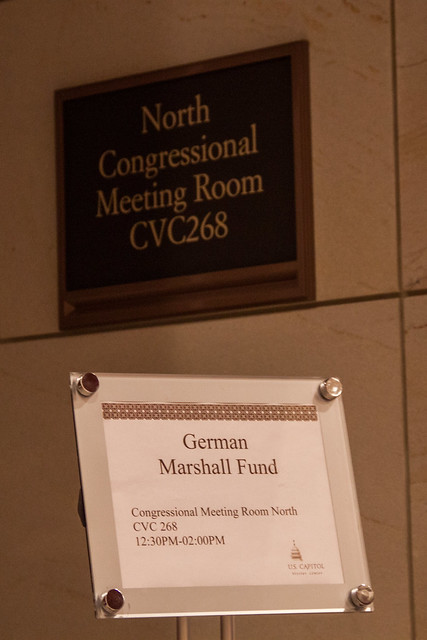
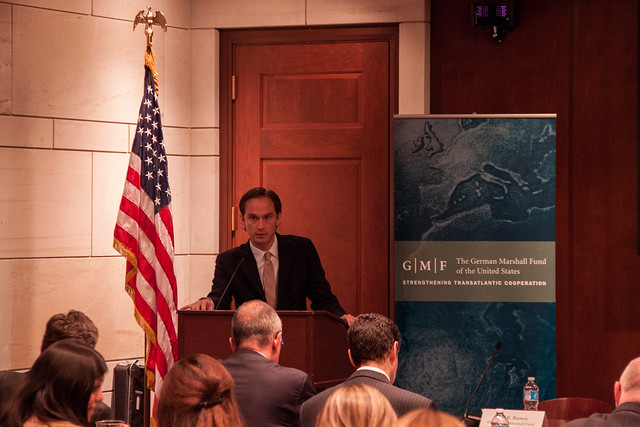
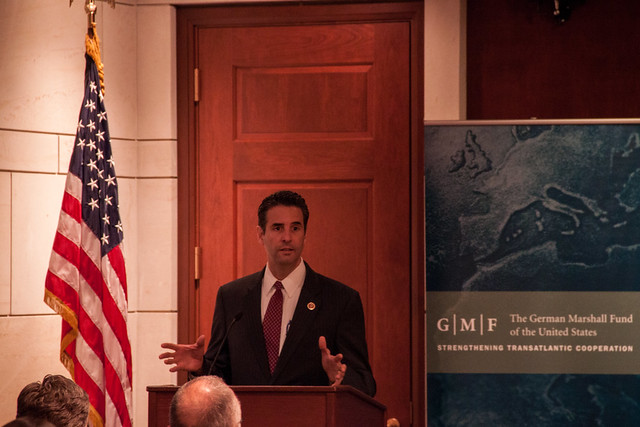
On Tuesday, February 11th, GMF convened a public event in the United States Capitol complex to examine the geopolitics of energy in the Eastern Mediterranean under the auspices of its Eastern Mediterranean Energy Project. The event brought together an audience of fifty senior representatives and leading issue experts from a host of Washington Embassies, think tanks, and the U.S. Congress.

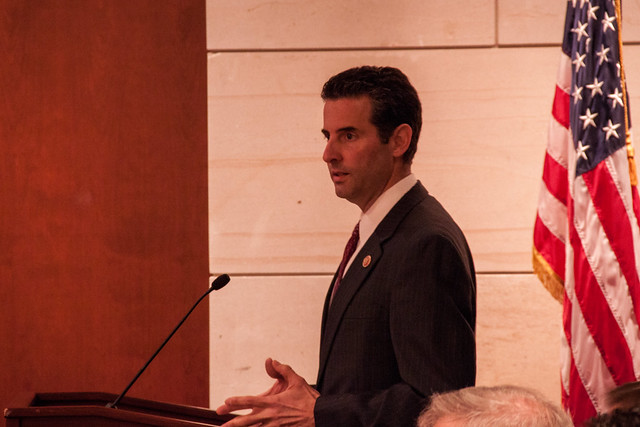
Four members of the U.S. House of Representatives attended and delivered remarks: Congressman John Sarbanes (D-Maryland), Congressman Gus Bilirakis (R-Florida), Congressman Ted Deutch (D-Florida), and Congressman Michael Turner (R-Ohio). Their speeches echoed common sentiment across political party lines that developing natural resources in a thoughtful and multilateral way can support stability in tense neighborhoods, such as the Eastern Mediterranean. All four members expressed their support for continued engagement by leaders in the U.S. and in countries in the region.

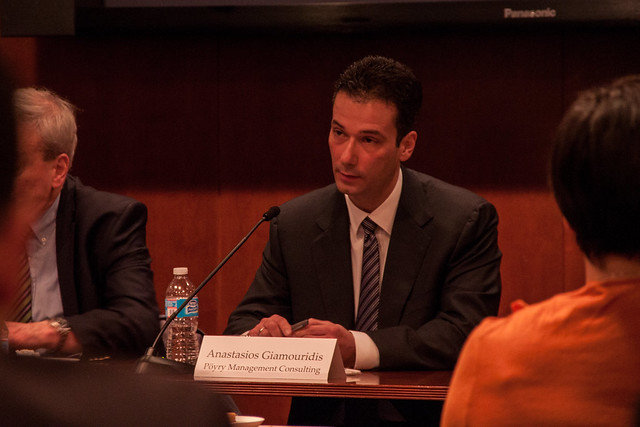
Following the remarks by the members of Congress, nonresident fellow Neil Brown opened the panel discussion, which featured experts Anastasios Giamouridis, senior consultant at Pöyry Management Consulting; Simon Henderson, director of the Gulf and Energy Program at the Washington Institute for Near East Policy; and Eric V. Thompson, vice president and director of CNA Strategic Studies. The subsequent conversation bore out many of the practical and political difficulties and opportunities presented by recent finds of natural gas in the Eastern Mediterranean.

Henderson made the point that although the discovered gas reserves are believed to be large enough to cover the domestic consumption of both Israel and Cyprus, further exploration is hampered by the small scale of the finds in absolute terms. He also pointed out that Turkey would be the most logical market for Israeli gas, should the resource develop, however Israel would likely remain a small player in the Turkish gas market, competing with the likes of Gazprom and others.

Giamouridis emphasised that the exploration of energy resources in the Eastern Mediterranean is still in an early phase, particularly in Cyprus. It is unclear exactly how much natural gas may be available in commercial terms, given the deep water nature of the resource and dry gas properties. He also highlighted that discussions of a pipeline to Turkey as the most logical export option for East Med gas fail to understand commercial complexities and risk factors and that the Turkish market may in fact not offer the best economic returns for East Med gas sellers in the long term. Finally, according to Giamouridis, linking the exploration and extraction of Eastern Mediterranean natural gas to the peace process would be a “recipe for disaster” that would make potential investors very nervous about financing costly extraction projects.

Thompson discussed the potential economic benefits of developing natural gas reserves by Cyprus and Israel, which could promote economic and political stability within each country. However, new infrastructure, such as offshore drilling rigs and pipelines, present new targets for groups such as Hezbollah. This could create a more complicated maritime security environment which could make it more difficult for the U.S. to operate there. Thompson also argued that the manner of development of potential gas reserves by Cyprus could orient that country more towards EU or Russia.
- See more at: http://www.gmfus.org/archives/the-geopolitics-of-energy-in-the-eastern-mediterranean/#sthash.ZIkQztHk.11kvtxiX.dpuf


Link to source: http://www.gmfus.org/archives/the-geopolitics-of-energy-in-the-eastern-mediterranean/

Bloomberg: Turkey really wants Israeli gas | Globes


The prospect of Leviathan field gas is prompting Turkey to normalize Israel ties.

"Bloomberg" reports that Israel and Turkey may resume diplomatic ties, after the long breakdown since the Mavi Marmara affair during the Gaza flotilla. "Bloomberg" quotes Turkish Foreign Minister Ahmet Davutoglu as saying that the two countries "are closer than ever to normalizing ties." Top Israeli officials are keeping quiet, with both the Prime Minister's Office and the Ministry of Foreign Affairs declining to comment on the remarks made in Ankara.
"Bloomberg" says that the Turks are seeking normalization in ties with Israel as quickly as possible for two reasons: the domestic problems of Prime Minister Recep Tayyip Erdogan, and Turkey's wish to obtain Israeli natural gas via pipeline from the Leviathan gas field.
“Erdogan really, really wants that gas, and could spin an agreement as Israel basically conceding to Turkey,” said Alon Liel, a former director general of the Ministry of Foreign Affairs. He adds that Erdogan wants Israel to export natural gas to Europe via a pipeline routed through Turkey.
Despite the chilly relations between the Israeli and Turkish governments and the halt in defense deals, Israeli export of goods to Turkey rose to $4.9 billion in 2013 from $3.5 billion in 2012.
Published by Globes [online], Israel business news - www.globes-online.com - on February 11, 2014
© Copyright of Globes Publisher Itonut (1983) Ltd. 2014


Link to source: http://www.globes.co.il/en/article-turkey-wants-leviathan-gas-report-1000916239

Tamar partners plan $15b regional gas sales | Globes

Tamar partners plan $15b regional gas sales

Tamar gas drilling

The partners want to use CNG technology to sell gas to Turkey, Greece, and Cyprus.


The Tamar gas field partners are planning $15 billion in natural gas sales to Turkey, Greece, and Cyprus without the need to build a pipeline. Sources inform ''Globes'' that the partners - Noble Energy Inc. (NYSE: NBL), Delek Group Ltd. (TASE: DLEKG), Isramco Ltd. (Nasdaq: ISRL; TASE: ISRA.L), and Alon Natural Gas Exploration Ltd. (TASE: ALGS) - are in talks with Edeltech Ltd. owner Uri Edelsberg, who wants to buy Tamar gas to supply it to customers in the Eastern Mediterranean Basin.
The talks have mentioned buying all the gas that may be exported from Tamar - 50 billion cubic meters (BCM) - plus another 30 BCM from the Tamar SW field, which will be developed as part of the main Tamar field. The amount of gas could increase in future if Isramco and Alon Gas's petition to increase exports from Tamar is accepted. Tamar has 100 BCM that has not been sold to Israeli customers.

Delek and its partners in Tamar originally planned to sell gas from the field to Gazprom via a floating liquefied natural gas (LNG) facility (FLNG), but the project, known as King, was frozen when the government's gas exports decision rendered the project uneconomical.

The negotiations with Edelsberg, which began a few months ago, picked up speed in the past few days, when an engineering feasibility study found an innovative technological solution - compressed natural gas (CNG). Natural gas demand in the Eastern Mediterranean is strong, especially in the Greek islands which are not connected to pipelines and must operate power stations with diesel. As a consequence, Cyprus has the highest electricity rates in Europe, and recently published a ten-year natural gas purchase tender.

Although the tender targets LNG suppliers, Israel is the only country able to supply CNG, which costs much less than LNG.

Edeltech owns independent power stations, including Ramat Hanegev Energy Ltd., Ashdod Energy Ltd, and a stake in Dorad Energy Ltd. It plans to bid in the Cypriot tender and wants to buy gas from Tamar at $7 per million British Thermal Units. The cost of transporting gas from Israel to Cyprus is estimated at $2.50 per million British Thermal Units, giving a final price of around $10 per million British Thermal Units, compared with the current price of $18 per million British Thermal Units for LNG.

CNG technology is also suitable for transportation to longer distances, to Turkey, Crete, and mainland Greece, all of which are interested in Israeli gas. The gas would be sent from the Tamar production platform to an onshore CNG facility, and delivered by a CNG tanker to the customer. CNG systems are being offered by Canada's Sea NG Management Corporation, which can meet delivery within three years form the order. CNG has several advantages over a pipeline: there is no need for the huge investment in construction; no need for permission from hostile or war-wracked countries for a pipeline to pass through their exclusive economic zones; and greater operational flexibility without the dependence on long-term contracts with a limited number of customers.

Published by Globes [online], Israel business news - www.globes-online.com - on February 11, 2014

© Copyright of Globes Publisher Itonut (1983) Ltd. 2014


Link to source: http://www.globes.co.il/en/article-tamar-partners-plan-15b-regional-gas-sales-1000916420