updated
3/21/2014 10:22:14 AM ET
LONDON (Reuters) - Russia's seizure of the Crimea and its threat
to cut off gas to Ukraine, a transit route to the rest of Europe, have
revived calls to reduce the EU's reliance on Moscow for energy, but the
blocs options are limited and costly.
The European Union made some progress in improving its energy
security after rows over unpaid gas bills between Kiev and Moscow led to
the disruption of supplies to western Europe in 2006 and 2009.
By improving its pipeline network, the EU is better prepared for a
new supply disruption, but it has not managed to reduce Russia's share
of European energy supplies.
Russia today is Europe's biggest supplier of oil, coal and natural
gas, meeting around a third of demand for all those fuels, according to
Eurostat data, and receiving in return a thumping $250 billion a year.
European leaders said on Friday that the stand-off with Moscow over
Crimea made them more determined than ever to end decades of dependence
on Russian gas, but they will have to work hard to convince the
skeptics.
"The curious feature of the energy policy that emerged from the
middle of the last decade is just how little serious effort has been put
into security - in particular Eastern security," said Dieter Helm of
Oxford University in a research paper this week.
While buyers can switch oil and coal suppliers relatively quickly and
easily, Europe receives most of its gas through pipelines that are fed
by only one supplier, chief among them Russia's state-controlled
Gazprom.
"Gazprom's market share in Europe is increasing (due to decline of
European production). So the aim of diversification of our supply is not
going to be achieved this side of 2020," said Thierry Bros, gas analyst
at French Bank Societe Generale.
"The question of diversification of supply post 2020, what is now in
discussion in Brussels, is going to be very difficult to achieve, as
with (gas) prices just below $10 per million British thermal units
(mmBtu), Russia is making alternative developments for Europe less
profitable," he added.
WHAT IS TO BE DONE?
Even so, there are alternatives.
The Baltic states of Estonia, Latvia, Lithuania and Poland, which
used to be part of, or dominated by, the Soviet Union but are now EU and
NATO members, all rely almost completely on Russian gas supplies.
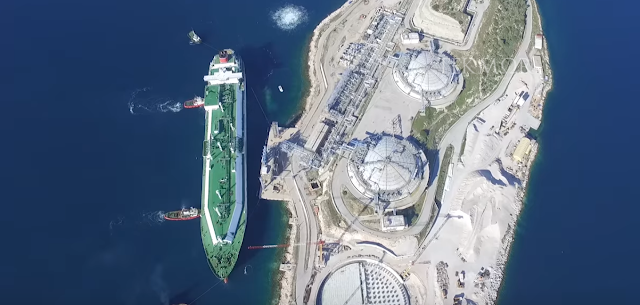
To reduce Moscow's energy grip, the region is planning to build several small-scale LNG import terminals.
U.S. LNG company Cheniere Energy, which expects to begin exporting
gas in the next two years, is one of the companies in talks to supply
the Baltic region.
Such terminals offer an alternative should Russia use gas for
political leverage, but LNG is too costly to meet the bulk of demand.
U.S. plans to export LNG largely have Asian customers in mind, as
prices there are almost twice as high as in Europe, so Europeans would
have to match those prices to secure supply.
"European LNG imports have declined steadily since early 2011,
reaching a nine-year low in 2013 as Asian and Latin American demand
continued to grow," BG Group, a major LNG shipper, said in its global
trade summary published this month, adding that it did not see this
trend changing soon.
Europe may, however, be able to tap a much bigger and closer gas source.
Almost one trillion cubic meters of recoverable natural gas has been
discovered in Israeli and Cypriot waters, enough to supply Europe for
more than two years.
Although export projects are at early stages and politically
difficult due to the region's instability, increased efforts are being
made to make some of its gas available to Europe, and with Cyprus the EU
would gain a new and internal supply source.
"With recent events in Europe ... and the aspiration of different
countries to diversify their gas supply, that puts another spotlight on
our massive resources," said Gideon Tadmor, CEO of Avner Oil, a leading
developer of the region's resources, at a conference this month.
But accessing East Mediterranean gas will be expensive. Cost
estimates to develop Cyprus's gas export project alone are as high as
$10 billion and would be the largest investment in the island's history.
Building gas export facilities in the region will also be politically challenging.
"Someone will have to win a Nobel Peace Prize before getting the region's gas flowing," one source involved in exploration said.
It also might not succeed in cutting out the Russian interest;
Gazprom is one of the companies that is interested in developing the
region's gas fields for export.
SHALE FAIL?
Though Europe's conventional gas reserves are declining, some still
harbor hopes that Europe could repeat the U.S. success in developing
shale gas.
While Europe has estimated reserves about three-quarters of the U.S.
figure, its geology is more complicated and it will be more costly to
extract. The politics also look more fraught, with governments such as
France, Bulgaria and Germany already halting exploration in the face of
public opposition.
Measures to increase the share of renewables also haven't helped to address Russia's gas supply dominance.
Since their output varies strongly depending on weather conditions,
renewables still require back-up by conventional power stations such as
coal, nuclear or natural gas.
Coal is unpopular, given Europe's emissions reduction targets, and
the prospects of increasing use of atomic power have been undermined by
Germany and others' decision to give up on nuclear.
History shows limited success in loosening Russia's grip.
Europe's biggest recent effort was the Nabucco pipeline, which was
supposed to meet 5 percent of Europe's gas demand from producers in
Central Asia and break Russia's almost complete supply monopoly in
Central and Southeast Europe.
But cost overruns, a lack of available gas, as well as Russian
lobbying meant that the alternative, smaller Trans Adriatic Pipeline
project was chosen, which will meet around 2 percent of EU demand by
pumping Azeri gas via Albania, Greece and into Italy, which is already a
well diversified gas market.
"On Nabucco, it has been game, set and match to the Russians," said Oxford's Helm.
Nabucco's failure has left the field open for Gazprom to build its
huge South Stream gas pipeline, which plans to meet 10 percent of
Europe's demand by pumping gas via the Black Sea into Southeast Europe
towards the end of the decade, cementing its dominant role in the
region.
(Additional reporting by Barbara Lewis in Brussels and Oleg Vukmanovic in London; Editing by Will Waterman)
(c) Copyright Thomson Reuters 2014. Check for restrictions at: http://about.reuters.com/fulllegal.asp
Link to source:
http://www.nbcnews.com/id/54738835/ns/business-stocks_and_economy/