Showing posts with label Nord Stream. Show all posts

Sunday, January 5, 2020

Russia begins TurkStream gas flows to Greece - REUTERS

JANUARY 5, 2020 / 1:48 PM

SOFIA (Reuters) - Russia has started European gas deliveries through the new TurkStream pipeline to Turkey, Bulgaria’s Bulgartransgaz said on Sunday, as Moscow looks to reduce shipments via Ukraine.

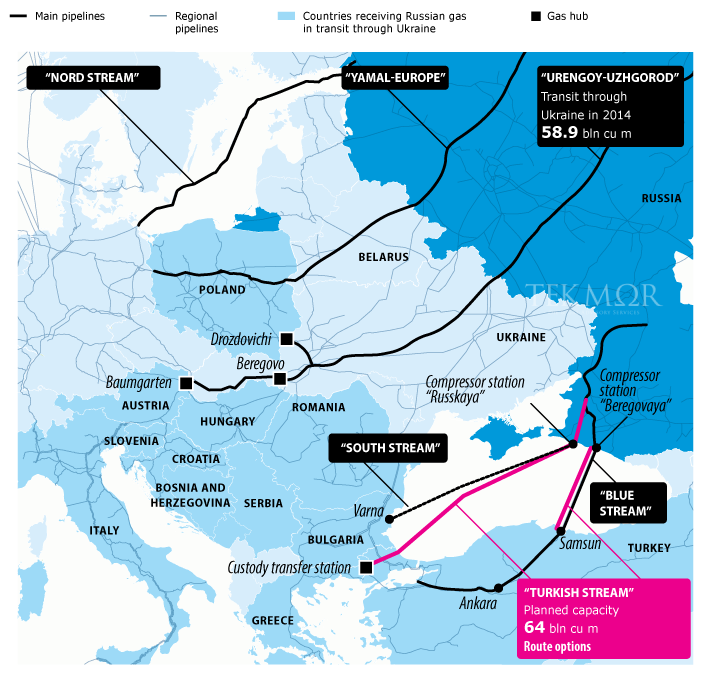
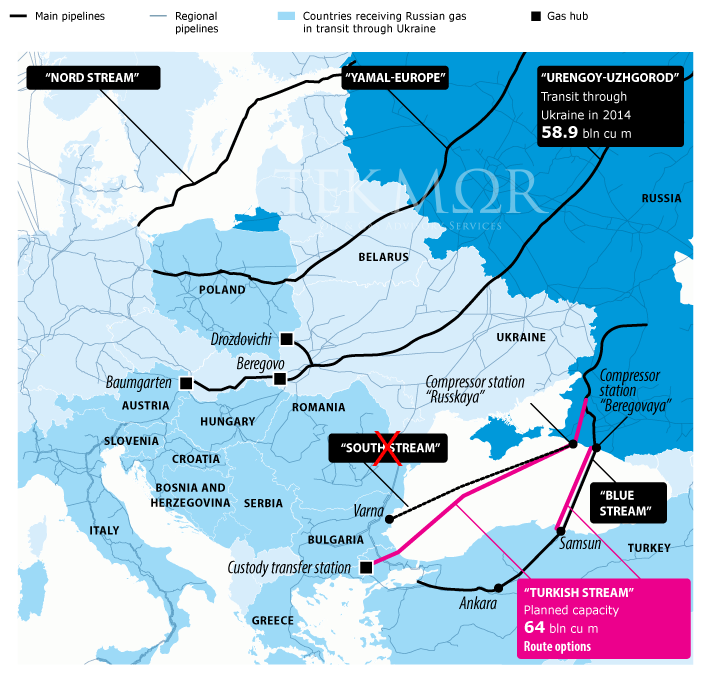
Russia is building TurkStream and doubling the capacity of NordStream across the Baltic Sea to Germany as part of plans to bypass Ukraine in its gas deliveries to Europe.

“Russian gas deliveries not only for us but also for Greece and North Macedonia are being carried through the new entry point (at our Turkish border),” Bulgartransgaz CEO Vladimir Malinov told Bulgarian national radio BNR.

Russian gas producer Gazprom started shipping about 3 billion cubic meters (bcm) of gas to Bulgaria via TurkStream on January 1, replacing a route that formerly passed through Ukraine and Romania.

Wednesday, December 12, 2018

Growing Dependent On Russia: The Gas Routes In Europe - FORBES

Dec 12, 2018, 12:05pm
Annalisa Girardi

This year Italy has become the second largest buyer of Russian natural gas, outdoing Turkey. Rome and Moscow historically have had close commercial ties within the energy sector, being Eni, an oil and gas Italian company and one of the largest multinationals in the sector, the first Western business to become a commercial partner to the Kremlin. This year Italy has become Russia’s second market, buying 18,3 billion cubic meters gas, against the 17,9 billion cubic meters acquired by Ankara. According to Bloomberg, Germany remains far in its first place, with 42,7 billion cubic meters gas purchased from Siberian gas fields.

Russian gas is a precious resource for Italy since it provides more than one-third of its total domestic demand. Natural gas originated in Russia reaches Italy mainly through the Trans Austria Gas (TAG) pipeline, a 380 kilometers duct hold at 89% by Eni. At this moment, 40% of national requirements are met by Gazprom, the Russian business that is also a major oil and gas companies worldwide, as well as being state-owned at 50%. The rest of Italian energy needs are mainly covered at 25% by Algeria and at 6% by Libya, while the country imports from Qatar the majority of liquefied natural gas which is later processed at the regasification plants.

Wednesday, November 28, 2018

The TurkStream Opportunity - CENTER FOR STRATEGIC & INTERNATIONAL STUDIES

November 28, 2018
Nikos Tsafos

As the battle for the Nord Stream 2 pipeline project continues, the offshore section of the TurkStream gas pipeline, from Russia to Turkey, was inaugurated on Monday, November 19. Two broadly similar projects have triggered sharply different responses—no one is threatening sanctions over TurkStream, there are no grand legal or diplomatic chess moves to stop the project, and the op-eds and conferences denouncing the project are few and far between. That is good news—no one needs more Nord Stream 2-like controversy. But it is also good news because TurkStream can enhance energy security; but only if Europe acts. For a continent bitterly—and, often, needlessly— divided by pipelines, TurkStream offers an opportunity to depoliticize gas and show that new infrastructure can be a win-win for Russia and Europe.

TurkStream will have two parallel lines: the first to deliver gas to Turkey, the second for onward sale to Europe (although markets will determine the actual volume split). Like other Russian pipelines, the short-term impact will be to change how Russian gas is sent to Europe: rather than flowing through Ukraine, Russian gas will be shipped straight to Turkey and, later, Europe through the Black Sea. Over time, as Russian exports grow, the pipeline will be delivering new gas rather than acting purely as a substitute route. This evolution takes time: gas transit through Ukraine fell by approximately 40 percent between 2011 and 2014, after the Nord Stream 1 pipeline came online, but it had largely recovered by 2017 (2017 volumes were about 10 percent lower than 2011).

Friday, December 8, 2017

Gazprom's natural gas exports to Europe, Turkey move past 2016 levels to fresh record - PLATTS


London (Platts)--8 Dec 2017 801 am EST/1301 GMTStuart Elliott, Edited by Alisdair Bowles

Russia's Gazprom is set to exceed on Friday the level of exports to Europe and Turkey that was recorded in 2016 as demand for Russian natural ss and cold weather across the continent

  • Sales to Europe, Turkey to reach 179.8 Bcm Friday
  • CEO points to 'unconditional reliability' of supplies
  • Nord Stream set for 87% utilization rate in 2017
Taking into account the nominated volume for Friday, Gazprom will have exported 179.8 Bcm to what it calls the Far Abroad -- Europe and Turkey, but not the countries of the former Soviet Union -- higher than last year's then record high of 179.3 Bcm.

Tuesday, February 28, 2017

EU's Move to Kill South Stream Cost Southeastern Europe Future Energy Security - SPUTNIK NEWS

28.02.201, updated 10:16

The countries of Southeastern Europe saw their future access to energy imperiled when EU bureaucrats decided to block the South Stream project, Srbijagas CEO Dusan Bajatovic told Sputnik Serbia; he stressed the importance of the Balkan region obtaining access to Russian gas via the Turkish Stream gas pipeline.

In an interview with Sputnik Serbia, Srbijagas chief executive Dusan Bajatovic said that EU bureaucrats' decision to block the South Stream project had cost Southeastern Europe its future access to energy.

He also underscored the significance of the Russian gas reaching the Balkan region via the Turkish Stream gas pipeline.

Tuesday, January 17, 2017

Russian gas flows to Europe, Turkey surge 25% on year in H1 Jan - PLATTS

London (Platts)--17 Jan 2017 931 am EST/1431 GMTStuart Elliott, Edited by Alisdair Bowles

Russian gas flows to Europe and Turkey were already 25.5% higher year on year in the first 15 days of January, according to the latest Gazprom data, having hit an all-time high daily level on January 8.

The continued high flows in 2017 -- following record-breaking volumes last year -- come as cold weather across Europe, especially in the east, triggers increased demand for Gazprom gas.

Russian gas prices also remain competitive compared with European hubs -- the oil price rally of end-2016 will only filter through to oil-indexed gas contracts in the coming months -- so European buyers are thought to be maxing out their Russian gas purchases.

In a statement Monday, Gazprom said gas flows to what it calls the Far Abroad -- Europe and Turkey but not the ex-Soviet states -- were 25.5% higher than in the same period of 2016.

Monday, January 9, 2017

Russian gas flows to Europe, Turkey break new records in 2017: Gazprom - PLATTS

London (Platts)--9 Jan 2017 800 am EST/1300 GMT
Stuart Elliott, Edited by James Leech

Russian gas continues to flow to Europe and Turkey at all-time high levels in 2017 following record-breaking volumes last year, as cold weather across Europe -- especially in the east -- triggers increased demand for Gazprom gas.

Russian gas prices also remain competitive compared with European hubs -- the oil price rally of end-2016 will only filter through to oil-indexed gas contracts in the coming months -- so European buyers are thought to be maxing out their Russian gas purchases.

In a statement Monday, Gazprom said gas flows to what it calls the Far Abroad -- Europe and Turkey but not the ex-Soviet states -- hit a new daily record of 621.8 million cu m on Sunday.

Friday, December 30, 2016

Gazprom's Alexey Miller on Nord Strean and Turkish Stream - GAZPROM

December 30, 2016

TEKMOR Note: 
The full Speech by Alexey Miller at conference call on occasion of New Year’s Eve can be found at the link below.

We intend to proceed with this work in 2017, which means that a new powerful gas transmission corridor will emerge on Russia's gas map. It will largely reshape gas flows as regards Russian consumers and international markets. Among other things, by expanding the northern corridor and gradually constructing new facilities in the northwestern part of the Unified Gas Supply System, we are building up capacities for gas deliveries via the offshore Nord Stream 2 gas pipeline.

The Nord Stream 2 project is running strictly on schedule. The gas pipeline will be brought online in late 2019. I am absolutely convinced that we will put onstream new gas export capacities in a timely manner and in full. The amount of gas to be supplied across the Baltic Sea via Nord Stream and Nord Stream 2 will total 110 billion cubic meters per year.

Thursday, October 20, 2016

Turkish Stream: The Cost of Russia’s Stubbornness - CARNEGIE MOSCOW CENTER

20.10.2016,
By Mikhail Krutikhin

Unlike Russian gas pumped via Ukraine and Germany, that flowing through Turkey will face tough competition from Azerbaijani, Iranian, Iraqi, and possibly even Turkmen and Israeli gas. Gazprom’s rivals won’t need to ship their gas as far, and they will have much lower pipeline construction costs. The gas market in southeastern Europe is not that big and doesn’t have a lot of room for growth.

Not so long ago, Turkey was on the Kremlin’s list of adversaries following the NATO member’s shooting down of a Russian fighter jet over the Syria-Turkey border. Now Russia is effectively relinquishing control over its southward gas export to Turkey. This is the extent to which the Kremlin is prepared to go to punish disobedient Ukraine—but it will come at a cost to Russia.

Wednesday, October 12, 2016

Gazprom to finance offshore part of Turkish Stream - NATURAL GAS WORLD

October 12th, 2016 9:05amMurat Basboga

Russian gas giant Gazprom will finance the construction of the offshore part of the Turkish Stream project, Gazprom CEO Alexei Miller said, according to Interfax news agency. In an interview with Russia 24 TV, he said that the company would start construction of offshore portion of the pipeline to Turkey in 2018.

The onshore infrastructure that will supply the Turkish market, will be financed and constructed by Turkey's state owned pipeline company Botas. Two companies could form a joint venture on a parity basis, the report added.

Miller also said that Turkish Stream would not compete for European markets with Nord Stream 2, a pipeline project which will supply northern Europe.

Tuesday, August 23, 2016

Turkey and the Energy Transit Question - CARNEGIE EUROPE

SEVERIN FISCHER
TUESDAY, AUGUST 23, 2016

For foreign and security policy analysts, pipelines tend to be the entry point into the world of energy. Pipelines create dependencies between countries, pipelines stay for decades, and pipelines have a highly symbolic political value.

In the European energy security debate, gas pipelines also have an identity function: you either support freeing Europe from its dangerous addiction to Russian gas by backing the Southern Gas Corridor—formerly known as “Nabucco” and designed to bring new gas supplies from the Caspian Basin, Central Asia, and Middle East regions into Europe—or you blindly follow the Kremlin’s breadcrumbs into the Nord Stream/South Stream-energy trap. Critical differentiation is rare.

Today, controversies over pipeline politics have a rather anachronistic flavor. This is mainly due to the growing flexibility of European—and partially global—natural gas markets in light of the massive increase in LNG supply, interconnectors, and spot market trade. This new market environment has not only changed the relationship between producers and consumers but has also altered the political and economic leverage of transit countries. This is especially important when looking at new transit countries, Turkey being a prominent example.

Monday, July 11, 2016

Turkish Stream: Still only a dream

July 11th, 2016

Russian President Vladimir Putin announced on June 30 that he and Turkish President Recep Tayyip Erdoğan had agreed to restore bilateral ties between their two countries. Russian Prime Minister Dmitry Medvedev followed the announcement with his own statement that economic sanctions against Turkey would be removed “on a gradual basis.”

Meanwhile, plans to build a natural gas pipeline—known as Turkish Stream—under the Black Sea to bypass Ukraine remain on hold. Russia halted negotiations on Turkish Stream after Turkey shot down a Russian jet on the Syrian border on November 24, 2015. The originally planned 1,100-kilometer pipeline would consist of four lines designed to transport sixty-three billion cubic meters (bcm) of natural gas annually. Sixteen bcm was destined for the Turkish domestic market, while the remaining forty-seven bcm was for the European market. Combined with the Nord Stream pipeline, Turkish Stream would have eliminated the need for Gazprom—Russia’s chief energy giant—to use Ukrainian pipelines to supply the European market.

Monday, October 5, 2015

Gas Strategies Discussed in Greece | Natural Gas Europe


October 05th, 2015

GAS STRATEGIES DISCUSSED IN GREECE

The annual Global Oil&Gas Black Sea and Mediterranean Conference took place recently in Athens, Greece, and various stakeholders laid their views upon the gas culminations in the regional markets.
Danila Bochkarev, energy fellow at the EastWest Institute in Brussels, attested that the proposedTurkish Stream pipeline project could indeed become a reality in the coming years, albeit in a different form as presently presented: significantly lower in terms of volume capacity - up to 75% less. That means the pipeline would have a maximum 17.5bcm capacity and chiefly supply Turkish and Greek markets without further expansion.
It is not improbable that the Trans Adriatic Pipeline (TAP) could be used to transfer limited amounts of Russian sourced gas. On the other hand, Nord Stream is currently of outmost importance for the overall energy security of the major EU natural gas markets and in that respect, regulatory affairs should be taken into account regarding EU-Gazprom future supply relations.
The Greek government, through incumbent Energy Minister Panos Skourletis, also pledged to follow through with Turkish Stream without making any assumptions around changes in volume or route.
The impeding opening up of the East Mediterranean natural gas supply route was touched upon by a cadre of experienced policy makers on the subject. The former head of the Energy Ministry directory of Cyprus, Solon Kasinis, placed emphasis on the recent gas discoveries offshore Egypt in the Zohr field, which could have more than 1 trillion cubic metres of gas in place.
According to the Cypriot expert, plans that call for the establishment of a pipeline from that region to the EU via Greece could be revitalized. In the coming months there should be strong competition and collaboration alike by all neighboring countries to firmly set up export infrastructure in the region, with a concentration on LNG installations. The Tamar field is operational and the Leviathan is about to be streamlined as well.
It was also noted that Italian ENI is still pursuing, after a 2-year break, potential gas resources offshore Cyprus in the sea blocks 2, 3 and 9, whilst French Total will commence its research by the end of this year in block 11.
Egypt has certainly emerged a big player and has its own set of options, including stronger cooperation with Israel and Cyprus and significant investment options in the LNG market. By 2021, the situation should be settled and if new discoveries are made, the region could see a golden era of natural gas both in terms of local gasification and in export potential.
Former chairman of the Cypriot hydrocarbon agency, Charles Ellinas, pointed out that the plan to establish an LNG terminal in the Vasiliko area of Cyprus could become a reality if sources of gas are also being directed from Israel.
There are also indications for more gas to be found offshore Cyprus and the major difficulty nowadays is to secure long-term financing for any project at hand. By combining forces with Israel, Nicosia could hope for options to export both to EU and Asian markets.
With the Zohr discovery and optimistic predictions for more reserves, Egypt could again become net exporter by 2022, a development that could ease the country's commercial deficit by many billions of dollars annually.
In terms of price competitiveness, the cost of Cypriot and Israeli gas sent to Europe would be around $12 per MMBtu in today's prices, which is more than Gazprom's price to the same destination. That means that any potential exports will have to take that under consideration. In any event, exports would be a long term issue and not for the short term.
EU authorities, according to Mr Ellinas, are generally speaking in favor of projects such as the East Med pipeline, but it is not in the immediate priorities of the Union or any member states, save Greece and Cyprus. For the moment, the EU is primarily concentrating efforts on the Southern Corridor project with its TANAP-TAP system of pipelines along with assorted interconnectors. Cyprus, therefore, should speed up its efforts for a new round of explorations and be ready to hand out licensing for new sea blocks by 2016.


 Natural Gas Europe welcomes all viewpoints. Should you wish to provide an alternative perspective on the above article, please contact editor@minoils.com  
Kindly note that we only lightly edit content for grammar and do not edit externally contributed content.

Source: http://www.naturalgaseurope.com/gas-strategies-discussed-in-greece-25580

Wednesday, March 12, 2014

Η Κομισιόν παγώνει τον αγωγό South Stream | ethnos.gr

ΕΝΕΡΓΕΙΑΚΟΣ ΠΟΛΕΜΟΣ ΣΤΗ ΡΩΣΙΑ

Η Κομισιόν παγώνει τον αγωγό South Stream

Σε στρατηγικό στόχο της Ουάσιγκτον και της ΕΕ, που μετά τις εξελίξεις στην Κριμαία αποκτά επείγοντα χαρακτήρα, αναδεικνύεται η προσπάθεια ενεργειακής απεξάρτησης της Ευρώπης από τη Μόσχα, καθώς το όπλο του ρωσικού φυσικού αερίου απειλεί να ανατρέψει τις γεωστρατηγικές ισορροπίες της μεταψυχροπολεμικής εποχής.

Η Κομισιόν παγώνει τον αγωγό South Stream

 Η Κομισιόν σε μια πρώτη κίνηση παγώνει τη διαδικασία για έγκριση δύο μεγάλων ενεργειακών σχεδίων της Gazprom, τον αγωγό South Stream αλλά και τον αγωγό OPAL, που παράλληλα με τα ανατολικά σύνορα της Γερμανίας θα καταλήγει στα γερμανοτσεχικά σύνορα.

Το θέμα της μείωσης της ενεργειακής εξάρτησης από τη Ρωσία τίθεται πλέον επισήμως και στα Συμπεράσματα της επόμενης Συνόδου Κορυφής της ΕΕ, ενώ η προοπτική εξασφάλισης εναλλακτικών πηγών ενέργειας θα βρίσκεται στην κορυφή της ατζέντας της Συνόδου Κορυφής ΕΕ ? ΗΠΑ, που είναι προγραμματισμένη για το τέλος Μαρτίου.

Ο «ενεργειακός πόλεμος» έχει ήδη αρχίσει και το μεγάλο ερώτημα πλέον είναι το πώς οι ΗΠΑ και η ΕΕ θα μπορέσουν να καλύψουν τις ενεργειακές ανάγκες των χωρών της Ευρώπης.

Ο αρμόδιος επίτροπος για την ενέργεια, Γκ. Ετινγκερ, σε συνέντευξή του στην «Die Welt», προειδοποίησε ότι με αφορμή τις εξελίξεις στην Κριμαία θα παγώσει η διαδικασία για την έγκριση του αγωγού South Stream.

Ο αρμόδιος Ευρωπαίος επίτροπος για την ενέργεια, Γκ. Ετινγκερ
 
Ο αρμόδιος Ευρωπαίος επίτροπος για την ενέργεια, Γκ. Ετινγκερ


Η Ρωσία έχει ξεκινήσει ήδη την κατασκευή του αγωγού που θα παρακάμπτει την Ουκρανία και θα καλύπτει από το 2018 μέσω της Μαύρης Θάλασσας το 15% των ετήσιων αναγκών της Ευρώπης σε φυσικό αέριο.

Nord Stream

Ο αγωγός αυτός αποτελεί το δεύτερο σκέλος, μετά τον Nord Stream στη Βαλτική Θάλασσα, του σχεδίου για παράκαμψη της Ουκρανίας, ώστε η Μόσχα να έχει απρόσκοπτη πρόσβαση στις αγορές της Ευρώπης. Για τον αγωγό South Stream απαιτείται και ουσιαστικά η έγκριση της Κομισιόν ώστε να μην παραβιάζεται η κοινοτική νομοθεσία που προβλέπει πλαφόν στο ποσοστό ιδιοκτησίας του αγωγού και εξασφάλιση πρόσβασης και σε άλλες εταιρείες παραγωγούς φυσικού αερίου.

Η Κομισιόν παγώνει τον αγωγό South Stream

Η Κομισιόν και ο αρμόδιος επίτροπος για την ενέργεια, Γκ. Ετινγκερ, ανέβαλαν την απόφαση για τη διεύρυνση της πρόσβασης της Gazprom στον αγωγό OPAL, ο οποίος τροφοδοτείται από τον Nord Stream και μεταφέρει αέριο, διασχίζοντας κάθετα τη Γερμανία μέχρι την Τσεχία, καθώς σχετικό αίτημα για εξαίρεση από τους κανόνες του Γ' Ενεργειακού Πακέτου έχουν υποβάλει και η Γερμανία και η Ρωσία. Ο OPAL, σύμφωνα με την ευρωπαϊκή νομοθεσία, πρέπει να διαθέτει το 50% της χωρητικότητάς του σε ανεξάρτητους παραγωγούς. Αλλά η ποσότητα των 36 bcm (δισεκατομμυρίων κυβικών μέτρων) ανά έτος δεν μπορεί να εξασφαλίσει παρά μόνο από τον αγωγό Nord Stream (που τροφοδοτεί με φυσικό αέριο τη Γερμανία μέσω της Βαλτικής Θάλασσας) και την Gazprom.

Ακόμη και ο κ. Ετινγκερ, όμως, παρά τις κινήσεις αυτές, έσπευσε να δηλώσει ότι δεν θα πρέπει να πληγούν οι οικονομικές σχέσεις ΕΕ - Ρωσίας, γνωρίζοντας όχι μόνο ως Γερμανός αλλά και με την ιδιότητά του ως επιτρόπου ότι οι απειλές αυτές έχουν «κοντά πόδια», όσο η ΕΕ και οι ΗΠΑ δεν έχουν πειστική απάντηση για την κάλυψη των ενεργειακών αναγκών της Ευρώπης.

Η απάντηση ήρθε όμως αμέσως από τη Μόσχα και η Gazprom ανακοίνωσε ότι περιμένει μέχρι το τέλος του μήνα να υπογραφεί κανονικά η συμφωνία για τον South Stream.


ΦΥΣΙΚΟ ΑΕΡΙΟ
 
Τα «όπλα» ΗΠΑ - Ρωσίας και η μάχη με τον χρόνο

Βρυξέλλες και Ουάσιγκτον, παρά τη σπουδή τους να αμφισβητήσουν την ενεργειακή κυριαρχία της Μόσχας, αδυνατούν προς το παρόν να βρουν ελαστικές εναλλακτικές επιλογές που θα αντιμετωπίσουν άμεσα τις ενεργειακές ανάγκες όχι μόνο της Ουκρανίας αλλά και των άλλων ευρωπαϊκών χωρών.

Η εξαγωγή φυσικού αερίου από τις ΗΠΑ, η εκμετάλλευση του σχιστολιθικού αερίου που υπάρχει στο υπέδαφος της Ευρώπης και το φυσικό αέριο από νέες πηγές όπως η Ανατολική Μεσόγειος είναι οι εναλλακτικές επιλογές που έχουν όμως ένα κοινό: απαιτούν χρόνο, τον οποίο όπως δείχνει και η εμπειρία της Κριμαίας η Ρωσία είναι αποφασισμένη να εκμεταλλευθεί, επιβάλλοντας με «όπλο» το φυσικό αέριο τετελεσμένα επί του εδάφους. Οι ΗΠΑ με τη γιγαντιαία πια επιχείρηση εκμετάλλευσης σχιστολιθικού αερίου παρακάμπτοντας τις εντονότατες αντιδράσεις λόγω των περιβαλλοντικών κινδύνων, το 2013 αναδείχτηκαν για πρώτη φορά η χώρα με τη μεγαλύτερη παραγωγή φυσικού αερίου παίρνοντας τα σκήπτρα από τη Ρωσία, η οποία όμως λόγω του πυκνού δικτύου αγωγών παραμένει η πρώτη σε εξαγωγές χώρα.

Η εξαγωγή φυσικού αερίου από τις ΗΠΑ απαιτεί ένα σημαντικό χρονικό διάστημα, καθώς η μοναδική βάση εξαγωγής LNG (ConocoPhillips στην Αλάσκα) έκλεισε το 2012 και τώρα μόλις κατασκευάζεται ο πρώτος μεγάλος LNG σταθμός στο Cameron Parish της Λουιζιάνα.

Λόγω και εσωτερικών συγκρούσεων το αμερικανικό Υπουργείο Ενέργειας έχει εγκρίνει μόνον έξι άδειες εξαγωγής 9,07 bcf την ημέρα, ενώ αναμένουν προς εξέταση άλλες 24 αιτήσεις για ποσότητες που θα φθάνουν τα 31 bcf, όταν η συνολική αμερικανική παραγωγή φθάνει τα 69 bcf την ημέρα.

Οι ενεργειακές ανάγκες της Ουκρανίας φθάνουν τα 5,1 bcf την ημέρα και της Ευρώπης σχεδόν στα 50 bcf.

Οι Αμερικανοί ασκούν πιέσεις για εκμετάλλευση του σχιστολιθικού αερίου στην Ευρώπη καθώς σύμφωνα με την Αμερικανική Υπηρεσία Ενέργειας (US Energy Information Agency) μεγάλα κοιτάσματα βρίσκονται στη Γαλλία, στη Νορβηγία, στην ίδια την Ουκρανία, την Πολώνια, τη Ρουμάνια και σε αρκετές ακόμη χώρες. Η Γαλλία και η Βουλγαρία όμως έχουν απαγορεύσει τη χρήση της υδραυλικής ρωγμάτωσης, η Ρουμανία και άλλες χώρες έχουν παγώσει τις διαδικασίες ενώ πρωτοπόρος αναδεικνύεται η Πολωνία, η οποία όμως είναι ακόμη στη φάση των ερευνών και των πρώτων γεωτρήσεων. Στην Ουκρανία από τα δυο μεγάλα κοιτάσματα το ένα που έχει αναλάβει η Chevron βρίσκεται στο δυτικό μέρος της χώρας, ενώ αντίθετα το άλλο αγλαό κοίτασμα τα δικαιώματα του οποίου έχει η Shell βρίσκεται στη Yuzivska στην ανατολική Ουκρανία στα σύνορα με τη Ρωσία.
 
Σχεδιασμοί
Στους σχεδιασμούς της Ουάσιγκτον και των Βρυξελλών κατέχει σημαντική θέση και η ανακάλυψη σημαντικών αποθεμάτων φυσικού αερίου στην Ανατολική Μεσόγειο, στην Κύπρο, στο Ισραήλ αλλά και στην Ελλάδα, που θα μπορούσαν να προσφέρουν μια εναλλακτική πηγή ενέργειας για την Ευρώπη είτε με αγωγό από την Κύπρο προς την Κρήτη είτε με αγωγό προς την Τουρκία, όπως φαίνεται να προτιμούν οι Αμερικανοί.

Το «Σπίγκελ» αποκάλυψε χθες ότι η γερμανική εταιρεία RWE στο πλαίσιο της συμφωνίας που είχε υπογράψει το 2012 με την Ουκρανία μπορεί να προμηθεύσει το Κίεβο με φυσικό αέριο τόσο από τον αγωγό Nord Stream (αν και το απαγορεύει η συμφωνία με την Gazprom) όσο και από τη Νορβηγία και την Ολλανδία. Αλλά αυτές οι ποσότητες, ακόμη κι αν υλοποιηθεί αυτή η ιδέα, δεν θα αρκούν παρά για να εξασφαλισθούν τα βασικά αποθέματα ασφαλείας εν όψει του χειμώνα.

ΝΙΚΟΣ ΜΕΛΕΤΗΣ

Link to source: http://www.ethnos.gr/article.asp?catid=22769&subid=2&pubid=63976236