Tuesday, November 19, 2013

Leviathan Oil Well Drilling Postponed | Jewish Business News

Published On: Mon, Nov 18th, 2013

Leviathan Oil Well Drilling Postponed

Twitter 0Facebook 0Google+ 0
Email --Email to a friendLinkedIn 0Share0FLARES
-
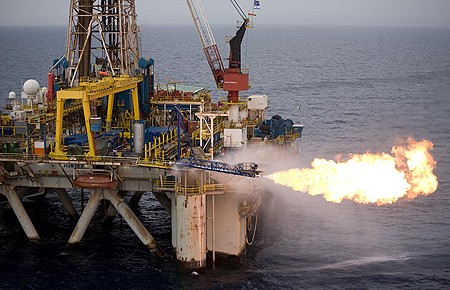
The ultra deepwater drillship, which was to begin drilling in the first quarter of 2014, is now not likely to start work before the second half of 2014.
-
cmimg_13108
-
Drilling of the well to Leviathan’s oil-bearing strata, which was supposed to begin in December, has been postponed. No new starting date for the $250 million well has yet been set but market sources believe that the postponement could be for at least six months.Meanwhile there is continued uncertainty regarding development of Leviathan’s gas field and the final investment decision has yet to be taken by the Leviathan partners. In addition, expensive equipment intended for developing the gas field has been sent out of Israel.
Noble Energy Inc. (NYSE: NBL) owns 39.66% of Leviathan, Delek Group Ltd.(TASE: DLEKG) units Avner Oil and Gas LP (TASE: AVNR.L) and Delek Drilling LP (TASE: DEDR.L) each own 22.67% and Ratio Oil Exploration (1992) LP (TASE:RATI.L) owns 15%.
Postponing Leviathan’s development could have major repercussions on Israel’s economy, which will face a natural gas shortage from 2015. At a recent electrical engineers conference Noble Energy VP Eastern Mediterranean Lawson Freeman said that regulatory uncertainty was the main reason delaying Leviathan’s development, such as the lack of an approved outline plan for bringing gas from Leviathan, without which Noble Energy cannot obtain rights to develop the field.
Leviathan’s partners are waiting for Antitrust Authority director general David Gilo’s decision on a suspected cartel in the licenses. The companies have invested over $800 million in Leviathan to date, mostly for drilling and planning the field’s development.
Postponing Leviathan’s oil well is the latest development in the saga. The Atwood Advantage ultra deepwater drillship, which was scheduled for delivery in September to drill the well, is still at the Daewoo shipyard in South Korea, and is now not likely to arrive before the second half of 2014. The ship was built to order for Noble Energy, after the rig that tried to reach the oil-bearing strata was forced to stop drilling at a depth of 6,500 meters because of high pressure disparities at the great depth. Updated estimates give a 25% probability of finding 1.5 billion barrels of oil in various target strata beneath Leviathan’s gas-bearing strata.
Construction of the Atwood Advantage was completed in September. Noble Energy has committed to hiring the ship at a cost of $584,000 a day, and planned to first use the ship at Leviathan before moving it to other deepwater fields offshore from West Africa and the Falklands.
Noble Energy said, “We remain committed to the development of the Leviathan field and continue to work hard to advance the project.”
Published by  www.globes-online.com


Link to source: http://jewishbusinessnews.com/2013/11/18/leviathan-oil-well-drilling-postponed/

Monday, November 18, 2013

Woodside uncertain on Israeli gas | Business Spectator

Woodside uncertain on Israeli gas


A struggle for control over Israel's gas resources has delayed Woodside Petroleum Ltd's proposed acquisition of a 30 per cent stake in the Leviathan field, The Australian Financial Review reports.
According to the newspaper, the $US1.3 billion ($A1.39 billion) deal is yet to be completed almost a year after its announcement as debate continues over how much gas Israel should keep for local use and how much it is worth.
Israel was mostly reliant on imported energy until gas was discovered off its coast in recent years.
Woodside could be cut out of the equation as Russia, China and South Korea want to lock up large chunks of the gas and some domestic parties want to keep the reserves at home, the AFR reports.

Link to source: http://www.businessspectator.com.au/news/2013/11/18/resources-and-energy/woodside-uncertain-israeli-gas

Thursday, November 14, 2013

Lure of Israel's gas may dampen Turkish ire | UPI

Nov. 14, 2013 at 3:13 PM

TEL AVIV, Israel, Nov. 14 (UPI) -- Israel is on the cusp of becoming a natural gas exporter and key energy power in the Middle East, a move that could produce significant geopolitical changes in a region beset by turmoil.

That includes a new alliance with Turkey, which seems to be moving toward setting aside its political differences with the Jewish state, just as it is doing with Iraq's oil-rich Kurds, in the interest of achieving its ambition to become the main energy broker in the region.

Israel is now considering its options for exporting gas from its Tamar field, which began production March 30, and the larger but still undeveloped Leviathan field, which is due to come onstream in 2015.

Between them these fields contain an estimated 30 trillion cubic feet of gas. Israel has set aside 40 percent of its gas production for export, expected to earn $50 billion in the next 20 years.

A pipeline under the eastern Mediterranean from Leviathan, which contains an estimated 16 tcf of gas, to Turkey is one of the more ambitious options.

If it comes off it could pump 105.9 billion cubic feet of gas a year to Turkey, which has no energy resources.

Eventually, that could reach 353 bcf annually in the second half of the decade using the pipeline, which will cost $2 billion to $3 billion to construct.

There are other options, including linking up with neighboring Cyprus, currently in the throes of exploring for gas off its south coast. That could involve building a $12 billion liquefied natural gas facility on Cyprus to handle joint gas exports to Europe and beyond.

Noble Energy of Texas and Israeli partner Delek group, which discovered the Israeli fields, are also drilling off Cyprus and they've made substantial finds.

But a deal with Turkey's still widely seen as a frontrunner, despite Ankara's rift with Israel over the May 30, 2010, storming of a Turkish flotilla of ships seeking to run Israel's economic blockade of the Hamas-ruled Gaza Strip in which nine Turks were killed by Israeli troops.

Turkish conglomerate Zorlu Energy disclosed two weeks ago it wants a 15-year contract to buy Israeli gas from Leviathan.

Zorlu, one of Turkey's biggest conglomerates, has been negotiating with Delek. Zorlu already has a foothold in Israel, with a 25 percent stake in Dorage Energy, which is building the Jewish state's largest independent power station.

Turkish Prime Minister Recep Tayyip Erdogan has stressed there can be no commercial tie-up with Israel until it pays compensation for the Turks killed in 2010.

But his energy minister, Taner Yildiz, made no bones about it last week: "Turkey is interested in Israeli gas."

Insiders in both countries are betting Erdogan's ambition to transform strategically placed Turkey into the region's energy hub for Russia, the Caspian and the Mediterranean will override his quarrel with Israel, which until 2010 was Turkey's strategic military and intelligence ally, and his personal feud with Prime Minister Binyamin Netanyahu.

They note that the Erdogan has green-lighted Turkey's move into Iraqi Kurdistan to secure access to its estimated 45 billion barrels of oil and large reserves of gas through a network of overland pipelines that will eventually carry 2 million barrels of oil a day into Turkey, despite Ankara's traditional distrust of the Kurds.

Turkey's Kurds have waged a separatist war for autonomy since 1984. But now he's seeking a peace agreement while his dealings with the Iraqi Kurds encourages them in their pursuit of their own independence from Baghdad.

The mooted pipeline from Israel to Turkey, which could eventually feed gas to Europe, which is struggling to break its reliance on Russia, will require inter-government cooperation to secure a long-term commercial deal.

Publicly, the Islamist Erdogan is still sniping at Israel. In August, he claimed Netanyahu's government was behind the July 3 military overthrow of Islamist Egyptian President Mohamed Morsi.

In October, there were reports Turkey had betrayed an Israeli intelligence operation involving agents in Iran.

But analysts believe the economic benefits of a gas deal with Israel, like the tie-up with the Iraqi Kurds, mean that pragmatism will overcome politics and prejudice.

"It's no secret Erdogan has bold ambitions for his country's regional and international standing," Istanbul analyst Joseph Dana said.

"Traditional adversaries, like Israel and the Kurds of northern Iraq, are now the backbone of Turkey's strategic future."

Monday, November 11, 2013

Egypt begins talks with Greece and Cyprus | Daily News Egypt

Egypt begins talks with Greece and Cyprus

  /   0 Comments   /   462 Views
The three Mediterranean countries seek to strengthen ties and discuss regional issues
Share     Print       Email
The Egyptian foreign ministry began hosting political consultations with delegations from Greece and Cyprus on Monday and discussed a number of ties between the three countries.
The consultations, hosted by the Egyptian Ministry of Foreign Affairs in Cairo, were scheduled to last two days. Head of the Egyptian side in the talks, Assistant Foreign Minister for European Affairs Hatem Seif Al-Nasr, met with Greece’s general director of the foreign ministry’s political department Dimitris Paraskevopoulos and Cyprus’ Deputy Secretary General of Foreign Affairs Tassos Jonis.
The political consultations were held to discuss “various political, economic, cultural, and technical issues, and to discuss ways to strengthen relations,” according to a foreign ministry statement. The Egyptian, Cypriot, and Greek delegations were also set to discuss regional and international issues “of common interest and coordinate positions on them.”
Seif Al-Nasr said that Egypt was “keen on strengthening cooperation” with the two sides, built on historic ties of friendship, adding that Cyprus and Greece “were among the first countries that supported the Egyptian revolution” and its transitional period. He also took note that Greece would take over the rotating presidency of the European Union in 2014.
Delegations from the three countries met in September in New York City on the sidelines of the United Nations General Assembly.
Last year the Egyptian and Cypriot governments agreed to cooperate in exploring offshore oil and gas in the waters between the two nations.
Last Thursday ahead of the talks, Deputy Prime Minister and Foreign Minister of Greece Evangelos Venizelos received the Ambassador of Cyprus in Greece Phaedon Anastasiou and Egyptian ambassador Ahmed Fouad Al-Badawy in Athens.
Both Greece and Cyprus cautiously endorsed the ouster of former President Mohamed Morsi in July, citing historical and traditional ties.


Link to article: http://www.dailynewsegypt.com/2013/11/11/egypt-begins-talks-with-greece-and-cyprus/

Friday, November 8, 2013

Cyprus and Lebanon to start negotiations for a production-sharing agreement | Famagusta Gazette


Cyprus Energy Minister Giorgos Lakkotrypis and his Lebanese counterpart Gebran Bassil met in Nicosia to discuss hydrocarbon issues

8/11/13 - Cyprus and Lebanon have agreed to start negotiations immediately for a production-sharing agreement concerning their hydrocarbon resources.

Cyprus Energy Minister Giorgos Lakkotrypis and his Lebanese counterpart Gebran Bassil met in Nicosia to discuss hydrocarbon issues.

As Lakkotrypis stated after the meeting, “we have agreed to start the discussion and conclude it as soon as possible”.

“We are opening a new era of a good cooperation between Lebanon and Cyprus in oil and gas” said Bassil said from his part, adding that Lebanon could constitute a potential market for Cypriot gas.

Both sides said the meeting was conducted in an excellent climate, reflecting the level of relations between the two countries.

According to Lakkotrypis, both sides briefed each other on the current state of hydrocarbon exploration and exploitation efforts and said they agreed to exchange experiences and knowledge.

The Lebanese Minister referred from his part to the historic relations between the two countries, expressing hope that they will be “translated into real economic relations”.

Bassil said moreover that his country was “open to discuss everything”, adding that Lebanon is keen to correct the mistake - as he put it - relating to the border between Lebanon and Israel.

We hope that with a future understanding, we can correct it and build the future together, the Lebanese Minister said.

He added that Lebanon may provide Cyprus with an alternative market to export its gas, noting that Beirut is also in need for gas.

On the LNG plant Cyprus plans to construct at Vassiliko area, on the southeastern coast of the island, Bassil said that Lebanon regards it in a positive light. “It can be also a possible diversification solution for our gas exports” he said.

He noted that the two countries share a “gift from God”, the rich hydrocarbon resources, and expressed hope to utilize them for the benefit of their people.

Bassil said finally that the vision for Lebanon-Cyprus relations includes other areas as well, such as water, transportations and even wine.

Cyprus is currently developing natural resources discovered within the Republic’s Exclusive Economic Zone (EEZ), while several international companies are involved in hydrocarbon exploration and exploitation activities.

The country has signed separate agreements with Egypt, Lebanon and Israel to delimitate its EEZ. The agreement with Beirut has not been ratified due to a difference between Lebanon and Israel.

SOURCE

The questionable wisdom of piping Israeli gas through Turkey | i24news

The reported political obstacles to the construction of a natural gas pipeline between Israel and Turkey are but another confirmation that relations between the two countries are strained. This last Israel-Turkey row also provides an opportunity to ponder the wisdom of building an Israeli pipeline to Turkey, in the first place.

There are good reasons why Israel and Turkey are considering the construction of such a pipeline. Turkey is a natural gas importer, while Israel is about to become a natural gas exporter. Not only is Turkey trying to diversify its gas imports in order to reduce its dependency on Russia’s expansive natural gas, it also wants to solidify its key role as a transit country for energy flows: Turkey is strategically located at the crossroads of energy exporters (the Middle East and the Caucasus) and energy importers (European countries). As the EU will likely become an importer of Israel’s natural gas, Turkey could provide a transit route for an Israeli gas pipeline to Europe.
However, relying on Turkey as a transit country for Israel’s exports to Europe would constitute a long-term strategic mistake.

The infrastructure for the delivery of natural gas (either via pipelines or liquefaction) is complex and expensive, which is why exporting and importing countries are generally locked in long-term agreements. Hence the need to carefully understand the potential risks of the Turkish option.

Building an Israeli pipeline via Turkey would likely undermine the emerging energy partnership between Israel and Cyprus. Noble Energy, the company that discovered the Tamar field off Israel’s coast, also discovered a field of comparable size (Aphrodite) off Cyprus. As a result, Israel and Cyprus control together about 40 billion cubic meters of natural gas – which represents two years’ worth of the EU’s natural gas consumption.

This is why an energy partnership between Israel and Cyprus is taking shape. Turkey, however, is opposed to such a partnership. Because of the Turkish occupation in northern Cyprus and because the tensions between Cyprus and Turkey, Israel cannot have it both ways and will eventually have to make a choice.

In January 2013, the Director of Israel’s Ministry of Energy, Shaul Tzemah, suggested the possibility of an energy partnership between Israel and Turkey. Right after that, Turkey’s Deputy Energy Minister Murat Mercan retorted that Israel would first have to apologize for the Mavi Marmara incident, compensate the families of the victims, and end the military blockade of Gaza. Even if Israel were to meet these demands, Mercan added, it would have to end its energy cooperation with “Greek Cyprus.”

The long-term trends clearly suggest that Israeli-Turkish ties will continue to deteriorate. The tension started way before the Mavi Marmara incident and is deeply rooted in President Erdogan’s Islamist ideology and policy.

Edorgan’s political mentor is Necmettin Erbakan, a former Turkish prime minister whose foreign policy was based on trans-Islamic solidarity and uncompromising opposition to Israel. As soon as he became premier in 2003, Ergodan’s foreign policy followed the path of his mentor.

In March 2004, Erdogan called Israel a “terrorist state” following the assassination of Ahmed Yassin. In February 2006, he received Hamas leader Khaled Mashal in Ankara. In January 2009, Erdogan publicly humiliated Shimon Peres at the Davos conference. In October 2009, Turkish state television started airing a series showing Israeli soldiers murdering Palestinian children. In November 2009, Erdogan declared that he would rather meet Sudanese President Omar al-Bashir (who perpetuated a genocide in Darfur and in South Sudan) than Israeli Prime Minister Benjamin Netanyahu. In March 2010 Erdogan claimed that the Temple Mount, Hebron and Rachel’s Tomb in Bethlehem were never Jewish sites. All of this happened before the Mavi Marmara incident.

In February 2013, Erdogan called Zionism a “crime against humanity” and in August 2013 he claimed that Israel was responsible for the military coup in Egypt. Obviously, Erdogan’s hostility to Israel is irrational. It was not caused by the Mavi Marmara incident, it was not fixed by Israel’s apology, and it will not be mended by international mediation between the two countries.

As long as Erdogan and his Islamist party are in power in Turkey, relations with Israel will continue to deteriorate. Therefore, relying on Turkey for Israel’s gas exports to Europe would be a mistake. Israel should pursue its partnership with Cyprus, instead, and build any future gas pipeline to Europe via Greece.
Dr. Emmanuel Navon heads the Political Science and Communication Department at the Jerusalem Orthodox College and teaches International Relations at Tel-Aviv University and at the Herzliya Interdisciplinary Center. He is a Senior Fellow at the Kohelet Policy Forum.

Link to article: http://www.i24news.tv/en/opinion/131107-piping-israeli-gas-through-turkey-is-a-really-bad-idea

Cyprus in Plan to Develop a Natural Gas Industry | New York Times

Cyprus in Plan to Develop a Natural Gas Industry

  • FACEBOOK
  • TWITTER
  • GOOGLE+
  • SAVE
  • E-MAIL
  • SHARE
  • PRINT
  • REPRINTS
LONDON — Cyprus, seeking to rebuild its economy after the collapse of its banking industry, will announce on Thursday an agreement with Total, the French oil giant, to develop a plant to liquefy natural gas, the Cypriot energy minister said.
Andreas Manolis/Reuters
The Cyprus energy minister, Yiorgos Lakkotrypis, is a former Microsoft executive.
Many questions remain, including where the gas would come from, given that Cyprus’s own offshore natural gas reserves have yet to be developed — or even fully explored. But the government is intent on liquefying natural gas to turn it into a shippable export product, part of a long-term strategy to pull the economy out of the deep recession that followed its financial crisis this year.
The deal with Total is highly speculative, though. The pact will be nonbinding and will depend on Total’s discovering gas in the offshore areas it is now exploring.
“Total follows with interest and supports the government’s efforts to promote the development of a gas liquefaction project in Cyprus, whose membership in the E.U. is a major asset,” the company said.
Building the facility, which could cost as much as $6 billion, “is not going to solve all the problems,” the energy minister, Yiorgos Lakkotrypis, a former Microsoft executive, said in an interview on Tuesday in London. “But it is going to go a long way for psychological reasons.”
Converting natural gas to liquefied form makes it feasible to export by ship, rather than requiring the construction of new pipelines.
Cyprus is still years away from having a natural gas industry of any sort. But the involvement of Total would give credibility to the effort. “What it potentially brings is an experienced player into the monetization of Cypriot gas,” said Catherine Hunter, an analyst at IHS, a market research firm in London.
Cyprus also probably hopes that Total would confer a kind of European seal of approval to ward off potential opposition from Turkey, which still controls the northern part of the island, a legacy of its 1974 invasion of Cyprus. Turkey objects to the Cypriot government’s awarding exploration tracts to foreign companies on the grounds that any oil and gas wealth should be shared with the island’s Turkish Cypriot residents.
Ms. Hunter said a liquefied natural gas, or L.N.G., plant on Cyprus might be eligible for European Union funds on the grounds that a new source of gas within Europe would contribute to energy security and create competition for dominant suppliers like Gazprom of Russia.
But Turkish hostility is only one of the obstacles to Cyprus’s gas export ambitions. The biggest question mark lies over the availability of the gas itself.
Noble Energy, based in Houston, found a large gas field called Aphrodite in deep water off southern Cyprus in 2011. Originally the amount of gas was estimated at five trillion to eight trillion cubic feet. But after Noble conducted further testing, Mr. Lakkotrypis said, the estimate was lowered to 3.6 trillion to six trillion cubic feet.
Either way, that is a lot of gas. If Cyprus used gas instead of burning fuel oil for most of its needs, about 10 percent of that would be enough to power the country for 20 years, Mr. Lakkotrypis said.
Yet it may not be enough to supply an L.N.G. facility by itself, analysts say. The industry rule of thumb is that a single-unit L.N.G. facility, which chills the gas to a liquid, requires about six trillion cubic feet of gas to make the plant economically viable.
A two-unit plant, which Mr. Lakkotrypis said could cut unit costs 30 percent, would require about 12 trillion cubic feet, far more than Cyprus’s estimated reserves.
It is possible that more gas will be found. Both Total and the Italian energy company Eni are exploring. Cyprus is in an area called the Levantine basin, where exploration began only in the last couple of decades and which the industry thinks contains large amounts of gas.
Cyprus has already identified the site for the L.N.G. plant at Vasilikos, an industrial zone on the south coast of the island, and is beginning the design work. Noble has been helping with that effort, but Mr. Lakkotrypis says that Total would probably be in charge. “Only the likes of Total can be the operator,” he said.
In some respects, building the plant could take on a life of its own. Mr. Lakkotrypis said construction would employ about 4,000 people — enough to make at least a small dent in the 75,000 unemployed. Cyprus, he said, is already on its way to becoming a regional hub for the energy industry.
Noble, which has Israeli partners, has found a very large field called Leviathan in Israeli waters not far from the boundary with Cyprus. J. Keith Elliot, Noble Energy’s head of eastern Mediterranean operations, said in an interview this summer that the company thought there was more to find in its own exploration block and in others. “In our view there is quite a bit of exploration left to do,” he said.
But finding more gas would take time. There have been hopes that Israeli gas from Leviathan might go to a Cypriot plant, if built. But talks on the subject have yet to produce an agreement, and Israel has many options — including building its own L.N.G. facilities and sending gas by pipeline to its neighbors.
There are questions, though, about who would buy the gas. Demand for L.N.G. has been weak in Europe of late and the production of shale gas in the United States could soon lead to American exports. “Global dynamics in the L.N.G. market paint an uncertain picture for future demand,” said Katan Hirachand, managing director for energy project finance at Société Générale in London.


Link to article: http://www.nytimes.com/2013/11/07/business/international/cyprus-in-plan-to-develop-a-natural-gas-industry.html?_r=1&

Greece encouraged by Ionian Sea hydrocarbon survey | UPI

Greece encouraged by Ionian Sea hydrocarbon survey

Nov. 8, 2013 at 12:32 AM   |   0 comments

ATHENS, Greece, Nov. 8 (UPI) -- Greece this week hailed the preliminary results of an oil and gas survey in the Ionian Sea showing similarities to earlier finds in Italian and Albanian waters.Greek Energy Minister Yiannis Maniatis, speaking Wednesday at a petroleum industry conference in Athens, said the first conclusions of a seismic survey carried out in the Ionian and south of Crete by the Norwegian company Petroleum Geo-Services were promising.
Maniatis said the initial findings revealed geological analogies between the underwater area of the North Ionian and Italian and Albanian regions of the sea where oil and natural gas have already been found, the Greek daily To Vima reported.
In the findings, PGS reported "a diversity of geological characteristics of the Greek subsoil and a corresponding number of potential petroleum resources" -- potentially good news for the cash-strapped country, which is seeking to improve its financial situation by ramping up its oil and natural gas production.
Greece says it believes it has at least $600 billion of gas and oil reserves, while the U.S. Geological Society has estimated the Ionian Sea holds 22 billion barrels of oil off western Greece.
The report notes that the 1981 discovery of the Katakolon oilfield in the Ionian is evidence of the presence of a system of hydrocarbons off the western Peloponnese region, while the area south of Crete remains unexplored.
PGS was chosen last year to undertake the seismic surveys after it performed similar work off the coast of Cyprus that led to the tapping of the first hydrocarbon reserves in the island's exclusive economic zone.
A research vessel collected data for three months in an 86-square-mile zone stretching from the northern Ionian Sea to 125 miles south of Crete. Since then, it has been evaluating the data.
The first round of concessions in the area are slated to be tendered in mid-2014, and if there are takers, drilling could start the same year.
Maniatis said the government has already started the process of opening the doors for three plots, while negotiations with short-listed companies are in the final stages. The exploration rights to exploit hydrocarbons there are expected to be ratified in the coming weeks by the Greek Parliament, broadcaster ANT1 reported.
The findings were revealed at the American Association of Petroleum Geologists conference in Athens, which drew a roster of oil majors, including E.ON, Chevron, Eni, Exxon Mobil, Gazprom, OMV, RWE, Shell, Petronas, as well as foreign diplomats.
Maniatis used the occasion to declare Greece had "entered the map of global energy" and to assure the industry players the country is stable and eager to work with them to develop its resources.
He stressed its energy institutional framework is in line with EU regulations and oil industry standards, and asserted Greece's corporate tax "can only be reduced and not increased," To Vima reported.
"Greece is an extremely attractive place to invest in a sustainable and contemporary context and invites companies to invest while respecting the environment," he said.


Read more: http://www.upi.com/Business_News/Energy-Resources/2013/11/08/Greece-encouraged-by-Ionian-Sea-hydrocarbon-survey/UPI-99101383888720/#ixzz2kZaAzdE7


Link to article: http://www.upi.com/Business_News/Energy-Resources/2013/11/08/Greece-encouraged-by-Ionian-Sea-hydrocarbon-survey/UPI-99101383888720/

Thursday, November 7, 2013

Cyprus, French energy company sign memorandum on natural gas plant | Shanghai Daily

Cyprus, French energy company sign memorandum on natural gas plant

NICOSIA, Nov. 7 (Xinhua) -- Cyprus and French giant Total energy company signed a Memorandum of Understanding (MoU) on Thursday to develop a natural gas liquefaction terminal on the south shores of the eastern Mediterranean island.
According to an official announcement, the MoU sets down Total's commitment to give priority consideration to using the plant for liquefaction and export of natural gas to Europe and Asia.
It states that the two sides agreed to cooperate in connection with the future use of the liquefaction plant taking into consideration Total's views on the development of the project.
Total has secured two offshore blocks in the Cyprus marine Exclusive Economic Zone and is expected to start exploratory drilling for both gas and oil next year.
Cyprus has also signed a similar MoU with Texas-based Noble Energy, which has already tapped a gas reserve in a separate block, estimated to contain between 3.5 and 5.5 trillion cubic feet of natural gas.
Cyprus is negotiating with Israel to jointly develop the liquefaction plant which will also serve exports by Israel, which has tapped huge amounts of natural gas in the Levantine basin of the eastern Mediterranean.
Gas reserves in Cyprus' Exclusive Economic Zone are estimated at over 60 trillion cubic feet, but the gas is not expected to reach land before 2020.
Economically depressed Cyprus is pinning its hopes for economic recovery on income from the building of the liquefaction plant, which will provide employment opportunities for thousands of unemployed people and future gas sales.
The project, along with constructing an undersea gas pipe, is estimated at 10 billion euros (13.4 billion U.S. dollars).
The European Commission recently approved three projects of common interest which concern Cyprus, one of them being a feasibility study for a natural gas pipeline from Cyprus to Greece.
Cyprus entered into a 10-billion euro bailout agreement with international lenders earlier this year and its banking system was dealt a near-mortal blow when it was forced to recapitalize by using uninsured depositors' money.
A group of technocrats from the European Commission, the European Central Bank and the International Monetary Fund is set to conclude a second review this year of the Cypriot economy on Thursday, which government sources expect to be successful.
This will entitle Cyprus, which has been shut out of international markets since May 2011, to receive more loan money to finance its government operations.


Link to article: http://www.shanghaidaily.com/article/article_xinhua.aspx?id=178727